


Look at me!
I bolt through Battery Park City. The air is sharp in my chest, piercing wind stinging my skin. I listen to the leaves crackling beneath my feet and watch them swirling around me, caught in the wind. My cheeks are burning red, cold sweat runs down the side of my face. I am 11 years-old and am an hour and a half away from home.
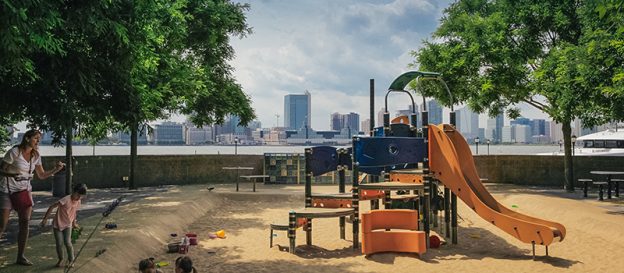
Staring at the vastness of dull-blue water ahead of me, I overhear the other children laughing in the playground within the park. Red swing sets, a bright yellow slide dulled by dirt and early-autumn frost. I contemplate what makes me feel so different from them—why I can’t feel the things that they do. It registers in my mind that they’re entertaining themselves. I decide that I am simply different, better—more mature. On a level above them all. It makes me feel good to think they’re inferior to me for doing something so mundane: laughing and playing, which, of course, is their right, as immature children. I tend to think highly of myself.
Attempting to remove myself from their clamor, I notice the buildings towering above. An office building, an apartment complex, a hospital. Seeing them assures me, knowing that, like me, the adults in those buildings carry the same weight of maturity that disrupts my breathing.
“Hera!” My mother calls after me.
She has been impatiently awaiting my return to the park bench she has settled on. The bench is surrounded by tufts of grass, flattened by sneaker and dog prints, and, finally, my boot soles. I remember her telling me off earlier. It was something about my running astray when she needs my company, about how I can’t slip away from her when she has so much on her plate. This confuses me. I don’t deprive my mother of my presence intentionally—in fact, I recall thoroughly enjoying the moments we spend together. My confusion comes from the idea of her needing my company, considering I have two just-fine older brothers who, theoretically, could handle the emotional load today much better than I can. They’re quite smart, if I’m being honest, despite the ruckus they cause. I don’t know where they are at the moment, probably practicing their parkour or terrorizing the small pizza shop around the corner—doing something fun. Or, at least, more fun than I am in my current predicament.
The thought crosses my mind, whilst I tune out her lecturing, that the reason my mother insists on my presence has nothing to do with my brothers’ adequacy or inadequacy, but rather that I must have something that they do not. Whatever that quality may be, I am fast to realize that it puts me above them. Their company is decidedly just fine, whereas mine is necessary. My brothers and I have grown up together— all our elementary school teachers were shared, most of my belongings were first theirs.
Suddenly, I feel myself beaming and nod intently at my mother’s every word, listening carefully to the way her r’s roll and her a’s round off. I give off my best impersonation of someone she wants to be by her side, showing her all the parts of me that teachers and other parents like: reserved, patient, attentive. I don’t say a word and hum and nod and absorb each syllable out of her mouth. My mother is quick to realize that I’ve begun to take her more seriously. She looks taken aback—surprised that I inhabit the depth it requires to do something as simple as understand. There is a familiar shout from the playground: “Get off of me!” My brother, undoubtedly, but she pays him no mind.
My mother’s turns her head, staring at the buildings. I can read her mind. My father is in the hospital—asleep probably, considering that at this moment she’s by my side and not his. I know she’s thinking about him. She must be. I can only imagine what his room looks like this time around. White with accents of blue is my guess, maybe this one has a balcony. I wonder if the nurses hung up my sloppy Get Well Soon!!!! card, a drawing done on bright orange construction paper—the only color we had left—with a curated selection of pink-yellow, and blue crayons. It depicts my dad and me holding hands in a field of daisies. It is a silly display of juvenility. I’m a better artist than I made myself out to be and am sure my father knows this. I could have drawn it on white printer paper. The card doesn’t need so many exclamation points. I still feel the need to remind him all the time: Look at me! I’m still your baby! Come back!
“Your mother is sensitive, you know,” my dad once told me, spread out like a starfish on his ICU bed.
“I know,” I said. Which was true. I did already know that.
“Meaning, you have to listen to her. She’s trying her best, really.”
I remember making an effort to consider his words. I always did, even before he got sick. My childhood was full of good cop, bad cop routines, always carried out in the same manner. My dad: always understanding, always taking my side; my mother: always the one yelling, with a short temper and a habit of saying things she didn’t mean. I remember them fighting once about which one had “spoiled” me, like either one had propriety over my upbringing. I didn’t stick around to see who won, as I refused to entertain the premise of their argument.
My mother shifts her attention back and tilts her head to stare at me inquisitively. I scramble to come up with an explanation for my new-found cognizance and settle on a half-truth.
“Baba told me to be more understanding.”
She pauses, then waits half-a-beat before admitting, “Well… thank you.”
Then she takes a deep breath and I copy her. The air is now thick, humid and salty. I imagine her cutting sandwiches for my school lunches and tidying my room while I scribble nonsensically on construction paper. I picture her getting married and then her having to see him puffy and ugly while on chemo. I don’t know how to tell her I’m sorry for the things I didn’t cause; it feels insincere in the way you hug a relative at a distant-cousin’s funeral.
When my father got diagnosed, she made me sleep in her bed to make her feel less alone. I tried to sing her Three Little Birds by Bob Marley to comfort her. She studies my face and grips my shoulder tightly with one hand. I think she can read my mind.
***
Hera Natt is a writer, native New Yorker and aspiring journalist. She is currently studying English creative writing at Pace University.
Very enjoyable. The consciousness.
Many good lines. I especially liked:
“Their company is decidedly just fine, whereas mine is necessary.”
And the next one.
“My brothers and I have grown up together— all our elementary school teachers were shared, most of my belongings were first theirs.”
More on brothers, please.
What seems most strange to me is how it reads like a poem, almost a poem, a poem brought back to prose. Or prose tipping towards a poem. I wanted more white space. More room.
The poets are always encroaching on the essay, they are like climate refugees of language, or students in the school of general studies who drop the University name without mentioning the side door. I don’t know why I am including these antagonizing remarks here, this has nothing to do with universities. It must be some residual atmosphere of the location. And the pieces amusing reflections on hierarchy and our need to… feel above.
Which maybe links back to the location, so close to what were once the tallest buildings in the country or maybe the world.