


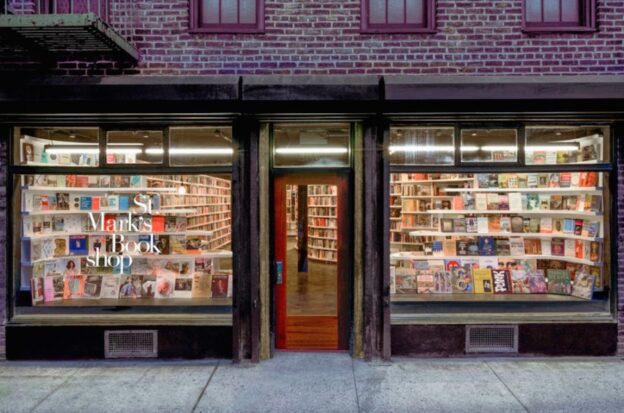
St Marks Bookshop circa. 2008
Mr. Beller’s Neighborhood Stories and Writers Revisited
Editorial Introduction by Zoe Kalaw
In the early 2000s, Greg Purcell wrote three pieces for Mr. Beller’s Neighborhood. They were funny, self-aware, and sharply observant, attuned to the minor humiliations and quiet revelations of New York City life. Like many of the site’s contributions from that period, they did not announce themselves as important. They trusted that the texture of the city—its jobs, its rooms, its passing encounters—was enough.
Purcell’s pieces were written between 2001 and 2003, during a moment when New York still supported a large population of people who lived close to its cultural surface without fully belonging to it. He worked at St. Mark’s Bookshop, one of the city’s now-vanished institutions, and wrote from inside a literary ecosystem that made room for observation, drift, and a certain kind of intelligent precarity.
Revisiting those pieces now, more than twenty years later, it’s hard not to wonder what became of the people who wrote them, not in the sense of literary success or failure, but in the more ordinary sense of work, geography, and time. What happens after the moment captured on the page? What does a life look like once the city that shaped it begins to recede?
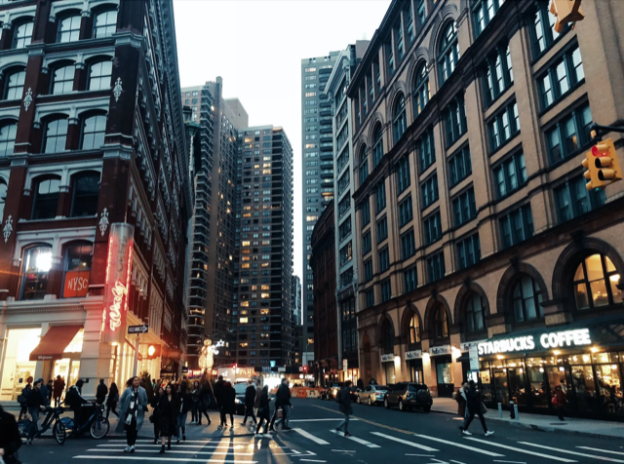
What follows is a recent conversation with Purcell, recorded over two decades after his contributions to Mr. Beller’s Neighborhood. In it, he talks about leaving New York, teaching as an adjunct, returning to his hometown of Kalamazoo, Michigan, and continuing to write amid the practical realities of work, money, and aging.
As Mr. Beller’s Neighborhood begins a new chapter on Substack (stay tuned), we’re interested in treating our archive not as a static record, but as a living conversation, one that stretches forward as much as it looks back. This interview is a first step in that direction.
If you are curious to read Purcell’s work, his stories are still available on Mr. Beller’s Neighborhood website. This interview has been lightly edited.
Greg Purcell – Interviewed by Henry Kaplan
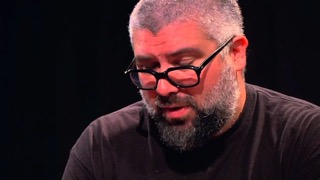
Kaplan: After writing these stories, did you stay in New York? Did you get a job? What happened there?
Purcell: I left and went to Amherst, Massachusetts, in 2010. So, I was in New York for about seven years and the whole time I was there, I worked at St. Mark’s Bookshop. Right after 2008, things started falling apart. For some reason, I have this very distinct memory of a sandwich chain called Olympia’s that was everywhere. And one day, they vanished overnight. I thought that was sort of funny. It was around 2008, and within a few years St. Mark’s had closed.
Kaplan: So, you worked at St. Mark’s until 2010, then you moved to Amherst and you’re still in Amherst?
Purcell: Nope. As usual for me, I continued to struggle to find work. I was still teaching through UMass, doing online teaching there while living in Chicago and trying to find a position there. And then the pandemic hit, and we didn’t know what to do. We had a month-by-month lease that ran out because our landlord suddenly had a passionate interest in renovating our apartment. My sister needed help at her retail store selling bird food here in Kalamazoo, Michigan, where I was born and raised. So, we moved here to Kalamazoo.
Now there are a couple of upsides to Kalamazoo. It’s cheap to live here, and we had saved money by living for the previous six or seven years with other people in large apartments, splitting rent. So, we had enough to put a down payment on a house. Our mortgage here is a fraction of the rent that we paid in Chicago. I’ve been working for my sister for about five years. And the reason it’s been such a strange week is because the store’s not doing well, and my sister had to lay me off this week. So, it’s strange that you would call me this week, because I am just now going to be collecting unemployment for the first time in over 10 years. It is a weird place to be—in your hometown, without a job, at the age of 52, collecting unemployment.
Kaplan: So, you had three jobs after your pieces were published, St. Mark’s Bookshop, UMass teaching and this bird food place, right?
Purcell: Well, yes, the teaching was all adjunct work. I taught three years of freshman writing and then started teaching junior year writing at the engineering school and a sort of social justice course, and I was also teaching online for continuing education for adult learners through their University Without Walls program. That’s actually the job I held longest at UMass and the one I was still teaching online at the college.
And I have done a whole lot of other little jobs. For example, I worked for this incredibly evil company called Pearson. It conducts all sorts of testing for different kinds of certifications. I was hired to write letters, physical letters, and mail them out. And the reason I did that is because there would be people who couldn’t show up for their certification tests, maybe because they skidded out on the road one night because it was freezing, or their kid got sick. And many of these people were in vulnerable positions, especially back then, where they wouldn’t have access to a computer. So, they couldn’t email directly to say, hey, I would like a refund or to reschedule my tests for the day I missed, at which point, if they had done that, they could very easily and quickly be fed into a database, which would tell them, “No, we’re not going to refund your money.” Laws in certain states, if they wrote in asking to reschedule or for a refund, a letter has to be produced and sent back to them, and a whole lot of research had to be done into that letter as to why in your state—every state had some sort of bylaw in its code—you won’t get paid back for a test that you missed. And so, I had to go through databases and track down the state’s bylaws and cite them in a letter, and explain, “no, you’re not going to get your money back,” and then fold it up, put it in an envelope, and send it to them. I did that for $11 an hour.
Kaplan: Geez.
Purcell: It was the worst job I’ve ever had. I did that for nine months on a contract basis, and one day, I came home on Friday, and they called me and said they would not be needing me on Monday.
That was the last time before now that I applied for unemployment insurance. So, I had unemployment, and then UMass needed somebody to teach in the junior year writing program in the engineering school, and I came back to do that, and this time, they actually hired me with a whole intake process that included me getting into the Massachusetts Society of Professors, and I got a union rate. It was pretty good for a couple years there, and then they conducted a search for somebody else to do my job. I don’t mean for this to sound like sour grapes. I have been replaying my employment history back to myself this week, and so these things, these memories are a little fresh.
Kaplan: So, you wrote these stories for Mr. Beller’s, and do you still write at all?
Purcell: Yes. Tom Beller knew me mostly as a poet, from Open City, but around that same time a science fiction story of mine got published in an anthology called Monstrous Affections. It was edited by Kelly Link. I’m writing a novel now, and shopping around for an agent, putting the final touches on the first two thirds of it. I know an agent who’s interested, so we’ll see. It’s science fiction. The great science fiction novelists to me are Jack Vance and I love Robert Sheckley, who’s also a very funny writer, and Samuel DeLaney and Ursula K. LeGuinn. All those classic science fiction writers.
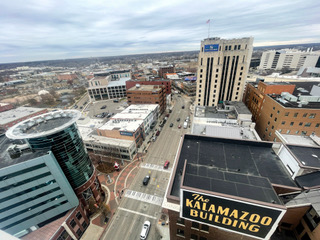
Kaplan: How is it in Kalamazoo? You were raised there, now you’re back. Is that weird? Is it cool?
Purcell: It’s deeply weird. I left in 1995 to go to school in Chicago and came back in 2020. So, I had been away for 25 years. My sister and my dad had a store together; it is a bird food store. My mother and my stepfather were stepping down there and retiring, and so it was a transition in which my sister was taking the store over, and she needed help. I didn’t have a job and needed one. So, it was a pretty good deal while it lasted. But being back in Kalamazoo is strange, both for me and Ash. We had intended to stay in Chicago, we have friends there, and Chicago’s a big, vibrant, beautiful city, and I consider myself a city person.
Kalamazoo has local energy, which isn’t bad. There’s a certain type of city I identify as weird, every state has them, and Kalamazoo is one. Its claim to fame is that Gibson guitars were made here for many years. John Lennon played a style of Gibson Guitar called The Kalamazoo and Malcolm X’s mother was involuntarily committed here when she was considered not fit to raise her children. When Ronald Reagan stopped funding mental institutions on a federal level, many of the patients entered the streets. And when I grew up, there were a lot of mentally ill homeless people in Kalamazoo. It’s a very mentally ill city.
Kaplan: Is Kalamazoo better than it was when you were growing up, worse, or different?
Purcell: It’s hard to say. Ten years ago, I would have said it was way, way worse. Once there were a lot of thriving industries: from checker taxi cabs to Gibson Guitars to Shakespeare Fishing and others. All of those are gone. There are two universities here: Western Michigan University and Kalamazoo College. Those are major employers and other than that, there’s a massive homeless population. So, it is a town that’s trying not to die.
Strangely, it’s being kept afloat by a group of shadowy millionaires who contribute money— there’s something called the Kalamazoo Promise here which made nationwide news. A billionaire who remained anonymous put a gift in perpetuity for students who stayed within the Kalamazoo school system. They would have their entire college tuition paid as long as they stayed in the city’s public schools. That was a big deal around here. And there is another shadowy group of millionaires profiled recently in Time who pay for things that the new Kalamazoo can’t afford like road maintenance and school funding but demand that the city generally keep a low tax rate on their residential homes. So, they’ve got ideological purposes that most of us are just too busy to look into very deeply, but they are inevitably right-wing, and the ask seems to get bigger and bigger in terms of laying off certain taxes which they presume to make up the difference for.
Kaplan: Do you enjoy working in the bird food store?
Purcell: I’m not so sure that I’ve ever enjoyed any job. There were moments in teaching that I enjoyed, but I can’t say that it was a calling that spoke to me. I like writing and having a lot of time to write and I like it when people get off my back and don’t tell me what to do. My sister mostly gave that freedom to me. I ran the store on my own. I did the scheduling and scheduled myself how I wanted, within constraints. I’ve never worked a full 40-hour week, and neither did she and you know we’re pretty happy except for the money. I really don’t know what’s next. My expenses here are low, so I’m not panicking, but I’m going to have to find something. If it’s not teaching, it’s probably going to be something menial, hopefully where the boss doesn’t get on me too much. I’m getting old. I don’t have much retirement savings, and I just hope people leave me alone a little bit to let me live out my days in peace and maybe I’ll get this novel published.
***
Zoe Kalaw is a Boston native and a student at the University of Chicago. As an intern at Mr. Beller’ Neighborhood, she has been exploring and writing about stories from our archives.
Henry Kaplan is a student at Wesleyan University and writes for the student newspaper, The Argus, which is published twice a week during the school year.