


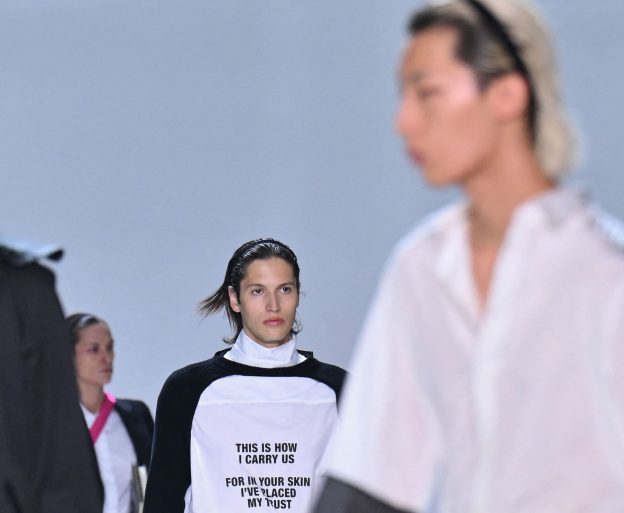
My first trip to New York as an adult was around a year ago. I went for only three days (to walk Peter Do’s Helmut Lang show) and was put up just off one of Times Square’s endlessly linear streets, in a VERY large hotel, constructed with long metal beams stretching endlessly into the sky.
Stepping out of the taxi in Times Square, I was immediately struck with childlike awe. I stood for a moment, grinning at the luminous advertisements on unfathomably big screens and all the people excitedly scattering about.
This elation was short lived, as the fumes of garbage and car exhausts quickly dissipated my sense of wonder. And having arrived at my sixteenth-floor hotel room, I couldn’t help but feel like an oppressed ant in a metal cell, imagining thousands of rooms, below and above and beside me, that were identical from bedside tables to air-conditioner units.
The next day I arrived at the fashion show. It was glamorous and much larger than any you’d find in London. After the standard procedure of being hurriedly maneuvered through a whirlwind of make-up bags, manicures, and gossip, I took to the “line up.’” Having had rather long hair at this time, my allocated hairdresser had put in quite the effort—wrestling it with very firm hair gel—to stop it from flopping around of its own accord.
I didn’t know, as I strutted down the cathedral-sized hall, flanked with rows of glossy people, that the gel had failed. A single Vaseline-icicled shard of hair—rigid and gleaming, had poked free in defiant rebellion. And yet, no one in the audience flinched, or even smirked at the animal atop my head. There is no rule in fashion more vehemently upheld than that of displaying stern confidence to mask the absurd.
The show was a success, and the excitement and commitment of all involved was notable. But my delight was soon cut short, when leaving the building I was faced with a man lying unconscious, fully clothed, but with nothing between him and the pavement.
The eerie contrast of the highly glamorous, affluent, and fashionable, indifferently cavorting just a few feet from this poor dilapidated soul is, I suppose, the price of American ultra-capitalism. The individualist spirit, in which all strive toward their ‘American Dream,’ where everyone intends to make it, fits the typically optimistic and expansive spirit of a young adult.
The alternative to success though is grim: few societal safeguards, no free NHS/health care, no council housing for the poor. So, if you don’t make it, you may end up facing the harsh realities of the man on the pavement.
Upon my return to Britain from this brief trip I had not yet, in all honesty, been seduced. But I ended up returning quite a few months later for an extended period of modelling work. My second trip turned out to be incredibly enjoyable. Much to my delight, I found myself this time in a very different part of New York: the East Village. Oh, the pleasantness of being surrounded by buildings not towering formidably over one. And the pizza! I was finally beginning to understand more of the city’s appeal. And I was soon taken—not just by the energy of the place, but also by the people.
Having begun socializing on this second trip, I realized how friendly and open New Yorkers were. Not only when out-and-about, but also in their work ethos. I noticed this upon my return whilst taking part in a J-Crew billboard campaign. It was shot on the top of a skyscraper—very exhilarating stuff. There were around eight of us, getting ready behind the camera to act as one big joyous group of friends—interlocking arms or legs in affectionately close proximity.
We were told to smile and laugh at one another as if we were all incredibly witty (we weren’t). Difficult at first, but such mad unprompted laughter becomes self-perpetuating by its own absurdity. Never in my eight years of British and European modelling had I been subject to such gleeful nonsense. On the contrary, modeling in England and Europe is largely about being stern, nonchalant or brooding. After the shoot everyone involved seemed to be making plans together, revealing an affability that seems commonplace in NYC.
This differs vastly from London where people are so closed off and suspicious that most venture no further than the five-friend circle they grew up with, even if these childhood friends happen to be twats. Fate is sealed early. Brits simply want to settle; no more effort, small talk, or novelty. Instead, they insult their friends in good spirit, so as to deflect their disdain for the weather and lack of economic prosperity.
I have been told by a few Americans that making new friends in Britain is unreasonably hard. In London everyone is so hidden and uncommunicative in social dynamics that one has to develop highly rendered social muscles to pick up nuance—reading tiny signals and subtext. This can lead to beautifully distinct and understated communications through indirect humor or subtle sentiment. But more often, it just leads to neurotic embitterment.
Arriving in America, where people seem to telegraph their inner world with a neon-lettered billboard, a Brit can ease up and use his highly trained nuance muscles to navigate with minimal strain. Americans see no sense in keeping their cards hidden and extend them all, allowing themselves to be read more easily. I suppose this is because in New York everyone is awfully busy, so we might as well just see what we have to offer one another and get on with things.
After my two and a half months came to an end, and I had to return home to London for winter, I immediately began to plan my escape. And around two months later, I moved back to New York. This last trip has been even more exciting than the second, and my appreciation for the city has grown.
After settling into my flat, I began to mingle, making friends of all ages and from various fields. There is a certain spontaneity of plot development that one can count on here. For instance, my friend visiting from London and I had decided to go to the park near my apartment for the first time.
Within around twenty minutes my friend was hit on by a pretty and excitable young woman, who, as it turns out, having taken a brief trip from medical school for a few days to visit New York, had just been cast in the lead role of a new Netflix show by a very prominent director.
I, now waiting for my Princess Charming to appear, was instead approached cautiously by a man wearing “high fashion’’ of the kind that only one without fashion would deem so. After declaring I was very tall, to which I nodded, he asked me if I would model a series of T- shirts with font that appeared to be inspired by electrocuted cat hair. I politely told him he’d have to contact my agent.
The plot thickened when my friend, his new romance, and I, all went to Jean’s—supposedly a current hot-spot for nights out. Arriving late I was ushered down into their basement area. It was dimly lit, with red light glaring through what seemed to be several overly efficient smoke machines. After a G&T and wading through some fog, I found my friends round a club table to the center-left of the room. There appeared to be very few people around us – until suddenly a group of what appeared to be models came in. After they tried to claim our table as theirs, we said they could join us. The group, consisted of two nineteen-year-old girl models, two bulked up male models in their mid-thirties, and one finance man. I could make out the finance man because he was short and stout. After some chit-chat with my friends, we watched the suited men grasp the necks of their white tequila bottles and the nineteen-year-old models, while their stout friend took photos of them with a wind-up holiday camera. It was highly entertaining.
When my friends left for a cigarette, I decided to stay and hold our places on the sofa. Soon after one of the mid-thirties model men with big muscles turned to me asking me to move. I curiously asked why, as I was of course saving my friends’ seats. Surprisingly, I was not met with the real reason which was “so we can take more photos of ourselves holding our tequila bottles and nineteen-year-olds.” Instead, he grabbed me in a rage, throwing me swiftly off the sofa. It was startling and exceedingly exciting. This kind of thing is not common in London. Brushing myself off and preparing to speak to him charmingly—to make him aware of what a neanderthal reaction he’d had— I sat back next to him, asking for his and his friend’s name. Much to my surprise, I was not met with eye contact, but with a grunt, followed by a “SHUT THE FUCK UP,” screamed through a gust of hot breath, as he picked me up, and once again, threw me off the sofa. At this point I was REALLY excited; this is the sort of thing you see in movies. The stout man then nobly took it upon himself to rise to the occasion and told me I should leave. I smiled down at him, amused at his angry red face looking up at me from under a balding comb-over, and left to reconvene with my friends at another bar.
There is a certain electricity in New York, whether it’s in the shape of a small angry finance man, or a slightly more elegant, medical-school student, who is a soon-to-be movie star. No matter the form, people seem unmistakably alive and vibrant. It is, as they say, a city for the young. In fact, after my time here I’m convinced that Britain is culturally, a centenarian fogy, whilst America (being 250 years old) is by comparison in its early 20s; not afraid to act, innovate, try new things, and do it all with unbounded optimism.
This social virility comes at a cost. I have been told by several people that this optimistic pursuit of bigger and better dreams also extends to relationships, particularly in New York. People are always trying to do better – and given there are so many good-looking people coming and going, I can see why.
***
Lucas Chancellor is a writer and model from London, recently based in New York. His writing has appeared in The Times of London and is forthcoming in Air Mail. An abridged version of this story appeared in The Oldie.