


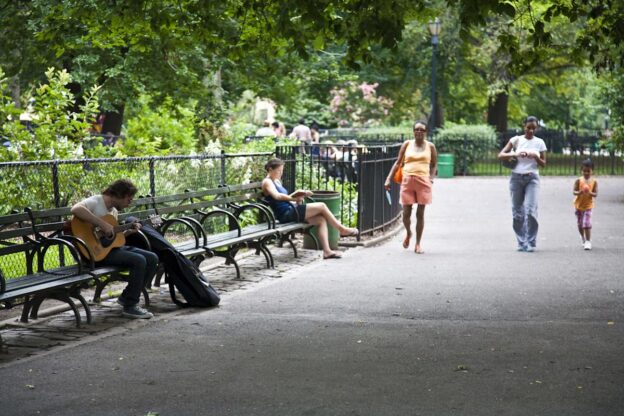
Tompkins Square Park
When I was kid growing up on the Lower East Side in the 60s and 70s a few of my friends’ parents were more than just parents. They were notables, although we, as children, didn’t appreciate it. They were, variously—a labor organizer, literary critic, foreign editor at a major news wire service, an influential minister, and an obscure struggling abstract impressionist who would, many years later, become a prominent figure in the art world.
Another parent was the downtown Black actress and political activist, Vinie Burrows. We just knew her though as Gregory’s mom. She once made a lemon meringue pie that was so awful I couldn’t eat it. I think she forgot to add sugar, and even the fear of being rude couldn’t get me to take a second bite.
Except for parties and special outings though, kids in those days didn’t spend much time with parents. The parents were busy with their own lives and endeavors, and we were happy to roam the neighborhood in search of fun and trouble, both of which were easy to find on the streets of New York City.
On one occasion though, when we were about 10, Gregory’s mom took us to a theater space on 7th Street across from Tompkins Square Park. An ensemble was putting on a series of short vignettes depicting life for Black people in America.
The audience was, not surprisingly, predominantly Black, and I remember feeling not fear or being ill at ease, I was with friends after all, but rather an acute sense of being out of place. Suffice it to say that growing up in arguably one of the most diverse neighborhoods on the planet was trumped by my whiteness.
I only remember one of the pieces performed that night. It is speculation, but I suspect that is because many of them were steeped more in theory and polemics than drama. They offered little for a child’s mind to hold on to.
But there is one that I do remember vividly. A family, two parents and two children, perhaps 8 and 10, are sitting in their living room doing what families do. They discuss homework and food, and the parents read while the children play on the floor.
Suddenly there is loud banging on the door and several, need we say warrantless, cops wearing pig masks burst in. Immediately, reflexively, each member of the family, the children too, as they were clearly trained to do, retrieves a hidden gun. Blasts ring out, the stage is obscured by smoke and when it clears, the family is alone and again going about its business.
I jumped in shock from the sound of gun shots and have never forgotten that scene.
Now as we read, watch, and see first-hand what is going on in America and are reminded, sometimes gently, sometimes bitterly, that this is only new for some of us, I remember that day from over 50 years ago more than ever.
***
Raphael Lasar is a librarian at Bell Labs. He lives, inexplicably, in New Jersey.
Great story. I have similar memories of different shows and paintings from that era.
What a fantastic little piece, the action being in the squinting through time… It is all set up so well. I wish it had continued longer. More time in the theater, more time about what happened after, more on the family you were with, maybe even where they are now. Gregory’s mom, at the least, deserves, another glance. This is the editor’s fault more than the author’s. I shall write a complaint (I guess this is the complaint.).
But it’s a terrific piece. A glimpse into another world of New York (and America): “The parents were busy with their own lives and endeavors, and we were happy to roam the neighborhood…”
Thank you for the kind comments. And go easy on the editor, because the author isn’t really a writer, and doesn’t even play one on TV.
This piece was clearly inspired by current events, but is, in fact, part of something longer the author has wanted to write with the working title, Why I Am a Racist. (Which, for the record and not to be misconstrued, is not a defense of my racism but a look at how being white in America almost necessarily means being racist on some level. But you get that).
As for parenting in the ‘60s and ‘70s, yeah, that was a trip…
Thanks again.
Ok non-writer, allow me, like someone calling into the radio station, to make a request: let the reflections of society and racism etc be implicit in the stories. Spell out the situation, dramatize it, one little piece at a time. Dante Ross did a decent job of this in a similar milieu; but go wide. “My Father and Myself.” “Stop-Time.” Gornick’s “Approaching Eye Level.” Lopate’s “A Mother’s Tale.”
I really wanted to spend more time in that theater. I want to know if people were smoking. What Vinnie’s mom was wearing. When it was that you saw her next. I want characters and scenes– please, DJ. Play my song.