


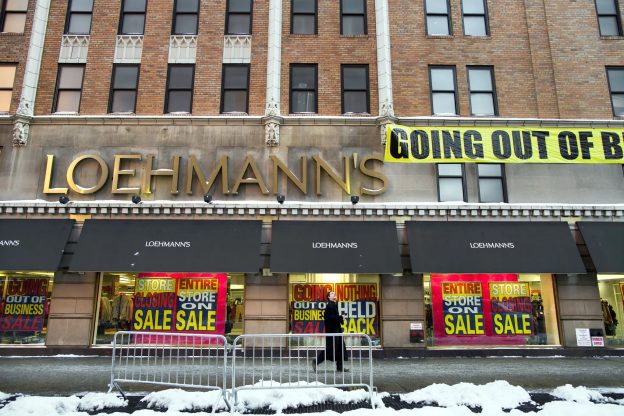
Did you have a favorite place in New York that’s no longer exists? I interviewed people about spots in the city that were special to them but are now gone.
Ellen is 70 years old and was a lawyer.
Henry Kaplan: What’s your favorite store in your neighborhood that shut down or closed?
Ellen: That is a very easy one. Barney’s. Barney’s was a luxury department store that had men’s and women’s clothing, and it had a restaurant.
You could spend a lot of time in the store and you wouldn’t necessarily have to purchase anything. If it was raining and you weren’t working, it was a good way to spend the day—have lunch, meet your friends, and look at the latest fashion trends. They also carried stuff that other places didn’t have. They just had a good eye for what was going to be popular, and the restaurant was great. It served American food. They had a chicken soup that was fantastic. You could sit at the bar and eat, or you could just wait for a table. The restaurant used to be in the basement level, which wasn’t so nice, and then it moved to the roof. So, it was very open and lots of windows. It was quite a good meeting place. It was on Madison Avenue and 61st Street.
The store closed right before COVID. It was just great, better than any other department store in New York. And they had little boutiques within the store. It had a look that was very contemporary. It wasn’t like your typical Bloomingdale’s, which is just chock full of inventory without the store design being too nice. At Barney’s things were spread out and very open. It was just better looking.
And the people that worked there had taste. They were giving good advice.
Henry: Would the people working there ever say if a piece of clothing didn’t look good on you?
Ellen: Yes.
Henry: And do you have any stories about it that you remember? Anything that took place in a Barneys?
Ellen: I remember seeing Rod Stewart with an entourage.
Janet is a 59-year-old casting director.
Janet: Right, so I have to think and base it on the West Village where I lived for, god, 23 years. I lived on Hudson and 11th. So, one was a restaurant. Not anything that was top culinary level, but a total fantastic neighborhood place and it really pisses me off that it closed in the mid-2000s. It was across from my apartment on 11th and Hudson. Right by the Bleecker Playground. It turned into an HSBC bank. And after that, I think it’s been an empty storefront, which really more than anything pisses me off about New York. It’s just annoying when great places go out of business and then nothing even comes in. Greedy landlords waiting for better deals.
But anyway, it was just a fantastic great neighborhood Chinese place with healthy food, clean, bright, big windows on all sides. Fantastic grilled chicken wings and grilled ribs and really, really good greens and nice staff. I had a small baby and toddler at the time, and they were fantastic with toddlers and kids, and they had amazing cold sesame noodles.
Once upon a time in New York, every Chinese restaurant had cold sesame noodles. And sometimes they were free if you ordered more than $10 worth of food, which is so funny when you think about how much more than $10 we spend on food now. But anyway, that was Mama Buddha.
Probably my second favorite place in the neighborhood was a bookstore. But of course, now I’m forgetting the name. It was on Bleeker Street and West 10th street (editor’s note: she is probably talking about either Biography Book Shop or BookBook, which were both on this block on Bleecker Street). It was just a used bookstore, It was open till about one in the morning and had stacks and stacks of used books. It was a great thing to do when you were passing through, spending some time going through this fantastic neighborhood bookstore.
Can I talk about things that weren’t in my neighborhood that I miss?
Henry: Yes, you can.
Janet: Loehmann’s. Do you know about Loehmann’s?
Henry: Like Willy Loman?
Janet: Oh, no, that would be hilarious. Like you go in, you get into a car, you put the exhaust and you commit suicide. No. It’s Loehmann’s. I think it was spelled L-O-E-H-M-A-N-N. It was a fantastic women’s discount clothing store. And it was a real old school New York place. There was one way uptown but then there was another one in the city, like in Flatiron (editors note:it was on 7th Avenue between 16th and 17th Street). There were racks and racks and racks of fantastic women’s clothes, and they had this thing called the backroom where the designer stuff was. And there were no dressing rooms in the backroom. It was just a big room protected by a curtain from the rest of the store and it had mirrors on all sides and hooks where you could hang your clothing. You had to take off your clothes and change in front of everybody else who was in there. There were all shapes and sizes of women. Old ladies and teenage girls and moms. So every shape and size, every age, everyone talking, everyone in their bras and underwear, putting on clothes and then, because it was New York, whoever was next to you would say, “Eh, you could do better.” … “That looks great on you.” … “I think you need a bigger size.” It was this total communal, hilarious New York thing. All these women peering at you with everybody naked and judging each other. The vibe was pretty friendly, but also pretty frank. There are so many amazing clothes I got at Loehmann’s and the backroom experience was like nothing else.
Any woman of a certain age who’s lived in New York, if you say Loehmann’s backroom, they will go into a story. I’m sure for some girls– like younger girls who got dragged there by their mother or grandmother– it was somewhat traumatizing, but the older you get you don’t really get a shit about standing there in a bra and underwear with strangers. But I’m sure it traumatized some people.
Some people love a store that is minimal and curated, but I like something like with a lot of shit where you are going to get some gems. That was Loehmann’s, So, no, it wasn’t cool. There wasn’t great lighting. There were like old people– yentas. But there were really super stylish people too. But you had to be like a professional shopper. I don’t mean truly a professional shopper, but someone who took it as a sport. It wasn’t for a beginner.
Now going back to the West Village, it was much more of a neighborhood than it is now. Bleecker Street used to have antique stores and used bookstores and video stores and maybe a couple vintage boutique clothing stores. It wasn’t like the mall that is it is now. So, I feel that my nostalgia for the bookstore is just generally for the whole West Village when it truly was more Bohemian and more about the neighborhood and the people who lived there, as opposed to now and all these flocks of girls that just come to the West Village to have brunch at Farmer’s Daughter or Butcher’s Daughter or whatever it’s called.
Henry: Yeah, it’s Butcher’s Daughter.
Janet: I can’t even say that the bookstore I miss was so unique. It just represented what the Village used to feel like. I feel nostalgic for that time when we were less established and less old and less wealthy, when the West Village was a younger, more affordable, funkier neighborhood. I feel so bad for you kids; not only is this world really fucked, but you have also lost some of these stores.
Liana is 39-year-old cartoonist and illustrator.
Liana: I went to college in the East Village and lived on this block that was all Japanese supermarkets and stores and I miss that so much. The city got too expensive for those markets. It’s changed a lot. I lived right off St. Mark’s Place. And yeah, there’s a book by Ada Calhoun called “St. Mark’s is Dead” that says that everyone is really sad when their particular St. Mark’s changes, but that it’s always alive in its own way. But I’m very sad about losing the St. Mark’s that I had, which was this Japanese supermarket and restaurant (editor’s note: it was just around the corner from St. Mark’s on Stuyvesant Square). It was dinky and had everything. There was a Japanese market called Sunrise Mart that was upstairs from the St. Mark’s Bookshop. The supermarket was small but it wasn’t too crowded, which I don’t think could even happen these days. Everything today is really crowded. It was cluttered, but in a really nice way. They had those triangles with rice in them and something inside the rice. They were very cheap—under a dollar. And they had mochi balls, which I never bought, ’cause I don’t like them, and they were expensive. They had all kinds of cool vegetables and fruits. Well, they had sushi. They had toys. They had little fun erasers. I was in college for four years, and it was beginning to change when I was there.
Henry: And did you ever come back to St Mark’s Place to go to any of these places?
Liana: Yeah, while I was footloose, before the pandemic, I used to go back to St. Mark’s all the time. And it’s weird to talk about this because I’m in Brooklyn now and I’ve moved even deeper into Brooklyn since the pandemic. I had some kids and am rarely in Manhattan anymore. And when I am moving through parts of Manhattan, I always have a specific destination. It doesn’t even feel like I live in the city anymore. I think a lot of people are feeling less connected. I mean, my cohort of people who are having a second kid are leaving the city. New York has become unliveably expensive. And all these great stores that can’t survive in this expensive place have closed.
Henry: Do you remember when the Sunrise Mart closed exactly? Was it during the pandemic?
Liana: Sunrise Mart, I think it was during the pandemic (editor’s note: it closed in 2022).
Henry: Do you have no idea why they closed…
Liana: They had a lot of financial problems. They overspent when they renovated the place. It ended up being a financial disaster, I think. There was talk that something else would open up, but it never has. The space is just sitting there empty.
Ryan works in video production and is in his mid-thirties.
Ryan: I’ve got two on the top of my head. They’re both here in Williamsburg. The upper end of Williamsburg. One was a restaurant called Delilah’s. It was a Philly-style sandwich shop. They did all kinds of crazy sandwiches. They had a secret menu. I would get stoned to go there when I was hungover and get these crazy, awesome chicken sandwiches. Um, they closed up. This other place, kind of near there, was this restaurant called Eden’s. It was on Manhattan Avenue with drinks. It was a restaurant, but after a certain hour, they changed to a dance club. It was a neighborhood institution.
Henry: And when did they close?
Ryan: They closed five or six years ago.
Henry: So, around the pandemic?
Ryan: Before the pandemic, oh sorry, god. It was eight or nine years ago. Time is so warped.
— These interviews have all been edited and condensed.—
***
Henry Kaplan is a student at Wesleyan University and writes for the student newspaper, The Argus, which is published twice a week during the school year. This summer he is living in New York.
Great memories! I was thinking that back in the 1970s and 1980s, businesses seemed to last longer. Like maybe 10 to 15 years. And nowadays, if they last 3-5 years it’s a miracle.
I wonder if the churn of business turnover is really higher nowadays compared to the past?
Colson Whitehead wrote: “You are a New Yorker when what was there before is more real and solid than what is here now.”
The question that occurs to me though is whether we really miss these tangible particular places, or is it our younger selves and those of friends and loved ones that we are missing?
It’s quite amusing that the first person interviewed by Henry misses Barney’s and the next one misses Loehmann’s. Hard to imagine two more different department stores…
Speaking of department stores, I don’t miss them in the least. All of them seemed awful to me.
A gem in the interview with Janet is the conflation of Willy Loman and Loehmann’s…though I can image Mrs. Loman doing her dress shopping at Loehmann’s.
I think it’s all tangled up as to places we miss, and who, and especially our younger selves, all in the context of the time we are reminiscing. Since I was a newly minted fashion illustrator, I think of the big department stores of the early-late ’70s:
B. Altman, where I had my first illustration published (and got my first credit card; women were finally allowed to get one w/o their husband’s name in 1974).
Lord & Taylor, waiting civilly until the official opening time, inside the entrance (on chairs, and being served coffee in china cups and saucers). After I got a job in the art lay-out department there, I’d eat lunch at an English tearoom counter a few blocks to the east, called Mary Elizabeth’s. Now THAT is my most missed eatery. They had a chopped cheddar and tomato sandwich that I tried to duplicate in my brand new Cuisinart (1977, a wedding gift) and let me tell you, it was impossible!
Anything (even the short-lived Galeries Lafayette) pre-trump tower. The horror of finding out that he took a wrecking ball to the Art Deco Bonwit Teller friezes, even after he had pledged them to the Met, has never dissipated.
Henri Bendel’s, even if I never really knew how to pronounce it.
Thanks for the assignment, Mr. Kaplan!
St. Marks theatre.”$1.oo movies all the time” said the marquee.I saw Midnight Cowboy and Billy Jack there.
The St. Marks was great. Double features for a buck. For years, before each showing a notice would appear on the big screen saying, “No Smoking Anything” and the audience would boo. Saw a lot of great flicks there,including several good French and Italian movies. Also witnessed two fist fights among audience members—once because a guy insisted watching the movie—for no apparent reason—with his umbrella up, blocking the person in the row behind. I had a high school friend who worked there who used to get me in for free.