


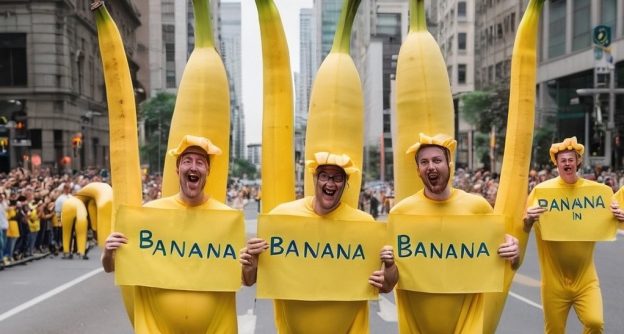
My husband’s Manhattan apartment overlooks Fraunces Tavern—a three-story brick building with dormer windows and a columned portico. Apparently, George Washington said goodbye to his officers there at the end of the Revolutionary War. But now, as I sit in the deep windowsill sipping coffee and watching the bar revelers below, I see a horde of men in banana costumes filing out its door, and I marvel at the wide range of dignity a little tavern can carry in 250 years.
I don’t live here. But when I visit, I soak in the cultural differences between New York and my home in Utah. Right off the bat, Utah doesn’t like alcohol, so watching these drunken men in banana costumes cluster on the sidewalk is a novelty. I take another sip and notice a woman pull out her phone and snap a photo. My smallest daughter joins me on the windowsill and says, “Someone took a picture!”
“That’s okay. I’m sure they love it.”
“Time to go!” Keith announces, stepping out of the bathroom with perfectly coiffed hair. I gulp the last of my coffee and hop up. We’re meeting his Asian co-workers for lunch at a dim sum place. I’ll be the only white person there—an experience practically unheard of in Utah.
“Won’t your white co-workers be offended if they find out the Asians have a private group?” I ask, giving him a smug grin. “DEI is illegal now, you know.”
“Exactly. DEI is illegal—which means we don’t have to invite any white people if we don’t want to,” he shoots back.
I belly laugh as we head out the door.
We walk the two blocks to the subway station and descend into its depths. It feels like entering a public toilet—that’s how dirty the New York subway seems to me. Utahns who haven’t used it tend to assume it might be glamorous. It isn’t.
It’s a short trip to 8th Street, and as we emerge, I enjoy the view from the sidewalk: buildings tower above us, each one different from the next. In Alpine, Utah, we live in the shadow of the Wasatch Mountain Range—its rocky crags loom over us with a kind of quiet, intimate grandeur. In Manhattan, people live under the shadow of skyscrapers—some monstrous, some elegant.
I hold my daughter’s hand as we cross a busy intersection and step onto a narrow, shadowed street. Stairways lead down to basement restaurants. Their fronts are lined with menus in Chinese characters. Strings of lights are wrapped around banisters and draped over door frames, twinkling in the half-light.
Before we can wonder whether we are the first to arrive, Keith’s co-workers saunter up to the restaurant, en masse. We shake hands, introduce ourselves, then pop below into one of the restaurants.
“We’ve been here before,” Angela says in a heavy Australian accent, “but we can’t remember whether or not we liked it!” We all laugh. Alison was born in Singapore but raised in Australia. I can tell she is the leader of the group.
“I would like to try this salted soy milk,” Gill comments. He loves opera and spends much of his extra time and resources at the Met. When the soy milk arrives, he invites us all to dip our ladles into it to taste.
“Why does it taste like bread?” I ask.
Steaming baskets of dim sum arrive, and we spend the next hour unstacking and restacking them, using our chopsticks to pull out the dishes we are most interested in. The skins are all different colors, and the fillings are both delicious and a little too odd for my taste. Each bite reveals a surprise, some good and others bad. I love the vegetable fillings but gag over the red bean paste. I tell the group that my sister-in-law feels that red bean paste is to white people as peanut butter is to Asians. My companions think about this a moment and confess that they don’t really like peanut butter. “It depends on what you ate as a child,” Jenna remarks.
My daughter entertains herself on my phone and picks at her plain white rice. Keith offers her fried bread and takes a big bite of it to demonstrate how delicious it is.
“She really only eats clouds and rainbows,” I explain. The group giggles, but I can tell they are a little confused. I smile inwardly, because when I say this to my Utahn friends who are parents, they instantly understand. It means she is a picky eater.
“So, she wouldn’t eat this?” Jenna asks, holding out a red-tinted potsticker with a bit of oily cabbage sticking out from the corner. She is sincere, but I grin because I know there isn’t a child in Utah who would eat that mysterious bundle.
The group slows in their eating. They’re all career people—working until nine or ten at night, then packing their weekends with parties, opera tickets, and Pilates classes. So far, none of the people I have met in Manhattan are parents.
“What is the hardest thing about having kids?” Gill asks.
“They’re expensive!” I say quickly, though I know that only grazes the surface of the truth. How do I explain to these people that my children’s well-being is the compass of my entire life? “I’ll buy groceries for the whole week, only to find out my teenagers are suddenly disgusted by everything I brought home—or craving something entirely different.”
I didn’t even mention how my sixteen-year-old son sometimes vanishes at 11:30 pm and doesn’t return until the early hours of the morning, leaving me to lie awake and worry until a sleep filled with nightmares finally claims me. Or how my fourteen-year-old daughter’s obsession with her pet bunny now dictates the entire rhythm of our household. Or how my youngest can’t be happy without a constant stream of playdates, which means I’m always texting other moms, hoping someone’s daughter can come rescue mine from her loneliness.
“Gill, don’t you have a teenage sister?” Angela asks, shoving a pork dumpling into her mouth and chewing.
He nods. “She lives on Snapchat. We snap all the time. She’s really funny.”
We all laugh, and I realize my world might not be as foreign to them as I’d assumed.
I glance down at my daughter, now playing Finch on my phone, her little legs tucked up beside me in the booth. And for a moment, I feel perfectly in between worlds—between skyscrapers and mountain peaks, red bean paste and peanut butter, ambition and tenderness.
As we head back into FiDi, we circle around Fraunces Tavern and I glance up at the swinging sign above the door—a Revolutionary soldier in a tricorn hat, still holding his post after 250 years. A woman with a large purse and a soft smile pushes through the doorway, followed by two girls about the same age as my own daughters.
And I realize: New York has plenty of its own families, with room enough for the drunken banana gang, for dim sum lunches with friends, and for sweet meals with daughters. Tomorrow we’ll go back to Utah—to clear air and wide roads and mountains that don’t blink with office lights.
But today, it feels like New York made room for us. And maybe that’s all anyone’s really looking for—a spot at the table, even if the dumplings are weird and your kid won’t eat them.
***
Julie Cornelius-Huang is a wife and mom of three kids. When she isn’t writing stories for adults and kids, she is walking her dog, digging in her garden, hosting tea parties, or riding horses.
I enjoyed reading this because it provoked me in some way I don’t even grasp.
It also provoked some associations which are easier to name.
One is a piece on this site called Mormons in New York by Brooke Shafner. Published in 2002, I just looked and see a couple of comments popped up in 2011. Would be amusing if a few more arrived in 2025.
link to mrbellersneighborhood.com
Another association is an event which I could summon on Google, but there is no need, I recall it well enough and don’t need to be reminded of the particulars: a young guy from Utah got stabbed and killed in the subway. I think this was relatively soon after 9/11. But I could be off by a decade.
That’s tragic enough. But the detail that I recall was that he really loved New York and in particular loved attending the US Open. His parents were either with him when it happened or rushed to the city. Either way they spoke of his love of the city/the US Open; I thought this was generous of them, strong of them, to speak well of the place where this senseless (and fairly rare) crime took place.
And here comes the US Open now.
Walter Kirn has also written somewhat darkly on this topic, or maybe it was in conversation. Of all the places/religion juxtaposition, I think the Utah/NYC, Morman/NYC juxtaposition is one of the sharpest and therefore most interesting.
For the record, I have had some good times in Utah.
I still think of the short order cook in Moab, white paper cap, in his mid forties, black rimmed glasses, who looked at my T-shirt that read, “The Poughkeepsie Review,” and with a big grin quoted the French Connection: “Pick you feet in Poughkeepsie.”
I had no idea what he was talking about, he had to explain. RIP Gene Hackman.
I liked this story, and it made I think I should go for some dim sum. Thank you, Julie.
Brian Watkins was the guy murdered in the subway. 1990. Terrible,
Also, of interest to me in the Age of Trump is the Utah Compact– a set of principles related to immigration supported by the Church of Jesus Christ of Latter-day Saints (LDS Church) that stresses avoiding family separation and the contributions of immigrants to the economy and the importance of integrating them into communities. In many respects, Mitt Romney was an outlier in today’s GOP, but not in Utah.
I’ve had great times in Utah… Interestingly, to me as a Japan watcher, were the prominent Mormon TV personalities there who, because of their language proficiency learned during their mission and “all-American” looks, became big stars in Japan….OK, I’m rambling.
I really like how the story circles back to the drunks in banana outfits. And I also like this line which I have never heard before; but it’s so great.
“She really only eats clouds and rainbows,.”