


My father’s mantra was, “I want ya to be healthy and strong.” More than ever, he wanted me to be athletic. Me! Athletic! Since he’d left, I’d done nothing but accompany my grandmother on errands after school, sit in the sun with her in the park or in front of the bank, and take ballet lessons once a week.
In a moment of anger, my mother had said, “Your father wanted a boy!”
I’m sure that’s true. How much easier it would’ve been for him. He would’ve called me Butch, taught me how to play baseball and taken me to Yankee Stadium. Later, he would’ve taken me to prize fights and wrestling matches and the racetrack, no doubt. I would’ve been his pal, his sidekick, his buddy. Butch would’ve been fearless. That, at least, is my fantasy.
How did a little girl fit into his life? A little girl didn’t. What did he know about raising a daughter? This father. The gambler, “the ladies man.” He hadn’t stuck around to raise his other daughter when he and his first wife had broken up decades earlier.
I remember when he taught me how to roller skate. I was four. In Riverside Park, he’d suddenly let go of my hand after promising he wouldn’t and let me roll downhill, screaming, “Daddy!” Finally, he’d grab me. I wanted so much to please him that I finally overcame my fear, but that was before he left me.
When he was a child, he learned to swim when a group of older boys threw him in the East River. “It was sink or swim,” he used to say. But that technique didn’t work with me.
When we’d play catch in Sheep Meadow in Central Park, and I missed or dropped or fumbled the ball, as I usually did, he’d smile and say, “At least, you’re getting some exercise.” I don’t know how many times he’d repeat that line in a single afternoon.
But I always felt I’d disappointed him. I threw like a girl. I threw the way my mother would’ve thrown had she ever picked up a ball. When he couldn’t hide his impatience, he’d say, “When the ball doesn’t come straight to you, ya gotta run for it!”
How many times did I stand there, frozen?
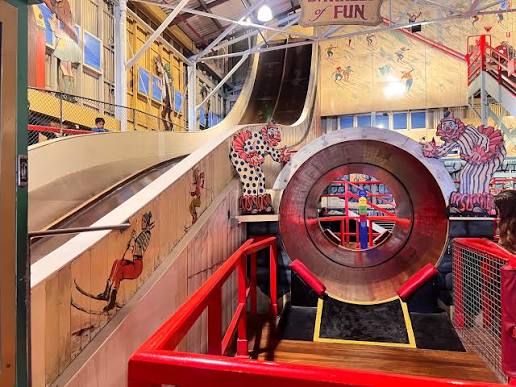
Barrel of Fun, Steeplechase Park, Coney Island
In between those Sunday afternoons when he challenged me, he took me to the places I’d loved before he left, especially Coney Island where, in Steeplechase Park, I could make my way through the rotating barrel, ride the giant slide, navigate the room with tilted walls and floor. I loved the crowds on the boardwalk, the beach, the ocean, the honky-tonk atmosphere. He let me go on any ride I wanted. Coney Island was the only place I enjoyed being scared.
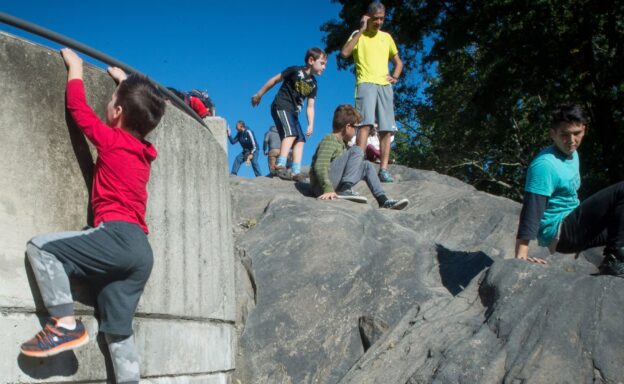
The excitement of being with my father didn’t stop me from being scared of climbing rocks near Sheep Meadow. I’d watch other kids scamper over them without a care. To me, however, they seemed as high as the Himalayas, though of course I didn’t know about those mountains then.
Each time I’d feel his disappointment as I stood at the foot of those rocks, petrified. “Come on, Butchy, ya can do it!” he’d say, over and over.
But I’d shake my head vehemently and say, “I can’t! I can’t!”
“How can you say you can’t when you haven’t even tried?” he’d say, lifting me up onto the lowest rock.
But I’d scream even louder,“I can’t! I can’t!”
“Just try. One step at a time,” he’d say. “I won’t let ya fall.”
“No!” I’d scream in terror. “I can’t! I can’t!”
He’d sigh heavily. “It’s not your fault,” he’d say. “Ya mother and her mother teach you all week long to be afraid. I only have Sundays to turn you around.”
There were times when he almost gave up. He’d shake his head and say, “You’re just like ya mother!”
When he said that, I felt like my mother. I hated feeling like my mother! What’s the point of trying! I can’t be a boy! I can’t even be a tomboy!
“They put so much fear in you!” he’d say, shaking his head. Then he’d sigh again. Sometimes this job of being my father seemed to be too much for him. He didn’t know how to undo the damage my grandmother and mother had done. But that didn’t stop him from trying.
The Ballet Recital
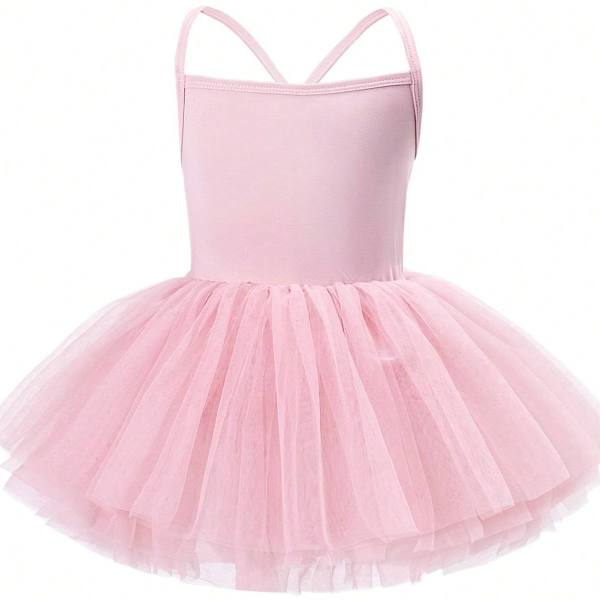
For my recital, I had to wear a pink tutu like the other girls in ballet class. But the moment I laid eyes on it hanging on the rack in the store, I made a face and said, “I don’t wanna wear that! I hate it!”
“Well, you’re gonna wear it whether you like it or not!” my mother said, the furrows deep in her forehead.
The satin top was too creamy smooth like the undergarments my grandmother hid in her drawer. Too shiny! The layers of stiff gauzy material that flared from the waist felt scratchy when I touched them.
“It’s too tight!” I said, when my mother made me try it on.
“It’s supposed to feel that way!” she said.
The night of the recital in 1951 when I came out on stage with the other girls, all of us in our little pink tutus, I wished I could be as invisible as the audience was to me in the darkness. Somewhere in that audience were my mother and father! I knew he was coming. But why? He always laughed at things as sissified as ballet. I guess he came to placate my mother. Why? Because he’d been away a long time running from Mafia shylocks?
As the piano played and our dance began, my head was so noisy I could barely hear the music. Should I dance badly for Daddy?Will Daddy think I’m more like a boy if I dance badly? Will that show him I’m not like Mommy? What about Mommy? Won’t she be mad if I dance badly? Don’t I want to please Mommy too?
Suddenly the audience laughed. What’s funny? I wondered. It dawned on me slowly. ME! I’m funny! I was leaping to the left, not to the right with the other girls. I stopped dead and covered my face with my hands. A cry escaped though I wasn’t sure it came from me. Next thing I knew I was sobbing loudly, frozen to the spot, so someone whisked me behind the curtain. But I kept sobbing, I couldn’t stop.
When the recital was over, my mother and father came backstage. I couldn’t look at them, I was still sobbing.
My father laughed, hugged me, kissed me. “You were fine. Don’t cry. It doesn’t matter,” he said. “Ya don’t need ballet.”
He turned to my mother, “What’s she gonna do with ballet?
“What do you know!” she said.
***
A Tennessee Williams Fellow in Fiction, Roberta Allen is the author of nine books, including three story collections, a novel, a novella and a memoir. Her stories have appeared in such magazines as Conjunctions, Epoch, recently in New World Writing and upcoming in the Evergreen Review. Also a conceptual artist, her work is in the collections of The Met and MoMA. Most of her art has been acquired by The Smithsonian Archives. Her writing papers have been acquired by the Fales Archive of NYU. See robertaallen.com
Really raw childhood memories; hard to take–like (not that I’d know, though I imagine) being an analyst, listening to a patient on the couch reciting the horrors of a childhood; like a ritualized memory till the memories themselves become a fixed place where you live out your life… Thank god for art–as a way of trying to reach the surface from a thousand fathoms below… …Like The Band in the song Stage Fright:”When we get to the end, he wants to start all over again.” How do get off the wheel? Do you ever completely get over stage fright?
How often do parents and children match? When you’re a kid, you’re like a lump of formless clay–completely in the hands of grown-ups who, most of the time, never grew up themselves, and you become part of the great chain of not being… Again–thank God for art!
I appreciate, too, the strong, vivid memories from the editor….
Mike, I got over stage fright many years ago. Though I may have had it after that experience I have no memory of it. But I was a very quiet child. Thank you for your comments.
Roberta Allen
PS I didn’t see the editor’s comments.