


I’m no fan of the sun. But my mother was its most devoted worshiper. She had dark hair and brown eyes, and her skin welcomed a deep tan.
My younger brother and I inherited our coloring from our dad, who was very fair. Growing up we were practically albinos with the palest of blond hair and blue-green eyes. We didn’t tan, we stroked, as Woody Allen said about himself. After a few minutes in the sun, our skin would match the color of a ripe strawberry.
When we played ball— pretty much every waking moment of our summer days—we wore brimmed baseball caps, and our bodies were likewise shielded by our sleeves and jeans. But still, we’d inevitably get at least one bad sunburn at the start of every summer. By early July, one layer of skin would have peeled off, and typically this happened more than once. Mom assured us this was perfectly normal.
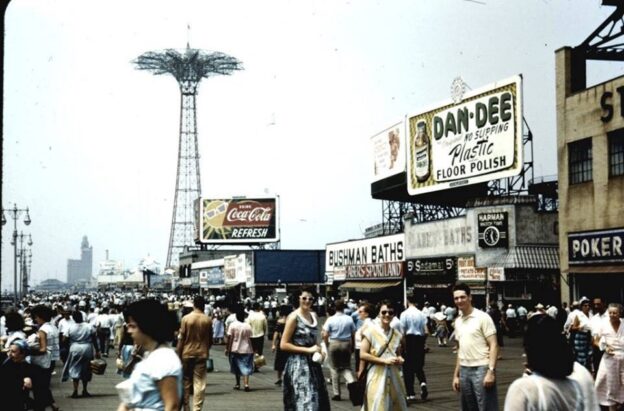
She insisted we join her in her rituals of sun worship. Her beach equipment included a shiny reflective visor to get those hard-to-reach spots underneath the chin, and a noxious mixture of baby oil and iodine whose purpose was not protection but magnification of the sun’s power. My brother and I could endure only minutes (really, seconds) of exposure to the midday sun, but her practice was to arrive at Coney Island—we lived eight minutes away if we caught every green light on Stillwell Avenue— well before noon and then to linger until three or four o’clock. Blithely unaware of any health concerns, she scolded me for my resistance to the benefits of the life-giving sun.
So, in the late 1950s and early 1960s, for several weeks of June and again in September, she would herd us up and plant us on a bath towel at Coney Island beach. Only by taking a bungalow in the Catskills, a hundred miles to the northwest, were our bodies spared massive doses of carcinogenic radiation throughout July and August.
An apocryphal yet plausible story has my mother responding to my whining and complaining about these beach excursions by asking exactly what it was I didn’t like about the beach. My answer, as I remember it, was direct, succinct, and all-encompassing: The air, I said, is too hot. The sand is too dry. And the water is too wet.
She found my reasoning even less persuasive than my whining. Coney Island held a pivotal place in her personal mythology. It was where she had met my father in the late 1940s.
Though I haven’t heard either of their voices in almost sixty years, I can remember them (mostly her—my dad was a quiet man) regaling me with the whole colorful saga of how they met, and where, and who was with them, and what they said and thought and noticed. I listened with about twelve seconds’ worth of interest, and so I’m left with only this bare fact: they met at Coney Island.
Logic and documentation supply the “late 1940s” part. Serving in the South Pacific, my dad wasn’t discharged from the Army until sometime late in 1946, and my parents married in very early 1949. That leaves a narrow 16-month window—from the summer of 1947 through the summer of 1948—when they could have met.
Now, retired in sunny Florida, I find myself trying to supply details that I used to ignore.
Were they each there with a crowd of friends, or had they come alone? Did they meet in the waist-high waves, or on a beach blanket, or perhaps walking on the shell-strewn sand? On the boardwalk? Or is “the beach” simply a metonymic shorthand — could they have met in a luncheonette a few blocks inland, on Mermaid or Neptune Avenue, or perhaps at Nathan’s hot dog stand on Surf and Stillwell? Maybe they shared a seat on the Cyclone or the Parachute Jump, or collided in bumper-cars? Were they introduced formally, or did one of them simply begin to speak?
I never saw my father at the beach in my entire life. And I imagine he had many of the same qualms, reservations, and the general antipathy toward it that my brother and I had, so it’s a wonder that he ever made it to the beach at all.
Another thing that I wonder about is how the introduction came about. My father must have been there with friends– sun worshipers, swimmers, tummellers (Yiddish for “boisterous jokesters”) — none of which he was. It’s hard to picture him, shy and dignified, approaching young women on his own without a lot of forceful encouragement. And my mother’s style was to surround herself with her half-dozen closest friends at all times, all laughing and interrupting each other, a configuration that would have discouraged all but the brashest.
So, I picture two clusters on a jam-packed beach: one group of young women and another group of World War II veterans—you’ve seen those photos of a few hundred thousand Brooklynites crowded elbow to elbow on a summer weekend beach—perhaps on adjacent blankets, striking up some sort of connection. The ultimate result, as far as I’m concerned, was me and my brother. We owe our existence to the rites of sun worship.
Today I live in the Sunshine State. I spend an hour in the pool most mornings and another hour in the afternoon, taking great care to restrict those hours to sunrise and sunset, specifically to avoid the sun as much as possible. Also to avoid people, if possible. I’m very much my father’s son in both complexion and temperament. But as I avoid the crowds, the sunshine, and the noise, I must acknowledge the vital role all three played in creating my small place on planet Earth.
***
Steven Goldleaf, a professor of English at Pace University, is writing a memoir entitled ONLY MOSTLY TRUE.
A great story. It brings back fond memories of your mom and dad. My son Brad was named after your mom. She had the best sense of humor.
Great story! I grew up in Brighton Beach in the 1970s/1980s and truly fondly remember my youth at the beach with older folks with sun-reflectors near their face and tons of baby oil.
Still remember all of the smells: That stuff plus the “Hot Knishes!” and “Ice Cold Beer!” that was sold by wandering beach vendors.
love it