


I arrived on Thompson Street in a yellow cab with one suitcase and $200 I’d saved from babysitting. That July morning in 1981 a radio DJ had declared it one of the ten best days of the year. A good day to start over.
When I’d turned 16 in May, I hadn’t foreseen any of this. The situation at my home had deteriorated quickly.
I rang the buzzer and my boyfriend came downstairs. He was eighteen.
“Is this all you brought?” he asked, lifting the suitcase and heading up the stairs.
“It’s all I need.”
I had gotten rid of most of my belongings, emptying the drawers and the closet and giving away most of my clothes, leaving very little at my mother’s. When removing the books from the bookcase, I paused a moment to look at my junior high school yearbook with the signatures and the well-wishes from friends and an embarrassing poem written for me by someone I hadn’t stayed connected with. Then I tossed it.
I followed my boyfriend up the stairs to the apartment he’d been sharing with his older stepbrother until two months ago. It had just two tiny rooms. The bedroom had a loft bed and a freestanding shower. There was no bathroom, just a “water closet” big enough for a toilet. It had a window but no electricity. At night, one peed by the light of the moon. The front room was basically a kitchen with a sink, a stove, and a refrigerator with the TV perched on top. Two old vinyl-covered office chairs were the only furnishings in the apartment. Cabinets lining one wall had so many decades of paint they no longer closed.
The three-bedroom, two-bathroom apartment I’d lived in with my mother and brother had once seemed like paradise with its newness and city views, but I was happy to be in this place where I felt safe. In the weeks before school had ended, my younger brother and I had slept on our sister’s living room floor.
There were two collections from childhood I couldn’t bear to discard, which I left behind in a trunk. I had more than a dozen dolls from various places we’d visited: Morocco, Spain, Portugal, Switzerland, Barbados. Then there were the baby dolls and the rag dolls: Holly Hobby, Heather, a large Raggedy Ann. I couldn’t take them. But I couldn’t toss them either.
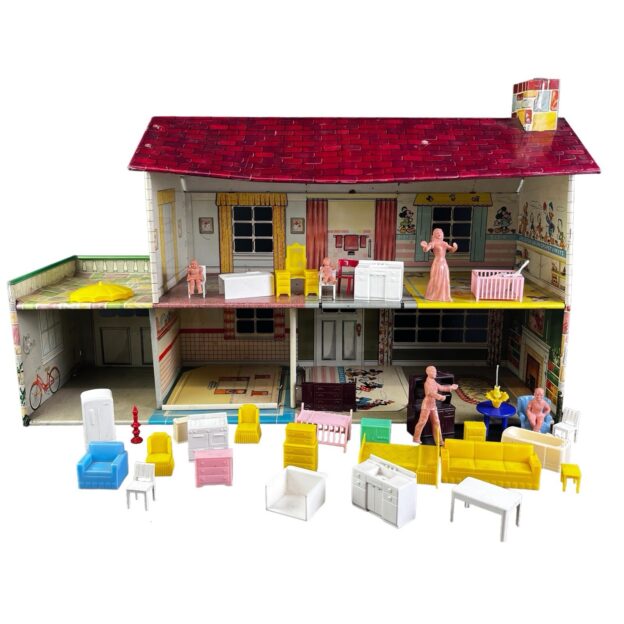
The dollhouse itself never belonged to me. It had been a loan from a family that hadn’t used it for years. But the furniture that had decorated it was all mine, collected one piece at a time from Shackman’s, the dollhouse miniatures shop on Fifth Avenue near Union Square. I would go there after ballet on Saturday, scouring baskets holding tiny plates and lamps and books. Just a couple of dollars would get me a treasure, a miniature book or little teapot to bring home. The collection was smaller than it had once been, and some of the pieces had been glued and put back together by my older sister after my mother had destroyed them in a fit of anger a few years earlier.
Packing the miniatures in a box, I remembered my mother on the floor with a hammer in her hand. She’d pulled the furniture out of the house, placing it in a compact pile on my carpet, lifting the hammer up and bringing it down slowly and repeatedly as if in a trance. Bits and pieces—little chair legs, porcelain chips from a bathroom sink–went flying like shrapnel. I was too stunned to try to stop her. I didn’t recall why she’d been angry.
I locked the trunk, hoping to retrieve it one day. My mother had the key, but it wouldn’t fit in my new place, even if I had been able to bring it there.
I looked around and saw my boyfriend had tidied the apartment. I took out the $200.
“My first contribution to the household,” I said with a smile.
SoHo hadn’t yet exploded into the chic, commercial, and soulless neighborhood it later became. There were still struggling artists and working-class families. Italian butchers sat outside pork stores.
The rent was $325. We also had the expenses of phone, electricity, and food. At eighteen, my boyfriend was lucky to have an art apprenticeship. It was steady work, but not especially well-paying. I’d been babysitting for years. I figured I could earn $300 or so a month doing that and maybe some other job in a store. Pooling our resources, we’d be okay.
A month earlier, I had sat with my brother across from two social workers who laid out a plan for us: we would be sent to a “diagnostic center” in Staten Island for nine weeks. There, they would examine the situation and figure out the best thing to do for us.
They wanted to get us out of our mother’s home. The police had been to the apartment many times. Child protective services had been called. My mother’s drunken tirades didn’t stop, even when a judge granted me an order of protection.
“What happens after the nine weeks?” I asked.
“Sometimes kids go to group homes,” one social worker said. “Others are placed with a family.”
“Sometimes the nuclear family is reunited,” the other one piped in. “It all depends on what they learn during the nine weeks.”
I had no intention of going to a diagnostic center. The options afterwards also didn’t sound promising. I no longer had faith in any adults. I had to get out of my mother’s place on my own.
About the same time, my boyfriend’s stepbrother, who he had been living with since he was sixteen, decided he wouldn’t be returning from a trip to Oregon as originally planned. My boyfriend couldn’t manage the rent on his own.
My social worker was skeptical when I told her my plan to move in with my boyfriend. She was leaving soon to have a baby anyway and assumed I’d work with another therapist while she was out.
“I just want to stop talking about it,” I said. I couldn’t imagine starting over with someone new, explaining it all over again. “I want to move on. Put it all behind me.”
My brother was fourteen. I felt guilty leaving him behind. He went to the diagnostic program at the end of that summer. My sister and I went to visit him, taking trains, a ferry, and a bus.
The Thompson Street apartment had a fire escape, reminding me of the tenement we’d lived in on the Lower East side when I was little. I hadn’t been allowed on that fire escape, which only overlooked weeds and trash. When I was nine, we moved a few miles north and a world away to an apartment on the 30th floor of a high rise. I spent hours staring out my bedroom window at the city skyline and the bridges that went from Manhattan to Brooklyn.
After my boyfriend left for work each day, I’d sit on our fire escape smoking cigarettes and eating Entenmann’s chocolate chip cookies out of the box. Someone on the ground floor of the building across from us had a fancy patio and a pool. The guy there sat outside, sunbathing and talking on the phone. He couldn’t see me. Sometimes he went into the pool, once without a bathing suit. I was jealous that he could swim anytime he wanted.
Swimming had saved my life. I missed it. Over the past year, I had swum nearly every day at a local pool. It was something I had control over as everything else fell apart. The pool was a safe place away from my mother. I would dip under the water and swim an entire length on a single deep breath in the quiet and solitude.
A public pool in the playground across the street always seemed filled with kids splashing, making noise. But I was too shy to investigate it in quieter times. I just needed to hide out and lick my wounds.
We tried to spruce up our tiny home. My boyfriend put down some discarded bamboo window shades as floor coverings and decided to build a drawing table. We carried the wood from a lumber yard a few blocks away, and he built a table that fit perfectly underneath the loft bed. We also needed a table to eat at, so we went back for more lumber a few days later.
In a housewares shop, weeks later, the salespeople stared at us, whispering.
“Are you newlyweds?” one asked
No, we answered, but we’d pass ourselves off as adults until we married four years later.
We stepped out of the shop and took each other’s hands. We’d spent too much on the napkins, placemats, and bowls but we were happy as we walked to our tiny apartment and put our new belongings on our bare wobbly table.
***
Dorian Burden was raised in New York City, her earliest years spent in the scrappy, immigrant neighborhood of the Lower East Side. She spent a decade working at such publications as Working Woman and Psychology Today before becoming a schoolteacher. She is currently at work on a memoir.