


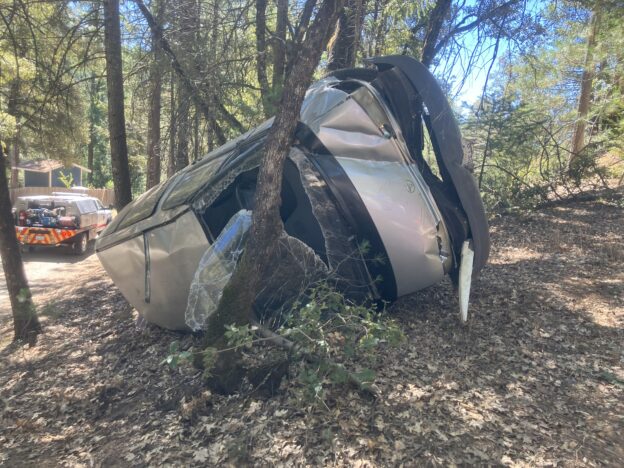
This past July, while visiting Grass Valley, California, a small town in the Sierra Nevada foothills, I nearly died.
I was driving my mother-in-law’s 1991 Toyota Previa on my way back to her house from a morning tennis match when the brakes gave out while going down a steep and winding hill. As the vehicle was speeding up, I tried to stay with the turns but ended up plunging off the road, crashing down a slope through trees and thick brush. Part of the way down that slope, the Previa flipped onto the passenger side and skidded to a stop. Hanging in place sideways from the seatbelt, I shifted the totaled vehicle into park, turned the engine off, unbuckled myself and crawled gingerly across shattered glass out the broken back window. EMTs, police and the fire department soon arrived. Aside from a head laceration, I was uninjured. An EMT suggested that I buy myself a lottery ticket.
Along with good fortune, the thick roadside undergrowth had slowed the vehicle down and perhaps saved my life. An irony is that brush was supposed to have been cleared in order to protect the community. Grass Valley is in the heart of wildfire country. Many of my family’s visits have been interrupted by evacuation warnings and heavy smoke, with air quality index readings soaring into the danger zone. But this summer to my delight the air was clear and the weather temperate.
Instead, it was New York City that was blanketed in smoke for several days this July. Reading about our city’s poisonous air and darkened skies brought me back to that afternoon in June 2023, when New York’s air quality was worse than anything I had ever experienced in California. At the time, I may not have quite believed that it could ever happen in the city, for I found myself walking maskless up Broadway, on my way to pick up my daughter from school. The panic that came upon me that afternoon as my eyes watered and my throat started to hurt, the fears I had for my daughter’s future, and for all of us were powerful and nearly debilitating.
Within a day or two, the winds had shifted and the air cleared, but my panic lingered and even deepened as I contemplated the possibility of these smoky days becoming a regular occurrence. The aftermath of the car accident has been similarly challenging for me. Right after the crash, I felt fine. The event had happened quickly, and I was okay. There I was, with my body and brain intact, amped up and ready to tell the tale.
But a day or two later, once my adrenaline had faded, an abyss opened. My mind went to the what ifs—the possibilities of death or serious injury— and what that would have meant for me as a father, and a husband, and a person in the world. The idea of my daughter, just 12, losing her dad terrified me, as did the possibility of not being able to watch her grow up.
I have been around long enough to see abysses open up for a number of friends. I lost a close relative to colon cancer in January, a few days after his 55th birthday. In 2015, my closest friend from high school was killed by a drunk driver while out on a bike ride. From time to time, I think about Rafe and his fatherless daughters, about lost potential, and the parts of his children’s journeys that he never got to witness. When these sorts of terrible events have happened to my friends and peers, I have tended to turn away or come up with tortured explanations as to why it happened to them, as opposed to me. I eat spinach. And kale. I go to the doctor. I do most of the things the New York Times Health section advises. Thanks to my vigilance and good efforts, my odds must be better than theirs. My journal entry from the day before the crash includes a list of “Things to do for longevity: Interval training, more veggies! Less sugar! Weightlifting! Increased social activity!” Typical stuff. All of which, in the face of a random catastrophe, is entirely meaningless.
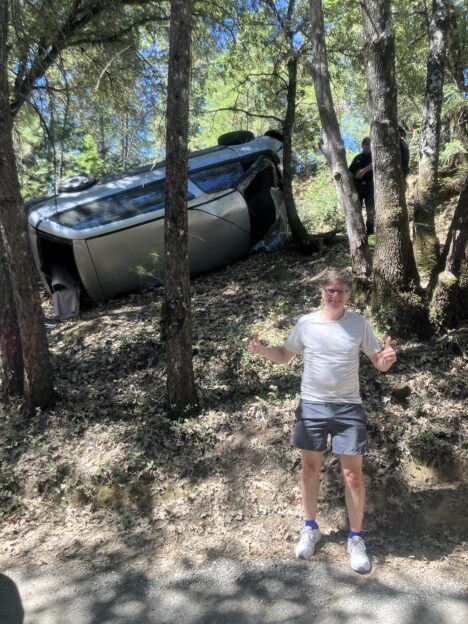
In Grass Valley, measures are being taken. Brush is getting cleared and forests thinned, and the fire squads are swift and professional. But some conflagration and catastrophe feel inevitable. Here on my native Lower East Side, a neighborhood devastated in 2012 by Hurricane Sandy, the city is raising the shoreline by ten feet, a huge undertaking which may not be enough to prevent further flooding and disaster. These are the abysses of the natural world.
As a playwright, I think often about abysses. They are, after all, rather dramatic. I try to enter into the core of stuff, hopefully with some levity and specificity. In my most recent script, To The Playground, set in the East Village, the play’s characters, all parents or grandparents of toddlers, toggle between the immediate (potty training and such) and the existential–climate anxiety, and deeper worries for the future. As the play goes on, the central character becomes increasingly consumed by fears, both personal and global, to the point where she can barely go on. In the midst of her panic, she is reassured by a fellow parent: “Look at them,” she says. They are together on the playground, where the entire play takes place. “This is what we have. They’re all so beautiful. They’re God’s creatures, Nature’s creatures – every last one of them. It’s what I do when the panic comes. I look, and it keeps me going.”
When my panic comes, I do that as well. I look. I take stock of all that I’m grateful for: family, friends, community, and art. It keeps me going, and yet we remain on the precipice. Catastrophes continue. It feels as if we are careening down a winding hill without good brakes. We might stick the turn, but then again, maybe not. We are in the midst of a huge, existential crisis, which, no matter what technical or political solution we may try to conjure, isn’t about to go away. Life in Grass Valley and in New York City, two places that I love and where I feel at home, is fragile, even evanescent.
That the crisis is enormous, and not entirely soluble is in no way an argument for paralysis or against political action. Imperfect and partial solutions matter—small steps on a local community level and within our larger body politic. It’s all essential. That work must happen, but meanwhile, wherever we are, we must also learn to live with existential uncertainty and to accept and even embrace our world’s deep fragility, along with our own.
***
Andy Bragen is a playwright and essayist. His latest work “To The Playground” will premiere at La Mama in December 2026.