


“Perhaps @Icegov should go check this corner out.” That’s how social media influencer and Turning Point USA contributor Savanah Hernandez captioned her October 19, 2025, video on X showing West African vendors selling counterfeit goods on Canal Street. The video has been viewed 5.1 million times. Several days after it went online, ICE agents raided the area and arrested nine street vendors. A Department of Homeland Security press release said that the agency was “MAKING NEW YORK’S CANAL STREET SAFE AGAIN.”
I’ve walked by the vendors’ place so many times, on the way to dinner with old friends at New York Noodle Town or a scoop of banana ice cream at Chinatown Ice Cream Factory. I’d always adjust my Senegalese bracelet, bringing it out from under my sleeve, as I passed by the Senegalese and Malian merchants. I felt an affinity, comfort with the teens and older kinsmen even if I passed by unheeded. I wondered if the guys would be surprised to learn I was half-Senegalese. Would it be a repeat of the scenario at Les Ambassades bakery where I’d get made fun for being a Senegalese no-sabo kid? It was probably naïve to think I was on the verge of some kind of heart-felt encounter. Dakar’s congested avenues are full of peddlers with their own cheap goods. To make it to the US and end up selling fake designer bags and watches on a corner in Chinatown wasn’t the dream.
In her video shot on Canal Street, Hernandez failed to turn the scene she witnessed into anything close to dangerous or threatening. What’s more American than entrepreneurial peddling? I began researching Hernandez’s videos, wondering how a descendant of immigrants—Hernandez’s mother is from Guam and her father’s grandparents were Mexican—became a commando for ICE.
Hernandez’s videos have gone viral on X, YouTube and Instagram, though she also publishes articles on TPUSA’s website. Her street interviews, which pull the most views, compile the most embarrassing responses from people she’s roped into talking to her. Younger college students stutter when they try to define white privilege. Others stumble when asked to cite sources for crime statistics. Their bloopers confirm that college campus bubbles may not prepare students for debaters with sharp elbows. But the quick cuts leave one wondering what parts of the conversations got left out. How did Hernandez introduce herself and her aims to the duped interviewees? Her contempt for due process and willful misinterpretations of asylum status make her videos closer to propaganda than news. She can be outright malicious with her editing, too: not above having her cameraman angle around to reveal one respondent’s belly fat.
Hernandez claims to have been close to Charlie Kirk, calling him “a mentor.” She works for Turning Point, and her street interviews mimic Kirk’s campus debate series. But her YouTube video eulogy for Kirk, which alternates clichés and hyperbole (“[Kirk] modeled Christ so well”) makes it clear that she’s far from Kirk’s heir. Her version of Christianity justifies vengeance. She calls Trump’s censorship campaign after Kirk’s death a “natural response” and assures viewers: “by the way, my friends, this isn’t cancel culture. This is accountability.” A true Christian wouldn’t deceive one’s neighbors, but Hernandez publicizes her deceptions. At DC Pride, she sports a rainbow pin that helps her get innocent responses which she then subverts in her editing: Hernandez plays raunchier moments from the parade over snippets of her conversations. One respondent’s statement—”we come from a very right-wing town… our town is very small, but I think I would just say that this is love”—can’t be twisted, so the anti-journalist drops it at the end of a 9-minute video, barely allowing it to play out before the video fades.
Kirk’s hour-long debate compilations sometimes gave space to sharp opponents, creating a rare dialogue. [1] Hernandez’s pseudo-conversations give her an out from substantive debates. At the Oxford Union, Kirk voiced his appreciation for a woman who had asked him: “if you were in my position, what would you ask yourself that would be most effective in challenging [your] core tenets?” Kirk dodged but re-affirmed the core principle of civil debate: “always come into every conversation believing that you might be wrong and that you might learn something.” When Hernandez accosts young people in Times Square to make fun of their bad answers on geography and history questions, it’s blazingly apparent Hernandz’s aims aren’t educational.
II
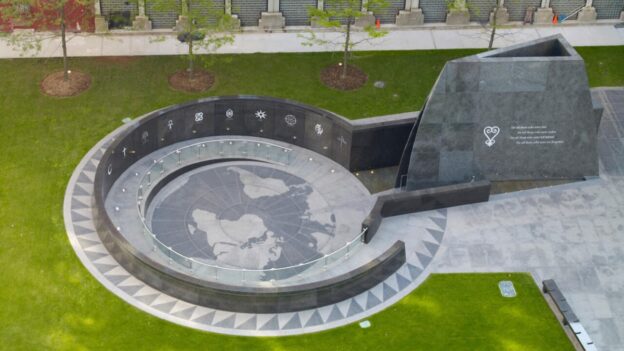
My mother and I got a reminder of how much there is to learn about this country the last time we walked by the Canal Street vendors. That day we had just come from the African Burial Ground National Monument at 290 Broadway. The museum’s staff gave me an important lesson on the 1741 Conspiracy. I had no idea white New Yorkers burned and hung to death thirty to forty enslaved black people in one of the most horrible American pogroms. The slain were linked to a supposed conspiracy to overthrow white rule. A set of fires across the city had alarmed slave owners making them crazy for blood. Judge Daniel Horsmanden’s execution orders relied heavily on the testimony of one indentured Irish teenage girl.
The memorial’s museum also helped connect my mother’s home world of Senegal to America: she was drawn to a collection of (replica) artifacts from New York’s colonial-era African community. A half oval wooden tablet with Arabic writing caught our eyes. In Senegal in Saint-Louis and Touba, I had seen kids from madrassas sitting on the street, some studying with the same instrument, others loafing, with the tablet strewn aside. My mom might have used the same study aid when she went to an Islamic school as a little kid. I couldn’t understand in the moment why mom was taking a picture of a slingshot behind a display case. She told me later this object spurred a memory of my Uncle Mbaye using slingshots back in Kaolack. He’d hunt birds in the forest. My mom would help cook his prizes. Kaolack has seemed sandy and marshy, not woodsy, when I’ve visited, but my mom insists it’s had more verdant days. She reminds me of the lemons and mangoes that’d grow in her grandmother’s backyard. Our New York apartment is home, but I do wish she had the space for a garden. Her plants in the kitchen window compete with the oven wires and dryer tubes. The memorial around the corner from the museum didn’t bring out emotion or memories for us. But my mom noticed one middle aged white woman, with her two kids and husband, who had started crying. My mom caught their accents. They weren’t Americans.
My mom and I turned down Broadway, leaving the mysterious stone complex amidst the quiet downtown courts and federal building. On Canal, the presence of the vendors seemed like magic. Just blocks away from where Wall St.’s wall once stood, constructed by enslaved African people hundreds of years ago, there were West African New Yorkers locked on the get-by. Were the gaggle of elderly African American women peering at goods for sale also thinking about ties to the African men? Did a passing physical resemblance to a family member spark a connection? I wanted to ask the African guys if they knew about the Burial Ground, or the 1741 Conspiracy? Too many questions, too many identities, it felt overwhelming. The memorial had broken down space and time.
Hernandez has made many videos exposing how immigrants are taking advantage of American (and even French) cities. But she’s never got a local angle in these settings. Hernandez talks up her love of country, but her patriotism amounts to her own upward mobility: “I couldn’t be more grateful to be a brown woman in America because this country has awarded me so many opportunities… freedom to achieve every single dream that I’ve ever wanted.” But I still hope Hernandez, in her travels, low-key loves the tamaleras she passes by, even if she rats on my people.[2]
Editor’s Note: On April 11, 2026, Savannah Hernandez posted a video of a woman hitting her and man shoving her at a protest at the Whipple Federal Building, an ICE detention site in Minneapolis.
1 Kirk owning the libs greatest hits gets views, but he also highlighted interchanges like the one that he called “the best gun debate I’ve had in years” where one guest speaker forced Kirk to cop the need for more extensive training for gun licenses. I’m still stuck on a clip of two black college students who took on Kirk, Vivek Ramsawany and a jeering MAGA crowd.
***
Ben Khadim DeMott is Senegalese-American, born and raised in New York City. He now works and lives on the South Side of Chicago.
Excellent story. Made me wonder where and how Hernandez came by her rapacious cynicism. The interview shtick she uses is a knock off of one used by Jay Leno years ago. People like her need to be kicked in their fake balls.
The author does an excellent job of vertically integrating personal history, culture and commercial sociopathy … not an easy thing to do. Dogs still eating dogs. Have we learned anything?