


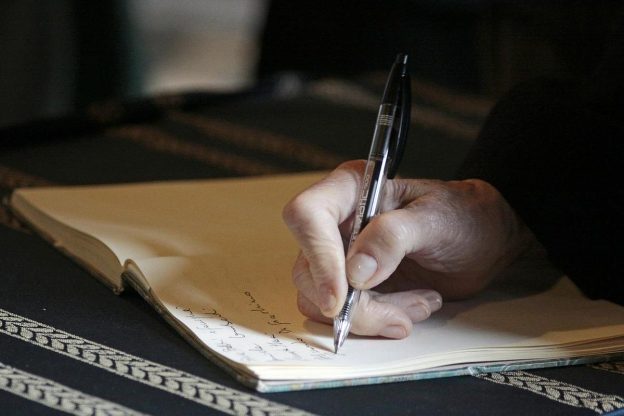
“Let’s go around the circle,” the writing instructor began. He was a small wiry man with a trim brown beard. “I’m Alan. I graduated from SUNY Buffalo and last year I got my master’s degree in fine arts. I’m from Long Island, Great Neck,” he told us.
“Everyone give your name and anything you want to say about yourself.”
“Hello,” said the small woman to his left. “My name is Lilian Fromm. I am here,” she spoke slowly, brushing back her white wispy hair, “because I vant to write about my childhood in Vienna.”
The week before, while bagging my groceries at the grungy Red Apple supermarket at 96th and Broadway, a notice for a “Writing Workshop” caught my eye. Nearly smothered by signs for beds for sale and apartment sublets, the index card mentioned that the workshop was starting Feb. 3rd and meeting every Wednesday at the nearby public library on Amsterdam Avenue.
In a room off the main reading room area, I took a look at my prospective classmates who had arrived before me. Sitting around a large table, most were thin with white hair. A sofa was weighted down with heavy coats, hats and scarves.
The next woman, after Lilian, looked frail but spoke in a determined voice. “I’m Eva Kaminsky from Varsaw,” she began, “and I vant to write about my life as a child before I come to New York.”
“Hello I’m Jake from Bucharest…”
One after another, they spoke. Many were immigrants and over the age of 75. They wanted to write about their pre-World War II life in Poland, Austria, Romania, Hungary, Lithuania. Lives and communities that no longer existed. This was 1979 and these people were about the age of my grandmother.
When it came my turn, I thought that compared to them, I had no such stories to tell. “I’m 25 years old,” I began. “Just a baby” someone murmured. “I’ve been in New York since last September. I’ve written poetry, now I want to work on the craft of short story writing.”
“Craft?” Jake and others looked puzzled. I soon came to realize, craft or technique didn’t matter so much to this group. Writing was the way to remember their childhood, a tool to recapture a lost past.
Not all the participants were immigrants though. There was Edna, from New Jersey, who introduced herself as a poet. “Let me say that I won the Joyce Kilmer Award for poetry in 1947, I’ve been published many times…”
“Like where?”
“The Joyce Kilmer newsletter and many other places.”
Bill told us with tears in his eyes that he’d written many stories “but all lost, unfortunately, all lost… I write from a feeling, an infiltration in the veins.”
“Hello, my name is Heidi,” said a frail giggly voice. “I like to make cutouts. You see this bridge,” She held up a paper construction, “It is a poem, ‘I am a bridge suspended over the murmuring waters’ ”
“I am Flora, I keep a journal since I am 18 years old. I am 76.”
“Hey, I’m Jack. I’ve clipped articles from 50 years before and I use them in my writing.”
“I write science fiction, spaceships, aliens, Star Wars. I’m Ben.”
“Hiram here. I want to ask you, Alan, what’ll I do about reading something that’s too risqué for the ladies here. Get my meaning?”
Alan coughed. “I want you to feel free here to say and write anything, but let’s go easy on things that might be offensive.”
There were nods around the table.
“I’m Sol. I want to do a murder mystery.”
“I’m Lena. I am a sculptor, an artist, and why not a writer?”
“Is that everyone?” Alan said. “Well, it’s so wonderful to meet you all,” he smiled. “I want to tell you the class format, we’re sharing our writing with each other, and you’ll be getting comments from me and also your fellow community of writers,” he stressed.
“Community of writers?” we echoed. This was a new concept.
After that first class I worried about my elderly classmates. Aging refugees and immigrants, with little money, I imagined them ending up on the sidewalk with all their belongings in a shopping cart.
Our first assignment with Alan was a character study. Eva read her story about her uncle who had been one of the partisans in the forest in northern Poland. The many names and dates made it hard for us to follow.
After a silence, Jake broke in. “I can’t understand nothin’!” he said, getting agitated. “How did he get there? What happened on the day you’re talking about! It’s just not clear to me!”
Eva’s reply was instantaneous. “I wasn’t scared from Hitler!” she shouted. “I should be scared from you?”
“Hey, hey,” Alan broke in. “Glad you’re responding, Jake, but your comments should always be constructive not destructive.”
“Whaddya mean constructive?” asked Bill.
“I mean, comments should help the writer, don’t just say I didn’t like that, but offer a suggestion to improve it.”
There were murmurs of “constructive.”
“I’m still not afraid from anyone,” Eva said.
I was in awe of their experiences. Partisans in the war. The Warsaw ghetto. The Viennese coffeeshops. The Anschluss.
My Manhattan neighborhood had its share of characters: panhandlers outside the Red Apple, bag ladies with their shopping carts moving up and down Broadway, little old women out in the rain with matching red plastic boots and pocketbooks, the men and women living in the SROs (single room occupancy hotels) who came out, spread their arms and yelled at fire hydrants and the sky. I didn’t write about any of these things, or about the wonderful Thalia movie theater on 95th St with its retro films, ramshackle posters and lumpy faded red carpet, or Riverside Park and my love of the city, the dirt, people on the move, and the sound of the newspaper vendors in the late afternoon: “POST! NEW YORK POST!”
I didn’t write about the folk dancing classes that I went to and the sad lonely figures that hung out there like Roland, who every time he wanted to dance with me, would bow and sputter: “Golly gee, I’d be so happy if you’d give me this dance!”
Instead, I wrote about a creepy boyfriend from the past.
When I read the piece, there was silence for a moment.
“I don’t get it!”
“So, what happened, did you break up with him?”
“Better you should be rid of him!”
“Words, words, too many words,” said Heidi. “I hear it all before.”
Alan stepped in. “I like the characterization,” he said, “but give me more plot. You need to have more conflict.”
More plot. This was one of the problems with using your past. Sometimes the the past didn’t follow a plot. Alan said we needed a conflict that you resolved, or maybe didn’t resolve. Lilian’s story on meeting Freud when she was a child, Jake’s on the separation and loss of his family at Auschwitz were incredibly moving, but they didn’t have the plot that Ben had with his aliens or Hiram with his macho men.
During the months that took us from winter rain and snow to spring sunshine, I cried and laughed at some of the stories we heard. As the days got longer, the city started coming alive. Purple crocuses bloomed in sidewalk cracks. The heavy coats that we piled on the sofa gave way to sweaters and light jackets.
When the course ended in May, we asked Alan if it would resume in the fall. He said to look for signs in the supermarket bulletin boards or neighborhood newsletters. But there was no new funding from the New York City Foundation for the Arts, which had sponsored the course.
I often wondered about our “community of writers,” especially Lilian and Eva, and hoped that life was treating them well.
Meanwhile, I had moved from 96th to 107th St. On the 5th floor, I had a sweeping view of Broadway, up past the Korean fruit & vegetable market at 110th, and south beyond the Olympia movie theater, which was so rundown that you could walk in carrying a whole pizza and nobody would say anything. My new apartment was tiny, cockroach-infested, had an elevator constantly breaking down and a lock on the front door that a small child could break. To save space, my bicycle hung from the ceiling like a deformed sculpture. Soon after I moved in, my downstairs neighbor, a saxophonist, was murdered, and the police knocked on my door to question me.
In my new writing class, the group was not mostly 75-year-old immigrants from Eastern and Central Europe, but people of all ages and professions, and we all cared deeply about craft and technique. We also cared very much about each other’s feelings. “I loved the energy that your piece had!” one might say. No one said things like “I didn’t get nothin!” To tell the truth, I missed the visceral reactions of my immigrant writing group.
One evening while browsing in the Bloomsbury bookstore on Broadway, I saw some chairs gathered together for a small poetry reading. A voice was saying she had won the Joyce Kilmer award in 1947. Edna? There she was, happily reading about a forest and sunlight and unrequited love; it was done with passion and emotion. She was breaking all the rules of good writing. Is it so important to get it right? I wondered. After Edna’s reading, I went up to congratulate her. We talked about Alan and our writing class and wished each other well.
Years later when I was teaching high school English, I compiled a class book of the students’ best writing during the year. I thought of Alan and our class. Wouldn’t it have been wonderful if we had put together such a book for our writing group? Then I could have relived Eva’s partisan story, or Jake’s about his family, or Lilian’s Vienna stories, or even Edna’s poetry.
As for me, I made peace that I might not have been a partisan in the Polish forest or part of the Viennese coffeehouse scene, but I had something special all right. I had Manhattan in my 20’s, and I could carry the city around with me wherever I went, wherever I ended up in the world.
***
Sherri Moshman-Paganos is a writer and former educator living in Athens Greece. She remembers fondly the five years she lived in Manhattan, years that inspired her to write her book, Step Lively: New York City Tales of Love and Change. She is also the author of a poetry collection, Wanderings: Poems of Discovery, and a teaching memoir Miss I wish you a bed of roses: Teaching Secondary School English in Greece. For some years now, she has published a travel and culture blog, olivesandislands.home
“I wasn’t scared from Hitler! I should be scared from you?”
Utterly wonderful memory of another time and another world.
What a treat to have experienced all those people first hand. In their relative anomoninity, you may have heard things said that they never told their families. Very nice piece of writing but, of course, I am prejudiced.
I admire people who put their thoughts and experiences in writing without worrying too much about “getting it right.” However, Sherri Moshman not only writes her thoughts and experiences courageously, but she “gets it right” every time. A pleasure to read.
One of my favorite details in the story is your use of the heavy coats piled on the sofa giving way to sweaters and light jackets to mark the passage of time. You paint a picture with your words.
I look forward to your next story.