


This excerpt from John O’Connor’s new book, A Short, Strange Trip: An Untold Story of Magic Mushrooms, Madness, and a Search for the Meaning of Life in the Amazon (pub date April 14, 2026), explores the peripatetic ways of both the author and his subject, the late American mystic and “psychonaut,” Terence Mckenna (1946-2000). McKenna, a countercultural figure in the 1970s who championed the use of psilocybin mushrooms, had a far-ranging influence on the psychedelic underground.
————
Once upon a time, when I had options and energy, I moved around a fair bit. After an initial stab at New York City—two heavily medicated, underinsured years—I moved to London. Having decided I was too poor for Brooklyn, I relocated to a town that was even more expensive, where I quickly became mired in deeper poverty and regretted every decision I’d made that brought me there. From the start, I missed New York terribly and fantasized about returning, griped incessantly about London’s inferiority: its deplorable food, appalling weather, wretched public transportation, shameful restrooms, to say nothing of its indecipherable dialect. When, a year later, I found myself living in Chicago, I soon came to regret every decision I’d made that brought me there, griped incessantly about its inferiority to London and New York, its deplorable food, appalling weather, wretched public transportation, and shameful restrooms, to say nothing of its indecipherable dialect. When, the following year, through an odd confluence of events, I wound up in Dakar, Senegal, I soon regretted every decision I’d made that brought me there, griped incessantly about Dakar’s inferiority to Chicago, et al., its deplorable food, and so on. When I finally landed back in New York, after an ecstatic three-week honeymoon, I regretted every decision I’d made that returned me to the Capital of Crazy, a repository for the dashed hopes and dismembered ambitions of 500,000 MFA grads, where I was soon inveigling everyone I could about New York’s inferiority, bar none, to every other place I’d ever lived. Even so, I couldn’t fathom living anywhere else. When I did think of moving—to Bozeman, Juneau, Little Rock, Everglades City, Coeur d’Alene—I noticed myself getting impatient with the very idea. Nothing was tying me down—no family, mortgage, parent–teacher conferences; no real job or career to speak of; no prospects whatsoever—which only served to magnify my inertia. I could just as easily imagine myself living in all those places as I could imagine myself living in none of them. Why am I telling you this? Because it was easier to stay put, I thought, and to take comfort in my failure to live anywhere happily, than to find myself packing and unpacking yet again, as Terence did throughout his short and travel-jammed life, always arriving and departing, freely discarding one paradise for the next, spinning the roulette wheel, determined to live unshackled to any one destination.
In the end, I did manage leave, after meeting my wife, and moved to Cambridge, where I abandoned all thought of returning to New York and accepted the futility of ever moving again.
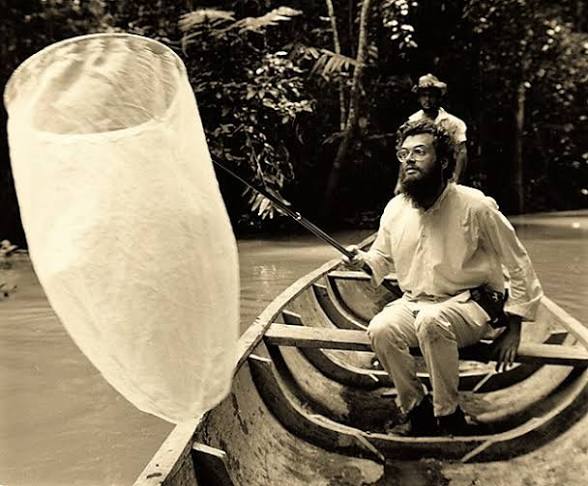
Not Terence. He was on the move just about from start to finish. I want to retrace some of it here, because his wanderlust, unlike my own, wasn’t a complete waste of time, and led him, ultimately, to La Chorrera. He didn’t need convincing that America was spiritually dead or that he’d make a name for himself in the history of religion—only that it’d be easier to do so in a primordial elsewhere. Over the next year or so, whether losing a girlfriend to an Israeli kibbutz or committing to no posterity whatsoever his Crypto-Rap musings, he gained momentum. Even with little idea of where he was headed, he was bound to come around to it eventually, so devoted to and focused on a “psychedelic call to arms” that other options never occurred to him.
Picture those gray lines on Google Maps that plot alternatives to the fastest route, bypassing shopping centers and apartment complexes and blue oblong lakes. Imagine if instead of “avoid tolls” and “fuel-efficient routes,” you could set it for “cheapest drugs” and “slowest and most uncomfortable possible routes,” and you’d have the hippie trail. Terence, with thousands of other bored dropouts, embarked on a romantic pilgrimage to Southeast Asia in the Leary and Ginsberg mode of drugs and deliverance. Most started out in Europe, typically London or Amsterdam, and passed through the Balkans before webbing out toward Jerusalem, Herat, Kandahar, Peshawar, Lahore, then perhaps on to Benares, Goa, or Kathmandu. Defiantly mindless and brimming with New Age fluff, they often left bad impressions on the people and places lying in their path. Of the young Americans she met in Nepal, the Free Speech Movement’s Kate Coleman said, “Almost everyone I met was a seeker and a moron.”
As could be expected, Terence charted a more solitary route, jumping ship after Israel to roam over North Africa, before bearing southeast to Mombasa, where he hopped a tramp freighter to Silhouette Island in the Seychelles, then still a British colony, 10,126 miles from Berkeley. In Kenya, he’d purchased a large collection of occult books, including works by British theosophist Arthur Avalon, all bound in red leather and weighing nearly one hundred pounds. After planting the cannabis seeds in a garden behind his Seychelles house, he began to write, only dropping his pen to read from his new library.
***
John O’Connoris the author of The Secret History of Bigfoot: Field Notes on a North American Monster, an NPR and Chicago Tribune best book of 2024. Born and raised in Kalamazoo, Michigan (the original home of Gibson guitars), he has an MFA in nonfiction writing from Columbia University and teaches journalism at Boston College.