


I started freaking out when I saw the vintage coat.
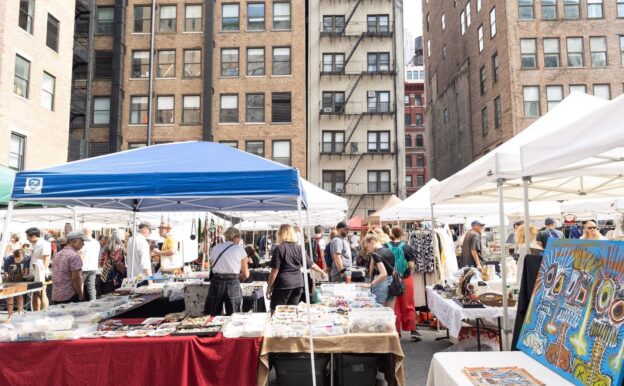
It was Saturday, a sunny and unusually warm day, the first day of spring, and I wanted a break from the endless immigrant rights meetings, the sign-making prep for No Kings 3, the bleak New York Times, Free Free Free Palestine, the strictly correct Guardian, the internet in general. I wanted the buzzy, soothing, wacky, shopping of a good flea market. I went to the one in Chelsea, at 25th and Sixth.
It’s got tables and tables and tables of costume jewelry shlock, beads, African masks and strange bric-a-brac from unspecified folk-art countries (when I visited a year ago and I picked up a great set, cheapo, of Tonala piggy banks from Southern Mexico). The Chelsea flea also has weird old LPs, amateurish erotica drawings, dead people’s stamp collections, and unidentified family scrapbooks whose long separation from the families they memorialize makes you want to cry. In one, from the late 1930s, I saw photos of a woman who looked exactly like a good friend of mine. I was considering buying it to gift to her but started thinking that for her to see her doppelganger from 90 years ago, someone she’d likely never be able to identify, could evoke emotions in her for which I did not want to claim responsibility. I put the scrapbook down. At another table, a middle-aged white man wearing Hokas, who looked to be from Westchester, was trying on a long, red priest’s robe as his wife, of similar sociological habitus, stood by, smiling. A cute young woman passerby told the man he looked cool in the robe. He looked delighted and laughed.
Then I saw the coat.
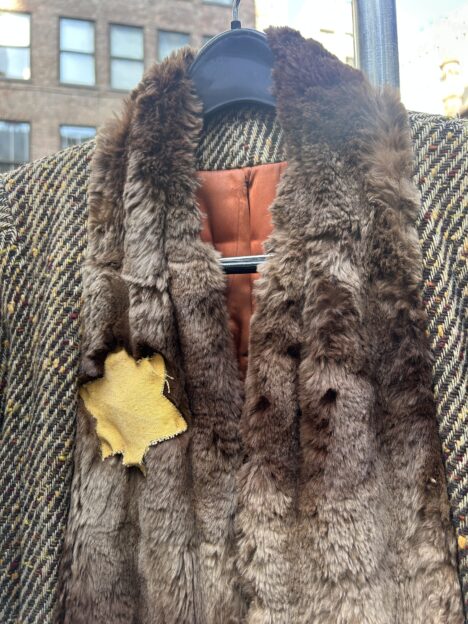
It was one of many women’s vintage coats and the first one on the rack, so the cloth star was clearly visible. A faded, frayed yellow star, sewn in the front on a lapel. The coat was a beautiful weave, wool, trimmed generously with genuine beaver fur. It looked old enough to be what I thought it was. I looked at the back. Near one shoulder was another frayed star.
A day after this happened, I was still ashamed that the first thing that came to my mind was the scene in “Zone of Interest” where the wife of the commandant of Auschwitz locks herself in her bedroom and twirls around in a full-length mink that she has acquired from the camp’s storeroom of goods confiscated from all the Jews who’ve been gassed. And then she sits at her vanity table and primps with lipstick from a tube she has fished from the pocket of the mink.
And then I did the exact same thing with the flea market coat, but as soon as I stuck my hand in, I felt nauseous.
Though the pocket was empty.
“What the fuck why isn’t this coat in a museum?” That was my second impulse: a silent thought impulse, intellectual not amygdalar. “Surely I’m not the first person to have seen this coat!” I continued thinking. “Why hasn’t someone bought it already and figured out something to do with it? This is New York City for chrissake…Hmm I wonder what it costs?” I took photos on my phone.
But I’m a journalist, and my craft finally kicked in: “Right now, what do we actually know about this coat?” I opened it and looked for a label. There it was, in silky, woven letters. They said that the manufacturer was “Sportowne,” a company in the United States.
Huh? Well, maybe rich women in Berlin before World War II bought clothes imported from America?
I googled the company, plus Ebay and Etsy. Yes, there were vintage coats from Sportowne. But they did not date earlier than the 1960s or 1970s.
By now, another woman had her phone out. “This is so troubling,” she said as she snapped away.
I started looking for the person in charge of the coat collection.
I found him at another rack, which had vintage women’s dresses. He was a light-skinned Black man just leaving middle age, with a strong Manhattan accent. He was being cheerfully aggressive with a young, blonde woman who was fingering a skimpy, yellow summer frock that was backless and made to tie in front. Her interest in the item was flagging, and the man kept trying to get her to commit. “Come on! Name a price! Let’s talk! Talk to me!” She kept holding back, and I was losing patience. “Um, can I ask you about a coat?” Like a dog involved with chasing a car, he ignored me. The young woman finally offered $15. The offer was quickly accepted, then the salesman was ready for me. I asked again about the coat “With the … umm … yellow stars on it. Is it what it … looks like? Where did it come from?”
“It’s been upsetting some people,” he said casually. “Even cursing and demanding it be taken down from the rack.”
“I bet! What’s the story?”
“Oh yeah well that whole rack there? It’s all costumes from a movie set. We just got them yesterday. Just put that coat out today. I don’t know. It’s got some people really angry.”
As he explained this, a few other people began gathering, including a short, swarthy guy in early middle age who had too much hair on his face and too much product on his pate. It turned out he owned the racks and the Black guy was his salesman. The sales guy took this opportunity to explain to the boss that the coat was upsetting people and maybe it should be dealt with. “I told her it’s a costume,” he said, gesturing to me.
At first the boss seemed surprised, but only for maybe five seconds. It then seemed to occur to him, also with amygdalar rapidity, that the coat might be much more valuable than he’d first supposed. He began readjusting.
“Yeah,” he said, “it’s a costume. But then, maybe it’s real? I mean, we don’t really know, right? How do we know it’s not real? It could be real. Even probably. You know?”
“Nah, it’s part of the movie stuff,” the salesman countered, and people drifted off. For the boss, however, the two frayed, yellow symbols were now overlaid in his flea market imagination with two crisp, gold symbols: $$. The men continued to vaguely and quietly argue, with little more emotion than if they had been economists at the Federal Reserve weighing the advantages versus disadvantages of raising the interest rate. I left as their disputation continued and wandered to a table selling beat up old watches.
***
Debbie Nathan lives in Brooklyn now, used to live in Manhattan, and has been checking things out in the neighborhoods, sometimes for Mr. Beller, for about 25 years.
Haunting flea market find, but I can tell you that yellow Star of David (makes me think of the yellow rose of Texas) is waaay too big to be a true Holocaust era yellow Star of David.
But the Chelsea Flea truly has stuff that would make you think twice about the item’s provenance.
In my experience, Chelsea Flea has tons of stuff discarded from TV, movie and theatre productions. So this all adds up.
“talk to me…”
Nice piece.
For some reason I wanted more about the owner of the stuff than too much hair on his face and too much product in his hair. I couldn’t picture it. It’s like there is a suggestion of ethnicity but no idea what. But I did enjoy how the commercial considerations overtook all others.