


In 1991, Joe Chinnici, my landlord, offered me a cash deal if I would decline to renew my lease.
The top-floor apartment at the corner of Bleecker Street and the Bowery had been my home for 13 years, the longest I’ve ever lived anywhere, before or since.
In retrospect, I like to think that it was my true childhood home; it’s where I grew up and learned how to take care of myself. I’d moved in with a cheerful, curly-haired two-year-old and moved out with a gangly teenaged son.
Over the years, our flesh and tears seeped into the walls and floors of that apartment; even the building’s marble staircase that led from one level to the next was stained with our blood. I am quite sure a pink shadow, faintly outlined on the step just below the third-floor landing will still be visible years from now. When he was six, Benjamin fell and sliced his knee open one morning as he raced down the steps, late for school.
Packing was a nightmare. I was working full time; it was early May, Benjamin was busy with end-of-9th-grade school projects and sports, and my brother Mark, in Massachusetts, sick with cancer, was on a terrible course, in and out of the hospital, one medical crisis after another. I went to see him every weekend, riding the Amtrak train up to Boston and back so many times that I could recite the litany of stations through Connecticut in my sleep.
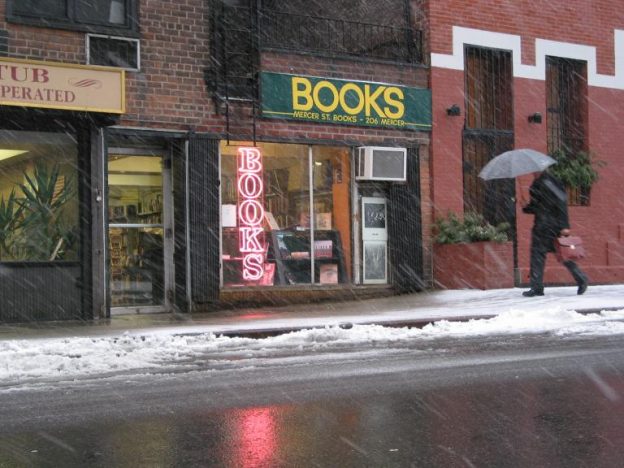
The proprietor of the used bookstore on Mercer Street came to the apartment and bought hundreds of my books. He sorted them into cartons, carried them down four flights, and took them away. The far fewer collectible volumes that I was willing to part with, such as the correspondence between Durrell and Miller, I sold to a small shop on 17th Street. I kept the photography books, the natural science, and the pop-up books that Benjamin and I both loved when he was little. I packed and kept far too many of the books that I considered lifelong friends. No questions asked; they always came with me. There were days when I mourned the loss of my books and wandered over to Mercer Street to look in the plate glass window that showcased the literary eye-candy. Once I lost my willpower and went in and bought back a book. But only once.
Having taken care of the books, I invited the guy who ran a warehouse-sized secondhand shop on Second Avenue to come over and check out what remained. He took the 1950s pinball machine, the tall enamel Hoosier cabinet, and the heavy mahogany library table that took up a third of the kitchen. That table was where we ate and watched the Mets religiously on a small cheap black and white TV I’d bought in Chinatown. We had done artwork, jigsaw puzzles, and homework on it. Bloodshed and tears and love and joy. Our favorite TV show was Fawlty Towers. Benjamin and I rolled on the kitchen floor in laughter watching it. We both loved the feckless character, Manuel.
Later, when my friend Linda’s mother Elsie, a local character who lived over Block’s drugstore on 2nd Avenue, died, Linda gave me Elsie’s color television. She brought it over one day, and said, “There, now you’ll be normal.” I thanked her profusely but did make it clear to her that it would take a lot more than a color TV to make me “normal.”
Finally, moving day came. The deal with my landlord was that I would receive the buyout money we’d negotiated only if the apartment was left completely empty and broom clean. Joe planned to come and inspect before signing over a check, so I was determined to fulfill my end of the bargain. By the end, I was utterly exhausted. The apartment was cleared of all the furniture; only a makeshift bookcase remained, constructed by one of my boyfriends from boards and bricks. I carried the boards down to the trash pile near the entrance to the building, but by then I was wiped out and just couldn’t go up and down that staircase the dozen more times that it would take to get rid of the bricks. So, I opened the window that led to the iron fire escape that zigzagged down the front of my building and carefully aligned the bricks outside on the rusted rungs, just out of sight, in case someone was to glance in that direction. I closed the window, swept out the four rooms, and sat down on the floor to wait for Joe.
***
Susan T. Landry is a writer and an editor. For life-blood money, she is a medical manuscript editor, editing articles for medical journals; and for pleasure and less money, she is also an editor of other writers’ stories. She founded and managed an online literary journal about memoir, called “Run to the Roundhouse, Nellie,” which is no longer publishing; Susan previously edited the print journal, “Lifeboat: A Journal of Memoir.” She lived in NYC for many years, and on the Bowery from 1978 to 1991. Susan now lives in Maine.
I feel deprived of the final scene when the place is inspected and the check is, presumably, signed. Was Joe a decent guy, or a jerk? Was the amount of money… well, it’s a given it was not enough. But do you forgive yourself for taking it? Do you wish you hadn’t?
But I suppose that is all a Joycean touch of ambiguity and I should take it as a gift.
Still, this leaves me feeling a bit greedy and a bit needy for more information – where do the mother and son go next? Was it the end of the New York City era or just the end of the Magic Apartment Downtown?
I had one of those. But I also had an experience that echoes this one in an entirely different city, a different circumstance altogether except for the part where a chunk of time has elapsed in a place and that era is now over, as is the place.
At any rate, the above is not a request for mere information. I hope you write the next chapter.
Even the mention of the beautiful Durrell/Miller correspondence hardly takes the edge off the grief I feel in this story.