


I took the train to school alone. My Brooklyn friends didn’t live along the 2 or 3 lines, plus I’m somewhat hostile within the first hour of waking up.
The commute was like a prolonged orchestral swell. The first leg of my trip, sprawled across a few of those ’70s sunset-toned seats, the sounds of the subway – muted by my headphones – mimicked that soft, initial tuning of a symphony. The sounds grew louder as I transferred to the 1 train at 42nd Street, crescendoing as familiar faces appeared on the crowded Times Square platform. Then, stepping onto my high school’s block: the final explosion of notes. There was always someone waving me down.
The journey home sloshed in reverse. I would exit the lobby in a sea of backpacks, my faction breaking off toward Columbus Circle. Then, along the A line, friends would flake away until I was alone again on the walk to my apartment building. That walk was like the hushed shuffling out of the aisles after the final applause.
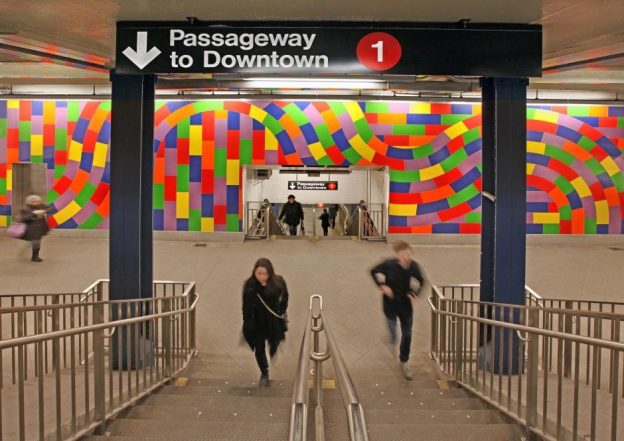
But for about ten minutes, when we were all together in the 59th Street station, my social dial was cranked all the way up. It had to be. Our overlapping debates competed with subway performers, the smell of piss and hot dog water, and a large, garish rainbow mosaic that I thought was a corny Sol LeWitt knockoff. I never mentioned that thought to anyone. I was often accused of being pretentious and was insecure about my diagnosis of the piece. But I didn’t like it.
Ten years later, I learned it was not a knockoff.
The artist Sol LeWitt was meticulous in the work’s design and installation; he couldn’t find any Americans able to produce the 250 porcelain tiles for the work, “Whirls and Twirls (MTA),” in the exact shade of the six colors he envisioned, so he ordered them from artisans in Madrid. The way the tiles shone had led me to believe the installation was a dupe; LeWitt’s famous wall drawings are – well – flat-looking.
At the time, LeWitt was the only contemporary artist I knew by name. I’d seen all 105 of his wall drawings at Mass MoCA with my parents the summer before high school. That exhibition is still there. Those works, as well as the subway mosaic, were completed just before LeWitt’s death in 2007. He had planned both projects but never saw either one.
Most of LeWitt’s work is meant to be installed without him, anyway. His art often consists of lists of directions for art students to execute. “Whirls and Twirls (MTA)” was installed in 2009. His designs are colorful, graphic, mathematical, and infinitely reproducible, though each iteration varies with the installer’s interpretation. I didn’t know much about art at fourteen, but his was easy to look at.
Except for that mosaic, which seemed off. And it’s one of the largest MTA installations in existence. I still don’t understand it. The work looks like a Waldorf toy or the carpet in a pediatrician’s office. It’s stark against the dirty subway floor and passengers. It doesn’t see natural light, it doesn’t evoke what his drawings did in North Adams, and it doesn’t feel as thoughtful as Lewitt’s other work.
LeWitt was Jewish, like me. And neither of us ever got around to getting a driver’s license. He cleared his throat too much during interviews. He rejected minimalism but was obsessed with lines and stuck closely to the rules he invented. I like to imagine him egoless, but not to the extent of not having anything to say. “Whirls and Twirls (MTA)” doesn’t say much. Or perhaps I’m not ready to see it. Maybe I spent too long staring at it, believing we – the mosaic and I – were impostors together.
***
Violet Piper is a writer and camp professional from Brooklyn. Her debut chapbook, “This is What They Said It Would Be Like,” was published in 2024 by Bottlecap Press.