


I’m sitting in Straus Park at 107th Street, where Broadway bifurcates. No need for alarm about this. Things created by God bifurcate. Adam would have been just another lonely guy moping around Eden if he hadn’t bifurcated after Eve stepped out of a dream and into his life.
Directly across Broadway is The Garden of Eden©—the supermarket, not the earthly paradise. There’s not much that the two gardens have in common, save for the fact that both are out of business. If you’re not too busy scrolling or texting or bifurcating or whatever, you may recall that God tossed A&E out of the original Garden of Eden because they ate an apple while hanging around the Tree of Knowledge. It wasn’t a Macintosh apple because God had not yet invented Scotland. And it wasn’t a Granny Smith, unless Adam and Eve had a nana that the Old Testament forgot to mention. So, I’m gonna guess that—considering how those two crazy kids couldn’t resist chomping down on it—it was a Golden Delicious.
Anyway, the first couple, egged on by Satan to eat the fruit of the Tree of Knowledge, suddenly realized that they were stark, raving naked. Now you’d think that as soon as Adam & Eve realized this, they would—like any hot, young couple who were taking a permanent gap year—fly down to Daytona Beach, book a room at a Best Western and bifurcate day and night till they passed out. But no! What happened was—as soon as it dawned on them that they were nude—they were assailed by two of God’s all-time greatest creations: SHAME and GUILT.
Meanwhile, seeing—in his typical all-knowing way—all this mishegoss going on right under his nose, God fell into a very bad mood. We’ll never know why, since, as we can clearly see in the Old Testament, he’s the kind of supreme being whose invariable answer to questions is “Because I said so, that’s why!”
God—realizing that Adam and Eve had disobeyed him—waxed wroth, filed the papers, and evicted them from Paradise. Then he boarded the place up, and, because he couldn’t let anything go, he also caused Adam and his sons-in- perpetuity to live by the sweat of their brows and work 24/7 like a dog—a creature he created just so that Adam would have to walk it three times a day, even if it was raining or freezing cold. God also caused Eve and her daughters-unto-the-end-of-time to bear children in great pain, and finally—as if all this wasn’t enough—he caused them both to have to buy special orthotics to treat recurring foot pain (which he also created).
As for the current Garden of Eden©, the supermarket—whose lifeless boarded-up windows I see from my bench in Straus Park—they didn’t violate any of God’s 2,698 commandments, laws, directives, rules, and daily tips for living. The one law they did break—the most important one (at least in New York City)—was that they couldn’t pay the landlord!
This law, according to most biblical scholars, preceded the more famous ones, aka The Sinai Directives (soon to be a Netflix miniseries). These Ten Commandments are the ones that resulted in the creation of the super-ego and have caused millions of people to go into therapy—and that’s just in New York City.
God, who when you think about it was the original landlord, created the real first commandment to read thusly: “Thou Shalt Always Pay Rent on The First of the Month, No Matter How High The Landlord Jacks it up, Even if You’ve Recently Been Laid off or Live on a Fixed Income.”
So, The Garden of Eden© supermarket is now permanently closed. This was a place that fed thousands over the decades and provided a living for hundreds of men and women (many of them poor immigrants). Its storefront was only fifty feet wide but added to the other extinct businesses up and down Broadway, its demise is a tragedy—one more yawning crater in the increasing economic and social no-man’s-land of Broadway.
When walking by these dead areas, I feel a chill. Every boarded-up, security-gated zone of emptiness represents someone’s shattered dreams. These vacant spaces now attract helpless, lost, down-and-out men and women who wander the city like sad ghosts. They lie wounded on the sidewalk; wrapped in old, raggy coats and filthy blankets, huddling against the boards and bricks, waiting—or having given up waiting—for a miracle that never comes.
In the meantime, I sit on this bench in Straus Park, trying to come to terms with my own mortality and watching, with untiring fascination and a surprising surge of affection, the parade of people passing by—the old and the frail, wobbling along with their canes; the twisting, skipping, jumping children, and all the rest of humankind, talking and texting, hurrying and worrying, on their way to some urgent appointment.
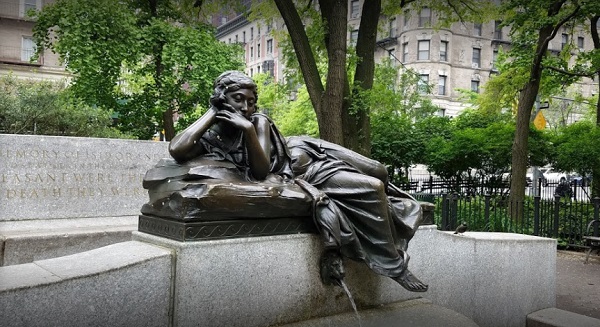
Straus Park—a very small wedge of territory—is filled with greenery. In the midst of this curated forest are a small, jewel-box garden, a bubbling fountain that doubles as a de-facto birdbath, and center-stage, a wonderful bronze statue of a beautiful young woman in repose, lost in a state of eternal reflection.
The park is dedicated to Isidore and Ida Straus, who perished when the Titanic went down in the North Sea in April of 1912.
This is how their story goes. When the ship was sinking, only women and children and the elderly were allowed into the lifeboats. Ida Straus, then sixty-three years old, could have gotten into one of the boats but chose to remain on the ship with her husband—knowing that they only had a short time to live. They had been married for forty-one years, enjoyed much success, and had brought up several children. Reviewing the stark choices presented to them, they chose to stay together and die as they had lived, in devotion and enduring love.
It’s early morning. There’s a chilly breeze, so I’m wearing a light jacket. I sit on the bench, my soul increasingly entwined with the day-dreaming woman in bronze at the other end of the park, the chirping birds, rustling leaves, and cooing doves and pigeons, pecking around for crumbs.
People pass by—some nodding, some smiling (is it the Mets cap?). Several people are walking their dogs. At this early hour there’s not a lot of traffic, so Broadway is relatively quiet.
I fall into a reverie. Most of my musing is focused on the past, since I don’t have a lot of future, and the present—with its pains, procedures and pills—is not very inviting. I’m not Isidore or Ida Straus, but I have known love in my life; love that sometimes descended like a miracle, rescuing me from despair; love that broke me out of my self-created prison and invited me to love in return.
Looking around this beautiful little park I don’t see lions lying down with lambs or naked people, snakes, or apples. But there is a flowing cornucopia of flowers, birds, dogs, babies and kids. Even the grown-ups seem to soften and breathe easier as they walk through the park. There’s a lot in life I don’t have, but for the time being there is this bench and the time and space to consider the strange journey of my life. This is my Garden of Eden and I’m grateful for every inch of it and for every minute of time it offers me.
***
Mike Feder is a retired radio personality and talk-show host. He worked on WBAI and WEVD in New York City, then later on Sirius-XM Radio and PRN.FM. He has performed his autobiographical stories at colleges, nightclubs and theaters.
His stories and cultural and political essays have appeared in The New York Times Magazine and Harper’s Magazine. He is the author of “New York Son,” “The Talking Cure,” and “A Long Swim Upstream.”
He has two grown children and lives with his wife on the Upper West Side of Manhattan
“Now you’d think that as soon as Adam & Eve realized this, they would—like any hot, young couple who were taking a permanent gap year—fly down to Daytona Beach, book a room at a Best Western and bifurcate day and night till they passed out. ”
Great visuals!
A poignant but also wry and funny elegy for this one particular stretch of Upper Broadway and for the casualties of our brutal economy. Thanks, Mike, for seeing the beauty “among the garbage and the flowers,” to quote another scripture-besotted bard.