


What is it with guys and guns? Do you think it’s just the sexual association? The constant media din about “being a man”? Too many John Wayne movies? Who knows? I can only tell you what made me a fan.
Guns were anathema in my father’s home. On the Pale, marauding Cossacks used guns to shoot at him and his family. Guns were for the goyim. Not even the ones made of liquorish were permitted under our roof.
Yet the cutest picture taken by my amateur photographer father, the one that was passed around when people asked, was of me as a 5 year old in full cowboy regalia, with a six-gun holstered to my side and the beginnings of a sneer contorting my freckles; the pose inspired by the broadcasts of Mutual Radio, which, three times a week, advised that “out of the past the thundering hoofbeats of the great horse Silver” approached and “The Lone Ranger [rode] again!”
It was 1943. We were at war, and guns were everywhere. My friends and I couldn’t get our hands on an actual firearm, but we would do battle almost daily in our Brooklyn apartments, chasing the guy who played the Nazi or the Jap, from room to room. We fired imaginary pistols formed by our extended thumbs and index fingers to “plug” the craven bastard. When one “shot” his “gun” it was necessary, first, to move one’s thumb toward one’s index finger to make clear the “shot” had been fired, and, simultaneously, to make a shooting sound. The least imaginative among us simply yelled “bang”. The more theatrical made a sound something like “puuuuuuch” with the back of one’s tongue pressed into his pallet, like my grandmother spoke all the time.
1943 was also the first year my parents could afford a summer place out of the City. People were desperate to escape New York in the summer because of polio epidemics. We rented a tiny bungalow only 30 miles away, with a lake, a communal well and a day camp. It was at that camp I met my first love, Leila Cherney.
An 8-year-old red-head with pigtails and a mass of freckles in place of a face, Leila’s folks’ bungalow was behind ours with a small apple orchard between. Every morning we walked together, sometimes hand in hand, to the glade around the well where we and about 10 other “Robins” gathered for the camp day. There we were read stories, played tag, ate cookies with milk—always accompanied by Prokofiev’s Peter and the Wolf, danced, and returned home together. Best Friends.
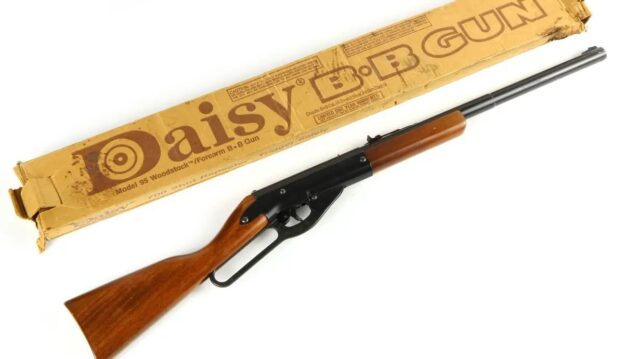
But even in Arden news of the war intruded, and my friends and I continued to wage mock gun battles. One evening I ran to Dad with a big request: it was time for a real BB gun. I had seen an ad in the New York Post the night before for a “Daisy rifle” that pictured a boy surrounded by his approving family happily knocking tin cans off tree stumps. The inference was clearly that this was a very “American” thing to do. The ad led to several weeks of persistent whining. Even my brother, Joe, a serious boy five years my senior, joined in begging for the gun. It was so against my father’s grain that it took almost of month before he relented. Then, one day, he emerged from his car with a box reading Daisy Air Rifle. What a dad!
At first, it seemed to be my brother’s gun, he used it so much. I didn’t care. We spent all our after-camp time shooting at cans and, when that paled in interest, at squirrels, and, when that became tedious, at rocks. But, gradually, none of it stayed interesting. Before long we shot only intermittently, then not at all. We’d run out of targets. The gun lay collecting dust in our closet.
One September night I wandered out on our back porch, alone and bored. A lamp shone in Leila’s bungalow about 150 feet away, where she sat with her back to me, illuminating the outside of her home and the flowerpot on the windowsill below her. I thought eagerly: “I’ll shoot that pot.” I knew it was safe because, except for her head, which was a 3-foot distance from the pot, Leila was entirely covered by her high-backed chair. I felt giddy, suddenly, with the prank’s potential. I could brag tomorrow about the “danger” that had been avoided with my expert marksmanship, bask in Leila’s pride at my handling a gun so well, and share giggles with everyone when I fessed up. Walking back into the bungalow, I got my Daisy, loaded it, and returned to the porch tingling with excitement at my brilliant plan.
The evening was so quiet. My own breathing seemed cacophonous. I took aim at the pot, but my sighting wavered and I couldn’t draw a steady bead. So, I placed the gun on the railing and bent to aim again. After a second or two, I had the pot lined up perfectly and squeezed the trigger ever so gently, as I’d been taught. The report punctuated the silence. THWACK! Leila certainly heard it because she immediately stood and walked away. I remained on the porch several minutes trying to confirm that I’d hit the pot, but to no avail. It didn’t matter. I knew I’d done a powerful thing.
Chortling, I returned the gun to its closet and joined my family in our living room. By 9 p.m. I was in the bedroom shared with Joe, fast asleep. What awoke me were the lights: red and white revolving unevenly on the wall. I jumped from bed and ran to the front porch. In the yard was a police car with rosettes twirling around its roof. My father and mother stood in a huddle with two agitated people, and two formidable state troopers. My brother was off to the side with someone I couldn’t place, until I peered for a longer moment and recognized Leila, with a huge bandage swathed around her head.
Grasping what had happened, I ran back to the bedroom and flew under the covers, head and all, thinking somehow, no one would find me in the sanctuary I’d created. I lay for a moment, invisible and safe… until my brother came in and pulled the covers off me.
“You’re goin’ to go to jail you jerk, and you deserve it.”
“I didn’t do anything.”
“Right, except shoot someone in the head, schmuck. You should see what you did. They’ll get you this time!” He slammed the door behind him.
Now a fearsome silence enveloped me, then accused me, prosecuted me, and judged me. I’d shot a person in the head! Would the police arrest me? Would my parents renounce me altogether? Would I have to live the rest of my life in a reform school with all those tough kids I’d seen in the movies? Would Leila speak to me again? I prayed. If I could only get out of this fix, I’d be good. But the room stared back: mute, punishing.
An eon later, my mother and father opened the door. Father looked at me with disgust, BB gun in hand. “So, you wanted a gun? Good, you’ll never see this one again! Do you know what you did? You could have taken out an eye, or worse, killed her. What got into you? Do you know the Cherneys can sue us?” Turning, he stomped away with the gun, the gun I, indeed, would never see again.
Mother was teary and took me in her arms. If ever I needed her, it was then. She embraced me and stayed, without a word. Eventually, through the door, I saw the police car leave, as did Leila and her parents. Were they going to look for an electric chair?
I didn’t go to camp for two days, afraid to bear the humiliation and disapproval I knew lay there since, by now, the entire bungalow colony must have understood what a thorough reprobate I’d become.
On the third day my mother convinced me to return. I dragged myself to the glade by the well, circuitously, so as not to bump into Leila. Arriving very late, the Robins were already scattered on the grass listening to Peter and the Wolf and eating snacks. I greeted no one, kept my eyes on the ground, accepted my snack without a word, and sat down apart from the group, miserable and repentant, but with no-one to repent to. Long minutes later, when the story got to where the bird flies into the tree to escape the wolf, I felt a stirring. I looked up. It was Leila. Sitting down next to me, her red hair interrupted now only by a small band-aid, she leaned into me and offered an Oreo. “You know this flute part is my favorite,” she smiled. I made up my mind, then and there, to love her forever.
***
Norbert Weissberg is a resident of East Hampton, New York and a student in the memoir writing class offered by the East Hampton Library under the direction of noted journalist Andrew Visconti
The first part of this was interesting to me because though I am of a different generation I was smitten by guns in a similar manner, complete with the John Wayne influence, though in 1943 it would have been the start of his run and by the time I got to him, with True Grit, it was the end. The object of my affection was also a BB gun. Did this continue for… another decade or two? Does it continue to this day? Is this BB mythology something that affects all young kids, or especially American ones? (I know the cowboy myth is potent and global, though who knows maybe it has waned.) But what I really want to ask is: were the little Jewish boys most susceptible of all to attractions of the BB gun?
At any rate, all of that was interesting in an academic sort of way, but the way the story settles into the drama of scene is just great. So many strong echoes of Roth (Conversion of the Jews) and Salinger (I forget in which story Seymour Glass throws a rock at a girl because, he explains, she was so beautiful… Raise High the Roofbeam, it turns out. “He said that she was so beautiful he had to throw a rock at her.”)
The ending, though… I felt a pang of love for Liela. Love and… gratitude!
P.S. Further reading in the genre: The Target Audience in Robert Bingham’s Pure Slaughter Value. Originally in the New Yorker. No Jews in that one, though.
Very nice story. Very charmed by the “Peter and the Wolf” references.
And the overall path with the BB gun is reminiscent of the classic film noir “Gun Crazy.” But in that film, the protagonist ended up killing a bird with a BB gun; the target of your affection survived the ordeal with a band aid and forgiveness.
Wonderful story!