


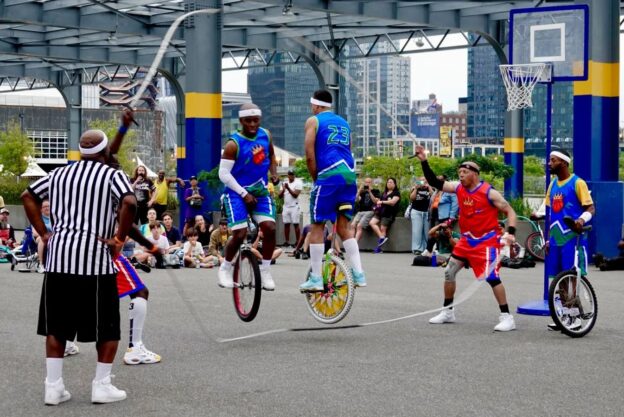
As Diana held the back of the seat, I hoisted my butt onto the unicycle and tottered up Broadway towards Needle Park. Pump, pump. Wobble, wobble. Diana would let go and run along beside me. Wobble, wobble. I would feel the narrow saddle slip between my thighs, then fly out behind me. I’d jump off quickly and try once more, before giving Diana a turn. It was her unicycle and her idea to practice on the street after work. Most passersby ignored us, but a few laughed or cheered as we worked on perfecting our skills. We’d go almost as far as the dangers of 72nd Street. If it was raining, we’d ride up and down the narrow hallway of our flat on West 68th, our hands skimming the walls for balance.
We were college students, sharing, quite illegally, a scruffy apartment with several others on the then scruffy Upper West Side. This was the 1960’s, before all the pain of the decade. Right before JFK was shot, before we lost Martin Luther King, before the full-blown horrors of Vietnam. A golden time, in a way, at least, for eighteen-year-olds alone in Manhattan.
Oddly enough, our college was located miles from New York at Antioch College, in Yellow Springs, Ohio, a left-leaning hub of experimental education. It was unique in that every three months we students departed the bucolic cornfields and beloved campus to head somewhere in the world for a “co-op” experience—a job or volunteer position—which allowed us to explore life beyond the classroom. Guanajuato, Stuttgart, California, medical centers or corporate offices, theaters or chicken farms….no place was off limits. And in time, we built up eclectic resumés and life lessons that would serve us well.
But for this three-month gig, some of us had chosen Manhattan. And we were on our own. No parents. No dorm rules. Just a mandate from the college to learn from everything that happened to us.
The five of us all had jobs obtained though the Co-Op office at Antioch. Diana worked in a hospital, as an operating room attendant; one of the others was a nurse’s aide; and two worked in schools as classroom assistants. I worked for UNICEF, with probably the ‘cushiest’ job of all of us. By day, we got decently dressed, rode the subway, learned to navigate adult offices and institutions and protocols. But at night and on weekends, we were free to love New York like children.
The unicycle proved to be a great way to experience west side city streets and the variety of humanity that roamed them.
We met a man who walked an imaginary dog and a girl who walked on her hands. We traded stories with tap dancers and burlesque queens. We met stagehands from the Met and an octogenarian who kept a parrot on his shoulder. Those were the kinds of New Yorkers who bothered to stop and ask us questions or encourage us or tease us. The more conventional citizens gave us wide berth. Through it all, we learned to respond fearlessly to comments and jeers and got adept at ignoring unwanted attention.
More than once, we’d run into the guys putting up gigantic Broadway billboards. We’d stop unicycling long enough to watch them work, sloshing some kind of gluey material onto a wall, smearing it around, then seamlessly extending the huge paper onto the surface. Our favorite was “Stop the World, I Wanna Get Off.” Once we cajoled a worker into giving us a big dry billboard of that show, along with a milk carton full of glue. We peddled home to stick the poster on the wall of the apartment, not thinking that we’d eventually lose our security deposit when it wouldn’t come off. Stop the world, I wanna get this poster off, we joked. We were giggly because we were eighteen and everything was still funny. It was all a learning experience.
We weren’t great tenants. Somebody’s father had signed the short-term lease for us. For two of us. But we were never fewer than five, not even counting our visiting boyfriends. The flat was on the ground floor and consisted of four rooms aligned like railroad cars, although it boasted that added narrow corridor which served as a unicycle track. There was an airshaft between our place and the next building that was so narrow one could almost reach across and shake hands with the neighbors. We didn’t know the neighbors, of course, but one day, a visiting boyfriend was yelling that he couldn’t find any salt and the stranger next door threw a canister of Morton’s across the airshaft and into our apartment. Since the building was overheated, we always kept the window open. The salt landed upright on the sturdy Amana refrigerator box we used as a kitchen table.
Because we were only staying for three months, we furnished the apartment in a minimalist style. I found an empty wooden cable wheel on a nearby building site. We assumed it was free for the taking, although in hindsight, I’m sure it belonged to Con Ed. We rolled it down the sidewalk with a little help. That night we were walking, not unicycling. The wheel might have come from the urban renewal area near the newly completed New York Philharmonic Hall at Lincoln Center. It made a good table, although a bit low. We eventually recycled the Amana box into a kind of sideboard.
Next door to us lived a menage à trois. We didn’t know those folks but we knew details of their lives because loud noises came through the walls. We found their daily existence alternatingly titillating and tragic. Eventually one of the men stabbed the other. That night, Diana and I stayed out later than usual and unicycled, with most of the other roommates coming along too. No one felt comfortable back in the building after the police questioned everyone in the vicinity. Death could happen in a flash, right next door. This was not the movies. It somehow felt safer to be out on the sidewalk of Broadway, comforted by the sounds of shrieking ambulances and lulled with the smell of hashish.
We never got good enough on the unicycle to use it as a means of transportation. If we wanted to go down to Night Court in the Battery or ride the Staten Island Ferry, we were dependent on the subway, like everyone else. But Diana and I became a fixture on that half mile of Broadway. We liked it when people yelled things at us like, “Don’t quit your day job,” or “Get another wheel.”
I guess having people yell at us made us feel seen in an anonymous city.
We often talked about what we would do after we graduated. Everyone had dreams. But Antioch was a five-year school, and graduation was a long time away. Some of us swore we’d come back, pursue interesting careers, and have fabulous Manhattan apartments with real furniture and without a unicycle. But we never did.
***
Gabriella Brand writes fiction, poetry, and memoir in at least two languages. A Pushcart Prize nominee in both fiction and poetry, her goal is to be published in all the countries of the Commonwealth. She teaches in the OLLI program at the University of Connecticut. gabriellabrand.net
I have escaped the present and am thrilled to spend this time in NYC with you, learning how to ride a unicycle and be young again, filled with the glee of first apartments, buoyant friendships and adventure floating around every corner.
Hilarious reminiscence!
I miss the days of seeing casual unicyclists in NYC. I remember one guy who walked his dog and got his morning coffee AT THE SAME TIME via unicycle in Park Slope near Boerum Hill about 10 years ago.