


“Hey, girls!”
Brandishing a lit cigarette, a guy in an army jacket beckoned my friend Robin and me. He was leaning against the wall of a warehouse near an elevated subway station in Queens, a few stops outside of Manhattan. Our new boss.
I’d been hired over the phone the previous day, after answering an ad in The Village Voice. It was January 1969. I’d just moved to New York City, a twenty-year-old girl from Ohio, impatient for a new life. Robin had escaped Kansas City to join me.
The man on the phone said the job was in sales. That sounded professional, and I imagined working in a sleek office tower like the ones I’d seen in midtown Manhattan. I told him that I had a friend who was looking for work as well.
“Bring her,” he said, wasting no words. He gave me an address and instructions to show up the next morning at 9:30.
We had temporary digs at an affordable hotel near Grand Central. The desk clerk told us the address was in Queens and that we could take the nearby subway.
“You want the #7 train,” he said.
I was excited to see the city outside of Manhattan. On a family trip to New York, when I was 13, I had begged my parents to take me to Brooklyn.
“Why do you want to go there?” my mother asked, with a dismissive wave of the hand. “There’s nothing but houses.”
Yes, but those houses weren’t in Ohio. They were different. People lived different lives in New York City houses. Not Ohio lives.
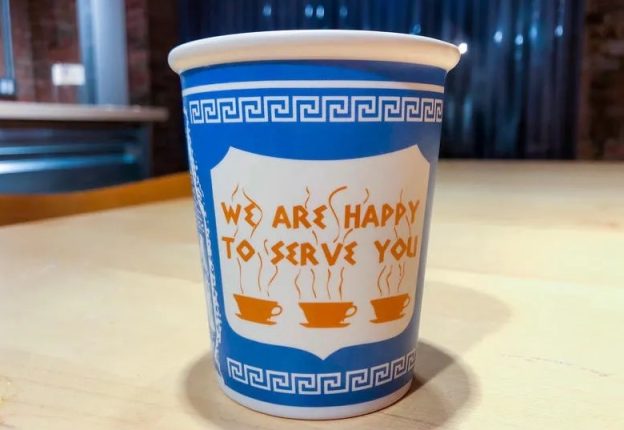
On our way to the station, I suggested we stop for coffee. I was eager to have my morning brew in the blue paper cup I’d seen the real New Yorkers carrying as they speed-walked to work during rush hour.
The woman at the counter seemed to be awaiting further instruction after I said, “Coffee, please.”
“You want regular?” she asked impatiently.
I nodded. I had no idea why I’d want anything but regular coffee until I took a sip and learned that “regular” wouldn’t get me black coffee in New York.
“I’d never have guessed it meant ‘with milk,’ I complained to Robin. “It doesn’t make sense.” Still, I was proud to now have this insider information.
When we arrived on the subway platform and saw people hustling on and off the arriving trains, I panicked. They moved so fast, and the doors snapped shut so quickly, without regard for the passengers. Would I get caught in their jaws?
On the train, I watched out the window at the rapid passage of tunnel walls and was startled when we emerged outdoors onto an elevated track. I stood near the door, watching for the right station, ready to hop off, and was relieved to exit without incident.
Outside there was a concrete landscape of factories and warehouses that seemed to stretch for blocks. There were no sleek office towers. With the help of a passerby, we found the address we were looking for and the guy in the army jacket.
He knew our names, but he didn’t tell us his as he handed us envelopes and a list of addresses.
“You,” he said to me. “Go this way.” He pointed to a side street where I saw a row of squat brick houses that were attached to one another and stretched down the street like a chain of paper dolls. He pointed Robin in another direction.
The envelopes contained order forms and brochures touting a Brittanica knock-off. The sales job was door-to-door, peddling cheap encyclopedias. Our pay: commission plus “expenses,” which he’d give us when we rendezvoused at the meeting spot at the end of the day.
After arriving at the block of houses where he’d pointed, I stood still on the sidewalk for a moment, allowing my vision of a professional job to evaporate into the Queens air. Then I gave it a try, ringing doorbells and talking brightly to the weary women who answered. I told them an encyclopedia had helped me produce grade A schoolwork.
“Then why are you doing this?” I imagined them thinking.
By lunch time, when I met Robin as we’d arranged, I hadn’t gotten any interest, nor had she. The day was overcast, and the air carried a deep chill. My body was rigid against the cold.
We left the envelopes on the sidewalk where we’d met our boss and climbed the stairs to the elevated platform to return to Manhattan. As we waited for the train, I looked out past the warehouses at the rows of narrow houses, huddled close. They were different. They weren’t Ohio houses, and the office towers were mere subway stops away.
***
Fredda Rosen is a non-fiction writer whose early work appeared in the Washington Post, Cosmopolitan, and the Philadelphia Inquirer, among other publications. She took a thirty-year detour from the writing life to lead a nonprofit organization and is thrilled to be writing again. Fredda lives in Morningside Heights with her husband and a large tabby named Monsieur.
“Brandishing a lit cigarette, a guy in an army jacket beckoned my friend Robin and me.”
Great line that lets you jump right into this. Is this fishy? Hell yes! Great piece.
Thanks so much, Jack!