


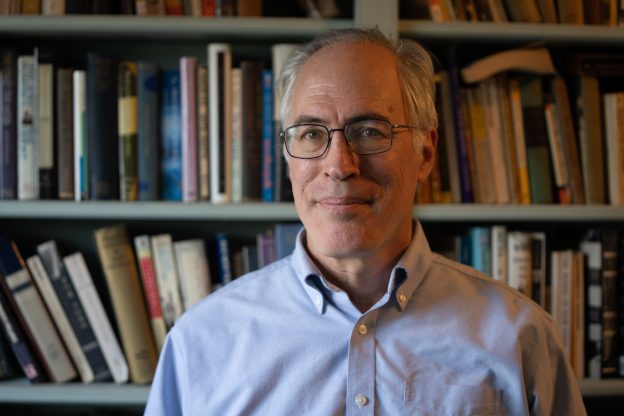
(This essay is adapted from a talk given by the author on May 28, 2025, at the Salgamundi Club at an event celebrating the 25th anniversary of Mr. Beller’s Neighborhood.)
In 2012, I was in a bar with my friend John O’Connor. His 2024 book The Secret History of Bigfoot got some rave reviews. You should read it.
Anyway, after a couple of drinks, we commenced discussing a story he had written, a work of self-flagellation about his hypochondria and a doctor who mixes up his medical records with that of another patient; and a story I’d written about the transformation that happened between the 1970s and ’80s in the neighborhood in which I’d grown up and a charismatic childhood friend, a kind of superhero, felled by his demons, not the least of which was drug addiction.
After the mutual obligatory words of praise and encouragement, John said, “You should submit your story to Mr. Beller’s Neighborhood,” which he explained was a literary site consisting of nonfiction stories about New York. He said it belonged to a former professor of his at Columbia, a guy named Tom Beller.
When I went home, I looked up the site. Back in those days Mr. Bellers’ Neighborhood had a map that showed the location of each story. And I immediately found a very short story that had taken place on my block in 1972, when I was 12 years old, called The Dynamite Brothers Meet The Slapper. It perfectly captured the block and a frightening street gang that had terrified us. It was the first time, and the last time, I’ve ever seen anything written that mentioned the gang. The hazy, marginal ambiance of the block was all there. “The Dynamite Brothers Meet The Slapper” by Snooder Greenberg. 393 words of deranged magic. And starting with that, I was hooked.
So I submitted my own story, and it was published, and then I wrote another and another, and over the next five years I had a little repertoire–short works of memoir. I’d done a lot of newspaper writing and published essays and book reviewing, but it gave me great satisfaction to have these particular stories and essays published. They were important to me.
At some point, an email correspondence between myself and the mysterious Mr. Beller developed. It turned out that we were both basketball freaks. The city game was a shared calling. And although he’s a few years younger than me, we had a series of connections—friends of friends. An impossible New York character Ricky Powell was a mutual acquaintance. I’d been friends with Ricky as a kid; we were both regulars at the 14th Street Y. Much later, after Ricky and I lost touch, Tom had gotten to know Ricky, who was by then a talented street photographer who spoke in his own invented street patois, something between W.C. Fields and Jimmy Cagney, updated for the 21st century. When Ricky died Tom encouraged me to write something about him. You can look it up on the site: The Life and Times of Ricky Powell.
In 2018 I noticed the website had become rather quiet. Then, for a couple of weeks, due to technical problems, the site went down entirely. I wrote to Tom and asked what was going on, and he mysteriously suggested we have lunch. We’d never met before. So, we went to one of my favorite Japanese restaurants—Sakagura, if you want to know. He was 20 minutes late. But other than that, we hit it off, and Tom asked me to take over as editor. The previous triumvirate of the site’s editors had all recently moved on. I agreed and so began my stewardship of the most comprehensive literary non-fiction chronicle of modern New York on the internet.
Editing the stories on the site has been a privilege. From the start, I enlisted a friend, Claudia Weissberg, to be the photo editor and get the stories up on our creaky WordPress site. And she has been there week in and week out helping make the site run. There have been challenges, but about once a week over the past seven years we’ve published a new story, usually on Sunday.
So, how about the stories from these last seven years? We’ve had good ones from writers as young as 19 and old as 92. We’ve published pieces from all five boroughs and from neighborhoods that most New Yorkers have never stepped foot in. We’ve had stories by first generation Americans, who arrived here from the Ukraine, South Korea, China and points in between, and coming-of-age pieces by African American New Yorkers who grew up in East New York, Harlem and Bedford Stuyvesant.
There’ve been lots of stories from older New Yorkers, even older than me. Quite a few are recollections of working-class Jewish neighborhoods in the South Bronx and Brooklyn that no longer exist. These are not just works of memoir; they are historical documents. You can read them by searching by neighborhood on our site.
One writer, Norby Weissberg, remembers how his family in Crown Heights had the first TV on the block. That TV changed the neighborhood, he explains. One of his stories, about kids gathering at his apartment to watch the 1947 Brooklyn Dodgers facing off against the New York Yankees in the World Series, recalls the acute embarrassment he feels about his father, a Galician man raised in Orthodoxy, who lacks even a basic understanding about baseball.
Some of our best stories are from New Yorkers whom E. B. White called “settlers”—Americans born elsewhere. They came to New York to escape but are also seeking something. They are pilgrims who bring a sense of passion to the city. In My First Year in New York, 1969 Angela Bonavoglia writes about leaving her sheltered Catholic world of Scranton and the wild adventures of her first year in New York.
There are transportation stories—transporting ones—that take place on the subway. Several describe epiphanies while observing confrontations. Donna Bailey’s The Bloody Stranger combines the story of the new arrival, the settler, with a realization of what she’s going to have to do to make it here. Other transporting stories are comic Odyssean tales of the writer’s attempt to get home. Bobby Sauro, after a night at the Limelight, fights his way on to the last Path train to Jersey, but that is just the beginning of his adventure in Last Call for the Bridge and Tunnel Crowd. Another transportation story of which I’m proud is Random Encounters Underground written by a subway motorman—a good friend of mine—who went by the moniker Train Operator X to escape the censure of the MTA. I’ve been bugging him to write another story because the ones he’s recounted to me in his living room are amazing.
Adventures of another sort are the subject of Prudence Wright Holmes’ hilarious story of sexual shenanigans and inhibitions in Doing My Homework at Plato’s Retreat. A grimmer, but still funny, account of sex and commerce that takes place in 1990s Times Square is Sex in the City: The Playpen by a writer who chose to use the pseudonym Madam X when writing about this period of her life.
Covid hit New York in March of 2020. For a short period about 800 New Yorker a day were dying from the virus. It killed a couple of our contributors with whom I had worked closely. A story we published by a young woman and another by a much older man explore urban notions of outdoor space in the time of pandemic. Sara Krowlewski’s In Paise of Rooftops, finds apartment building rooftops are a palliative. In Nostalgia for the Norm, Peter Wortsman longs for the sounds he once loathed—car horns, the thump of construction and the clink and clang of business as usual.
Some of our authors have contributed original and valuable reporting. John Paul Carillio, in Sick at Work at Amazon, described unsafe working conditions that he and others were subjected to at an Amazon warehouse during the height of Covid. Ted Hamm, in Louie and Me, reported on his pursuit of a very corrupt NYPD detective whose false testimony has resulted in the wrongful imprisonment of scores of New Yorkers.
Over the last seven years the site has been sustained and has survived only because of contributions from regular contributors: Susan T. Landry’s tales of the 1970s Bowery, thrift store consolation, and the melancholy of an early morning on New Year’s Day, Jack Szwergold’s superb 1980s Brighton Beach memoirs, the work of the great photographer Larry Racioppo, zany Seinfeldian adventures recounted by Kelly Kreth, the poems of Dan Hubbs about his years as a building superintendent, and Mike Feder’s wistful excursions on the Upper West Side.
Our most interior stories—and it’s something I wouldn’t have expected—are the ones of our youngest contributors. Their struggles with depression, gender identity, parents, drugs and alcohol, and— for the women, at least— infuriatingly clueless and callous young men, have been a revelation. I guess if I’d spent my early 20s isolated and closed off from companionship because of a pandemic, and more than half my life surrounded by the depravity and absurdities of a social and cultural life dominated by cell phones and a political life dictated by Donald Trump, I might be down too. One of my favorite stories by a younger writer was Travis Schuhardt’s account of his interview with a college admissions officer at Columbia.
We’ve published so many good stories. It seems unfair to take note of these and neglect others that I enjoyed, but these are some that came to mind as I was writing this.
Before ending, I want to talk a little about three people no longer alive whose stories meant a lot to me.
John Reidy wrote five stories for Mr. Beller’s neighborhood in 2018 and 2019 about growing up in Woodside, Queens, in desperate poverty with a blustery alcoholic father. His stories depict a difficult childhood where cruelty was interspersed with humor, exhilaration and spirituality. All five are good stories, but check out Christmas Balls. It will lift you up. The novelist Bonnie Glover was the wife of my best friend in high school and wrote of her childhood growing up in the rough neighborhood East New York. Her lovely story Lost in Coney Island describes a summer day camp outing and her hope of connecting with her absent father, a “street man,” as she described him. Last, but certainly not least, there is my twin brother, Peter, who died of pancreatic cancer in 2022. He wrote two remarkably vivid stories, one about the very violent special education elementary school he attended from 1st to 3rd grade and another about a summer job as Good Humor man, called The Ice Cream Wars. I miss him and think about him all the time and am so happy to have his stories, and Bonnie’s and John’s.
I hope you can find time to read some of these stories, and that you’ll keep telling stories of your own and listening to new ones.
Great work, Jacob! And great work keeping this site chugging along.
I was just introduced to this community and am fairly smitten. Great reading at Salmagundi this week.
What a wonderful essay, Jacob! I was so sorry that I couldn’t be at the event, but I am very happy to have your essay. It captures the spirit and diversity of NYC and of the site and of its contributors–enlivened by your spirit as well. And thank you so much for mentioning my piece–I hope to be able to contribute once again in the months ahead.
Lovely essay, Jacob. It was a pleasure to read your appreciation of so many of the writers who are contributing to the site starting with the essay that hooked you. I look forward to reading a number of the pieces you mentioned. As a settler, I’ve been in awe of the city from day one. Still am. And, yikes, day one was many a decade ago. Thanks for giving a forum to so many of the voices that make the place what it is. Look forward to more from Mr. Beller’s. Thanks and best to ya!
I am the Donna Bailey who wrote the story The Bloody Stranger. I have since written essays and stories on my Facebook page. So many of my friends on Facebook have encouraged me to write a book, which I am now self publishing. The book is I Can Make It Here and it will feature two dozen stories about unusual experiences I’ve had living in New York City. Each story is titled and they don’t have to be read in any particular order. The Bloody Stranger is the first story in the book. Thank you so much for the shout out. It was great being published on this site.