


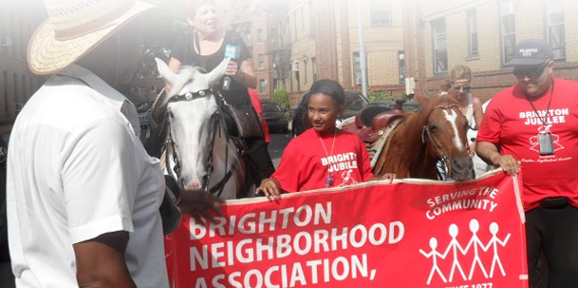
The Brighton Jubilee was a street fair started by a local Brighton Beach neighborhood association in the mid-1970s. At the time the neighborhood needed a good promotional effort — if not a friendly slap on the back— because it was, in many ways, a depressing craphole.
Unlike today’s New York City street fairs, which are cookie cutter and filled with the same vendors selling the same stuff, the Brighton Jubilee was truly a neighborhood affair. Lots of local vendors and shops set up card tables and sold whatever they could. If you kept your eyes peeled, you might find a true bargain.
On an August day, in the early 1980s, I was wandering around the Brighton Jubilee looking for cool things. I was in junior high school and still had a soft spot for novelties, pranks and magic. You know…joy buzzers, invisible ink, trick ice cubes with flies in them. And there was always at least one vendor selling that kind of stuff at the Brighton Jubilee.
As I wandered, I passed vendors selling silly string and those pop-snap things you throw on the sidewalk to make an exploding noise, but I didn’t see much else. Then, somewhere around Brighton 13th Street I stumbled across a small array of tables selling truly random — and questionable — piles of junk.
The older guy in charge, and his wife , seemed to be very nice. The main table — and the area beneath it, near it and around it — was filled with stuff that seemed to have been culled from the garbage or the left over detritus of someone’s apartment after the person passed away. An oddball array of tin cans and a mess of hardware and tools littered the ground. In the midst of all this, occasionally something nice like a small porcelain statuette could be spotted, but that was about it.
I poked around and found a small, humble array of misfit toys on a corner of the table. But none of them really interested me. When I was about to give up and move on to another vendor, I spotted a bunch of stuffed paper bags, stapled shut , that had hand drawn question marks and “$1” written on the side of each one. The sign near them explained: “Grab Bags $1 Each.”
I asked the guy what was inside and he simply said, “All kinds of stuff. Buy one and see!”
“Yeah, buy one and see!” said a friend of mine who had joined me in my street fair wandering. So, I gave the old man a dollar and slowly moved my hand over the table, trying to decide which of the bags would be mine. Soon enough, I picked one and opened it, ripping open the stapled top of the bag and looking inside.
It was a mix of junk: marbles, a few toy soldiers, some junky trading cards and a few pieces of hardware, including a fuse and electrical adapter. There was even a semi-usable ballpoint pen. It was a miniature sampling of the items this guy sold at the table, except that it was in a bag! But mixed in with the other stuff was a slightly water damaged copy of F. Scott Fitzgerald’s “The Great Gatsby.”
“Wow! That’s a good book,” my friend said. The old guy who ran the junk table agreed, “You scored a good one,” he said, as he looked at me admiring my score, while simultaneously eyeing other people who were rummaging through his junk.
“I never read this,” I said. In fact, at that point in my young life, I truly hated reading. It was always a chore and seemed — based on the way that teachers treated it in school lessons — a kind of punishment.
But this time I was actually excited to have a book. I mean “The Great Gatsby” is a respectable piece of literature, right? And this time around I wasn’t being bullied, pressured or cajoled into reading it by some miserable teacher. Instead, I wanted to read it because somehow — via luck, magic or pure randomness — I had scored the book from a seemingly worthless bag of junk being sold for one dollar.
And honestly, it was the first book — other than a few children’s books — I ever enjoyed reading.
I could write a pile of bullshit about how Gatsby’s longing for Daisy, or Fitzgerald’s depiction of wealth and the pursuit of the American dream resonated with me, but that would be a lie. There was little about the book I could relate to myself. Gatsby was a rich guy living on Long Island longing for the love and attention of another rich person living somewhere on Long Island. But the theme of the book is not what drew me in; it was the flow of the words that really got to me. The ease of the prose and the seemingly honest expression of ideas and imagery drew me in.
And I learned all this on my own. Not thanks to any teacher’s demands or assignment requirements but rather due to the pure luck of picking the right $1 grab bag full of junk at the right time from the right street vendor during a neighborhood street fair.
***
Jack Szwergold is a skilled web developer who has worked for Artforum and the Guggenheim Museum. He founded the Onion’s website in 1996 and currently works for the New School.