


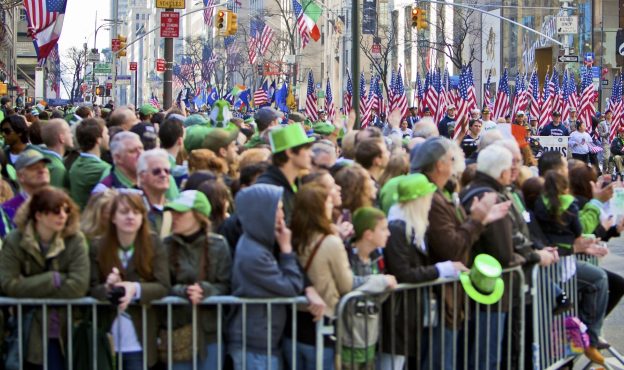
St. Patrick’s Day, March 17, 2009, promised to be another disaster for the Retail Collection of the Plaza Hotel. Hordes of green-clad spectators streamed down the escalator into the basement. Their eyes averted the luxury goods on offer, as their destination was the hotel’s public bathroom.
Within the first hour, I had given directions to the toilet over a hundred times.
“Why don’t you just print out directions,” Janet muttered.
My co-worker pulled off her glasses. Her eyes were out of focus like someone waiting to be informed by a doctor that they were blind.
“Firstly, because Americans can’t read maps and secondly, we might get lucky.”
I was wearing a leprechaun tie and a forest-green Donegal Tweed suit jacket.
“Lucky how?” Janet refocused her eyes on the parade-goers.
“Someone might buy something.”
My mother’s Irish mother had come to America at the age of 14. Nana said she was lucky, and I bet on the survival of the luckiest, instead of the fittest, every day of the year.
Today was no exception.
“Buy what?”
Janet put down her People magazine. She would take most of the week to read it. “We have no crosses, no NYC charms, no Claddad rings. That’s all these people buy besides beer.”
“Nothing wrong with drinking beer.” My grandmother had brewed beer in her Jamaica Plains cellar during the Prohibition. I celebrated Beermas at least once a week, and Guinness was good for pregnant moms.
“My father said whiskey was invented to keep the Irish from ruling the world,” Janet said
.
“Stop being so negative, Janet.”
“Not so negative? Our store is in a basement. Only three things function in a basement: a bar, a brothel or a boiler.” Janet’s morning Valium was wearing off. Her hands shook as she pointed a long fingernail to the bathroom for the benefit of an older lady in distress.
“Plus, our merchandise is dreck. Who staying at the Plaza would buy this crap?”
“A blind man might.” My friend Richie Boy had partnered up with two losers to rent the space. One was a thief and the other was broke. Janet and I hadn’t made a sale this month and only two in February, but I dreamed of selling a million-dollar ruby. The commission would pay off my debts and buy a plane ticket to Thailand, so I could see my kids.
“We might get lucky.”
“2009 is not a year for luck.” Janet’s hair had been blown-dried so many times that her coif resembled a thatched peasant hut. One session at the upstairs beauty salon to repair the damage was out of her price range.
Two years ago, she had grossed $200,000. This year she’d be lucky to hit 50K.
2009 was not 2005.
“It could be worse,” I said.
Rain was the norm for most St. Patrick’s Days. The Neponset River in Boston had flooded its bank on Evacuation Day 1968. In Lower Mills Station only the tops of the trolley cars had been visible. Today’s forecast was blue skies and fleecy clouds. It was a good day to be Irish.
“That’s what’s scaring me.” Janet plucked a Valium from within her purse. A doctor friend had put her on the suicide watch. I watched to make sure she only ate one.
Within ten minutes she achieved her desired level of apathy and resumed staring at her magazine’s photos.
“I’ll be back in a few minutes.” I left the store and signaled the security guard to keep an eye on Janet, because while there might not be customers, the previous month two thieves had clipped the store with bad credit cards.
I had a coffee at the Austrian pastry shop and then made the rounds of the Retail Collection.
Every salesperson had the same story. Not a single one of the day’s walk-ins had purchased a gift from the luxury stores.
No musk-ox sweater, no Sea Island cotton shirts, no imported alpaca blankets.
St. Patrick’s Day was shaping up to be another goose egg, and I returned to our store infected by Janet’s pessimism,
“It’s your friend, Richard.” Janet handed over the phone and buried her face in the magazine.
“How’s it going?” Richie Boy was in his store on 47th Street.
“Lots of green going for a pee. It’s as if someone was handing out flyers on 5th Avenue advertising PEE IN THE PLAZA.”
“Any sign of the Arabs?”
Several hundred Saudis were supposedly encamped at the Plaza.
“None.”
Yesterday one had come down to the Retail Collection and looked at an emerald ring belonging to Richie Boy’s partner. The asking price was way off base for a stone filled with resin. Hoping for a second shot, I had secured two exquisite emeralds from an Afghani color stone dealer. Both were gems and locked in our safe.
“Maybe they’ll show in the afternoon.”
“I’ll be waiting.”
“Is anything ever going to happen there?” Richie Boy was losing sleep over this store.
“It is the Plaza. I’d like to say yes.” It had taken over 700 years for Ireland to free most of the island from the British.
The Plaza had been a destination for over a hundred years, but the new Israeli owners had trashed the legendary hotel to sell condos and invested nothing in advertising for the Retail Collection; and the sound system was stuck on same nine insipid world songs. Sometimes I felt like working here was torture, and I said to Richie Boy, “This place is a lost cause.”
“I’m going to give it another couple of weeks and then pull the plug.”
Richie Boy’s father had been against the deal from the start. Closing would prove the old man right.
“Just keep my partners from ripping me off.”
“You got it.” I hung up the phone.
Janet’s eyes were stuck on the same page. Many bosses would have fired someone in her condition.
The five hours to closing threatened to stretch their length beyond three-hundred minutes, until an elegant woman in her 40s descended on the escalator.
Cherry-red hair framed a face as white as an equinox moon. Her slender body looked like it had never borne an extra ounce of weight. As she stepped off the escalator and her stiletto heels clicked on the tiled floor, salespeople snapped to attention.
Janet put down her magazine, took off her reading glasses, and rose from her chair. Years of experience had honed her radar for a potential customer. Her eager smile was a masterpiece of Park Avenue dentistry, and I hated telling her, “Janet, she’s coming to see me.”
“You?” Disappointment tremored on her face.
“Dove’s an old friend.”
I left the store to embrace the redhead. Her face retained the youth of a woman twenty years younger, except for the world-weary grey eyes. The injections of her Swiss rejuvenation clinics bordered on magic.
I released Dove and introduced her to Janet.
“You two are friends?” Janet couldn’t believe that someone so ‘fabulous’ was my friend.
“We’ve known each other since CBGBs.” Dove and I had met at the bar during a Ramones show. She had been a rail-thin blonde back then desperate to become the second coming of Nico. Several punk groups promoted her as tomorrow’s darling.
Back then Dove lived too much for today to be anyone’s tomorrow. Later she opted for a career as a Senator’s mistress. She had been a woman so long that most people had forgotten her life had begun as Dave.
“Over thirty years ago. I once saved his life,” she said to Janet
.
Dove’s husky voice recounted her revenge on a thug from New Jersey who had beaten me with a baseball bat outside of a Paloma Picasso party. My attacker had acquired a permanent squint after she stuck a cigarette in his eye. Janet watched intently, as Dove surveyed the jewelry under glass.
“If you see anything you like, I’ll be happy to show it to you.” Janet had a tendency to step on other salespeople’s toes. While this practice was considered bad form, I admired her lack of shame.
“When your friend Richie Boy told me that he had opened a store in the Plaza, I had expected South Sea pearls, Burma rubies, and pink diamonds,” Dove said, wrinkling the delicate cartilage of her nose. Her taste ran toward Madison Avenue and Place Vendome.
“We have some pretty crappy stuff, I admitted.” Richie Boy’s busted partner had loaded the cases with second-hand merchandise from pawn shops and out-of-style closeouts from bankrupt jewelers. Our inventory was an unavoidable embarrassment, but I had two aces in the hole.
“I have something in the safe that might interest you. Emerald green for St. Patrick’s Day.”
One emerald cost about $200,000, but the other was in her price range, and I held it up, a 5-carat Sea-Green Emerald surrounded by a micro-pavee of diamonds in an 18K gold and platinum ring.
“Very nice.” I slipped it onto her finger. She was a size 6, same as the ring.
“The color reminds me of the Connemara Hills after an afternoon rain. Nothing greener than Ireland where it’s either raining, stopped raining, or about to rain. Wetter than a bucket of beer,” I said.
Hearing Dove laugh made me realize how much I missed her, although not enough to give her the ring for free.
We haggled on the price like two old nuns arguing over the baptismal name of an abandoned baby.
“$32,000 and not a dollar less,” I whispered into her ear. This was my sale.
“I love it when you play tough.” Dove dipped into her pocketbook and withdrew a clutch of c-notes. “Green good?”
“Even better on St. Patricks’ Day.” I eyed Janet. This was 100% my sale. I wasn’t giving the loser a dime. It was her bad luck.
I called the emerald’s owner and beat him down an extra $1000, ensuring Richie Boy still got his cut. His partners would get nothing and at the end of the day I’d have almost enough to get out of town.
Dove counted out the money. It was about an inch thick, and I stuck $4000 in my pocket.
“So now that’s out of the way. I think it’s time for a drink,” Dove said, as she glanced at her delicate Audemar-Picat watch. I had seen an identical model on 47th street for $120,000.
“You haven’t stopped drinking?”
“I’m no quitter. I like the afternoon. The bars are empty then. It’s St. Patrick’s Day. You’re Irish. I’m Irish.” Dove turned to Janet. “You don’t mind if I steal your partner for a few minutes. We have a little catching up to do. How’s the Oak Bar these days?”
“It isn’t what it used to be.” Janet had stuck her head in the famed bar once. $16 glasses of wine were beyond her means. Mine too, but $9 Stellas were affordable.
The Oak Room was packed. We sat at two stools at the bar. The bartender remembered Dove from long ago. She ordered two Jamesons from Orlando.
“A little heavy for the early afternoon.”
“It’s St. Patrick’s Day. It’s never too early.” Dove clinked my glass.
She held her drink like a woman but still drank like a man. Some masculine traits were harder to lose than others.
“We hadn’t seen each other in eight years. Holding her hand bridged that chasm of time. Her model’s life now revolved around the fashion seasons in Paris. I amused her with tales of Thailand, my two wives, four children, an arrest for copyright infringement, coming back to the States to take care of a crazed dog in Palm Beach and finally opening the store in the Plaza.
“I thought the Plaza would generate big sales. I’d work four years and retire again. Couldn’t have been more wrong. We’ll be lucky to last out the month.”
“These are tough times and bound to get tougher,” Dove said, as she eyed a table of businessmen in the corner.
Dove signaled Orlando for two more Jamesons. The veneer of elegance slid off her skin after the third whiskey and she laughed with the haughtiness of a whore claiming the best corner into the Holland Tunnel.
“Are you staying at the Plaza?”
“Not a chance.” She admired the emerald in the early afternoon light filtering through the Oak Bar’s wide windows. “I’m strictly a St. Regis girl. I like the King Cole Bar.”
I hadn’t had anything to eat all day, and the whiskey was rotting my belly. I slid off the stool. “Dove, I have to get back to work.”
“Not before we see the parade.” Dove hooked her arm over my elbow.
She had always been stronger than me. “You worried that that girl working with you is going to steal the store?”
“No, she’s no thief. More like she’ll have a nervous breakdown. Janet lost her money with Bernie Madoff.”
“She’s not the only one.”
“You?”
“I don’t travel in that circle. Now don’t worry about Janet. She’ll survive without you for another thirty minutes.”
Dove had just bought an expensive ring, and the customer was always right. “You’re seeing the parade whether you like it or not.”
“I don’t like the parade.”
“Everyone loves a parade.” Dove led us down the marbled hallway to the foyer.
Muted drums muttered louder with every step. A high school band performed Michael Jackson’s BEAT IT. The St. Patrick’s Day playlist had expanded during my absence from America, but I had other reasons for shunning the parade than music.
“I’m from Boston. This parade has nothing to do with me.”
When I was growing up, the march through Southie had been a riot waiting to catch fire at the end of Broadway. Marchers had congregated at the dozen bars in that odd intersection and by mid-afternoon the orderly procession had devolved into a milling donnybrook. Fisticuffs had been the rule in Boston on St. Patricks Day. Broken noses and black eyes had marked a man’s honor for days, but the pugilistic mirth soured for me after the school busing riots of 1975, and I had left my hometown for New York in 1976.
“Are you talking about gay people not being allowed to march?” Dove checked our reflection in the mirror.
Other eyes were on us.
“That’s exactly what I’m talking about.”
The security man at the hotel entrance sensed something amiss with my partner, but Dove was able to pass for a woman, because she had been just that gender for most of her life.
“Hard changing how the Church tells people to think,” Dove said, ignoring the guard’s scrutiny.
“Don’t I know it.” I pushed my way through the revolving door. A high school band was stalled in front of the Sherry-Netherlands. 5th Avenue was packed twenty deep. The sky was blue to heaven and the temperature was balmy for March.
“Are you coming out of the closet?” she asked.
Standing on the steps, Dove’s mouth softened to a smile. Twenty years in Europe would never change her being a New Yorker.
“I’m a sexual adventurer. Straight sort of, but I don’t like exclusion in the Land of the Free. Gays and Lesbians should be able to express their Gaelic spirit.”
“Land of the Freaked is more like it and especially with our brethren,” Dove said.
“Yes, sex is a taboo subject for us. No one wants to talk about knocked-up teenage girls or predatory priests.”
“Because we’re all Irish.”
“I’m half,” I said.
“You love touting that thin Yankee bloodline, but you’re as green as a four-leaf clover.”
“Doesn’t mean I have to support the ban on gays or lesbians marching in the parade.” My younger brother’s radio show in Boston had crusaded for acceptance by the straight world. He died of AIDS without the battle won, and I carried on his struggle in my own way.
“I don’t understand why anyone gay would want to associate themselves with this crowd,” I said.
“Because you’re straight, or so you say.”
“Most gays think everyone is gay.”
“They’re not 100% wrong. You’re a little twisted in your own way.”
“Not really. I’m not gay or bi. But outlaws have no sexual designation.”
“Never?”
“Except with you.”
Dove had attempted to seduce me many times and she had succeeded the night she stuck the cigarette in my attacker’s eye.
“I wanted you so much. Still do.”
“I’m an old man now.” I was flattered by her desire but was faithful to my Thai wife. “And I’m set in my ways.”
“The parade is over a hundred years old. It’s set in its way too.”
No woman liked ‘no’ for an answer and she strode into the crowd.
“It’s the only parade to march up 5th Avenue. The others head downtown.” I held Dove’s hand. Her fingers and palm were teenage soft, and I regretted my stubborn ways. It had been months since I’d been with a woman.
I pulled her closer. We made a good couple, judging by the admiring looks from the crowd. I peered over their heads at the marchers.
“There’ll never be a gay contingent in this parade. The Ancient Order of Hibernians are scared, if they let in the gays and lesbians that there’ll be a float dedicated to Ireland’s most famous homosexual, Oscar Wilde. Or banners honoring Roger Casement.” The revolutionary had been martyred by the British for his politics, not his homosexuality.
“Or bands playing songs of Sinead O’Connor,” she said.
“That would be too much to ask,” I said. The singer had told the Pope to fuck off on TV and her statement had branded her as dangerous to the Church, but in my mind the church was a greater threat to the young than a shaved-head pop star, who had suffered from the abuse of the vicious nuns at an infamous laundry school of Dublin.
Bands, politicians, majorettes, crowds. Cops, drunks, and fights. The latter was another reason to avoid the parade. The brawls turned very ugly fast, and the cops rarely intervened before someone got bloodied.
Female parade-goers gazed at Dove’s forest-green Armani suit, cut two inches over her knees, with envy.
The outfit cost more than most of them earned in a year. I could have lived off the price of her high heels for a month. Several pedestrians whispered to each other, thinking that she was famous.
“I think they want your autograph.” In my clothes I looked like her driver.
“I’m not famous.”
Dove posed for her admirers, as if she were a French actress or a retired ballerina. Her poise had been perfected after years of practice.
“You were always famous for me.”
“More infamous than famous, but less of either one than you could imagine.
She pulled me forward to the police barricade. Two officers turned to stop her forward progress. Dove whispered to one. The young cop glanced over his shoulder to a distinguished-looking man in his 70s.
The man motioned the policeman to open the barrier for Dove.
“You want to come?” This was her show, but it was nice of her to ask me.
“No, I’m going back to work.” I pointed to her ring finger.
“Thanks for everything.”
“My pleasure.” She held up her hand. The emerald shone in the afternoon sun like a pagan god’s eye. It was that good.
“Call me at the St. Regis tomorrow. We’ll have drinks.”
“Consider it a date.”
She blew a kiss and approached the older man, who greeted Dove with a kiss on the cheek and linked his arm with hers. They made a nice couple.
I turned back toward the Plaza, planning to close the shop, send Janet home, pay the dealer for the emerald ring, and pass by 47th Street to drop off Richie Boy’s share. Then I’d go drink in the East Village with friends at a small Irish bar. I’d buy a few rounds, and we’d tell stories about haunted schoolhouses and kissing Catholic girls. Most of them would be true.
I stopped at the top of the steps of the Plaza.
The parade had resumed its uptown progress, and Dove had disappeared from sight.
***
OPEN CITY declared Peter Nolan Smith an underground punk legend of the 1970s East Village. In the last century the New England native worked as a nightclub doorman at New York’s Hurrah and Milk Bar; Paris’ Les Bains-Douches and Balajo; London’s Cafe de Paris, and Hamburg’s Bsir.
In the 1990s Peter Nolan Smith was employed as a diamond salesman on West 47th Street in Manhattan’s Diamond District. The 2000s were spent in Thailand running an internet company and raising his family.
He is currently based in Fort Greene, New York and Thailand.
His website mangozeen.com covers has over 5000 entries.
His motto: “All stories are true if interesting.
“Only three things function in a basement: a bar, a brothel or a boiler.”
Killer line in a cool story.
I loved this one. Desperately want to know what became of Janet…