


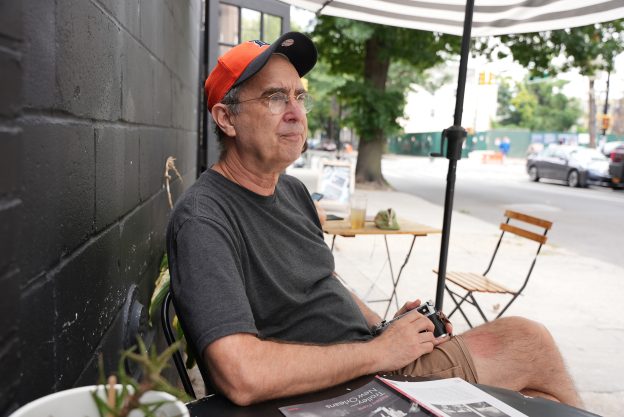
I must have looked deranged when I walked into the café. Like a guy scanning the club at last call. No one struck me as particularly interesting, so I adjusted my standards and decided that everyone caught my attention.
Wiping sweat from the back of my neck, I approached a pair of men. Probably colleagues. “Sorry to interrupt,” I said. They looked up with polite smiles. “I’m looking for two people who’d be interested in having free drinks tonight at a bar.” Their faces settled at the end of the sentence, so I blazed ahead while taking in their expectant stares. “I’m a documentary filmmaker, and the two people we had lined up for tonight’s episode had to cancel last minute, so I’m looking for replacements. The show is called Bar Talk and the idea is simple. Every week we film two friends having a conversation at the bar. I saw you two chatting and figured you were friends. We would pick up the tab, and you two can drink as much as you want as you catch up.”
The younger of the two smiled and said, “As romantic and serendipitous as that sounds, we’re going to have to say no.” The older gentleman nodded in approval.
I tried a girl on her laptop. She laughed awkwardly, looked at her phone, and said “actually I have a date tonight.”
I made for the exit. Next to the door was a man who looked to be in his late 60s. I stopped out of sheer desperation and made my pitch.
“The thing is, I don’t have any friends,” he said to me.
The man volunteered that he was trying to get “this thing” made, a screenplay he’d written. It would be shot in Prospect Park, he explained. He’d just moved to New York from Austin and was renting an apartment for a couple of months. “To see what happens,” he said.
I tried excusing myself, but he added that he’d finished three other screenplays that were “ready to go.” He claimed he’d made a short documentary about the legendary photographer Gary Winogrand, thanks to some “never-before-seen archives” he’d found at the University of Texas. And he’d made a short fiction film that did well. “It went to 27 film festivals,” he said, “not top festivals, but the next tier, high-medium festivals.”
I thanked him for his time and told him I was going to try scouting candidates for the show at another café.
He stood up and pulled out his business card. His name was David Keenan.
“Let’s grab a coffee one of these days, maybe we can help each other, or maybe you know someone that would be interested in working on this film at the park.” His maybes receded as I waved back from halfway across the street.
***
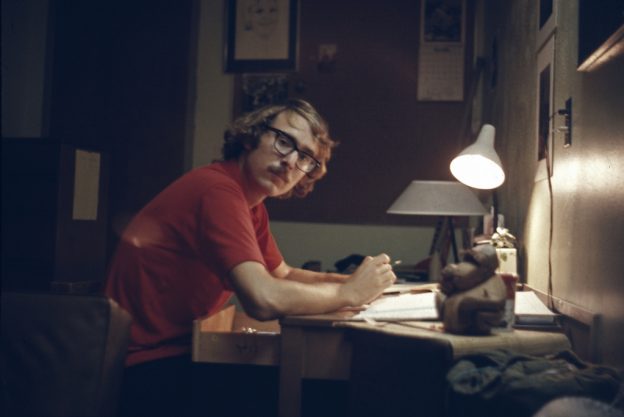
Some days later, I was seated outside the same café when I got a text from him saying he was already there. I walked inside to find David sitting with his coffee.
He was wearing a gray tee, a Detroit Tigers cap, and had a Leica M7 camera around his neck. A “rangefinder” he said as I inspected it.
“It does something with the mirrors. If you look, you’ll see there’s a patch in the middle that coincides with the focus. Coincides? Or not coincides,” David said, searching for a word, and then offered me a palm up, asking for the answer.
“Aligns,” I tried, and he unfurrowed his brow.
“Aligns, yes.”
“It’s something with the mirrors,” he added.
I could feel myself feigning interest. The sincere thing to do would be to just ask him again whether he could be on Bar Talk on Monday. When we’d had another cancellation the previous day, David’s multiple coffee invitations came to mind, and I had agreed to meet up with him.
Regardless of his answer, I told myself I’d hear out his projects and probably make some empty promises. I wasn’t any closer to unlocking the film industry than him, after all.
“It’s a great way to approach people,” he said of his photography. “I’ve made lots of friends like that. Some of my closest friends. A long time ago, I did a portrait series called Look At Me where the person is looking straight at the lens. Just one photo. I talk to the person, and we make a connection before I ever pull the trigger. The other day I ran into one of my subjects.”
“A guy you’d photographed?”
“Yeah, I stopped him, he was on his bike, and said, “Wait, didn’t I photograph you 12 years ago?” And he remembered me.”
“Wow,” I said genuinely.
“When I photograph people, I don’t do it in a steal-your-soul kind of way. I want to make a connection.”
I interrupted, “Your friend Garry Winogrand, he would definitely steal your soul.” I thought of his black and white street photography where he sometimes captured a beautiful woman without her consent.
“Yes, he would,” he laughed. “I’ve done that too. How’d your Bar Talk shoot go, by the way,” he asked. “Did you end up finding someone?”
“We did for that episode,” I said, sensing there was a new opening.
“Oh good. How’d the idea for the show come about?”
“At a bar, honestly. My friend and I were drinking and talking about literature. Our conversation had reached a very unrestrained point, and we thought, what if we could hear other people’s conversations as they reach that same point, whatever that might be. People from across all walks of life. It has to be between friends. It has to be at a bar.”
“I know what you mean about reaching an unrestrained point… I was at MOMA the other day and saw a guy writing in his notebook. He was sitting and he would just write and write. He looked so beautiful… Have I told you I’m gay?” David projected a casual tone when he said it, but he adjusted his cap and recrossed his legs.
“No,” I said. I replayed my moments with him. Nothing in his behavior had indicated that to me. It was a refreshing reminder that the many layers of the world do not need my awareness to exist.
“He wasn’t looking up at the paintings, but I think they must have inspired something in him that made him write.”
“What were the paintings, what century?”
“Who’s that artist who did ‘Dreaming of Water Lilies,’ I think it was called?” he said, frowning.
“Monet,” we both answered at the same time.
“Was it Monet,” he whispered, trailing off.
Later I’d look up the painting and discover that David had added the “Dreaming of” part.
“I’d be nowhere without my ability to meet strangers,” he said. “My friends keep asking why I keep coming back to New York City. In the past couple of weeks, I’ve met three friends. Well four.” I wondered if he meant me. “I would never be able to meet these kinds of people in Austin.”
I put a hand on the table space between us, like someone who finally arrives at a topic delayed by pleasantries.
“So, how’s your project going?” I meant his film at Prospect Park, but in the back of my mind there was still my hope of recruiting him for the show. It made me feel slimy.
“Great, actually. I’m editing old photos I’ve dug up. I think they could make a really good photobook.”
I realized that David had interpreted my question and gesture as if I were signaling at the Leica M7 resting between us. The man had an abundance of projects.
“Is this the Look at Me series?”
“No, that’s something I finished 10 years ago. These are photos I took while I was in college. I dug them up and scanned them and I’m restoring them.”
David dipped under the table and pulled out his laptop and brought up a roll of photos clearly from the 70s. Friends hugging in college dorms. Guys in clown makeup. A guy with a black eye. Crowds storming a football field.
“Which one’s you?”
“That’s me.”
The similarities had been lost to time. His height was all that remained.
I judged that the motivation behind the book was simply that he was feeling nostalgic. And that wasn’t enough.
“I’m drawn towards ones where it’s just two people hugging or fooling around,” I offered unprompted. “I sense a strong friendship with those. Whereas these group ones don’t tell me much.”
“Yeah, the question is how to situate the photos so that they are more than just pictures of me and my friends.” I was glad to hear him say it himself. “I showed these to a friend of mine and before he even saw them, he suggested pairing them with photos of what they look like now. I said, “At least look at them first!”
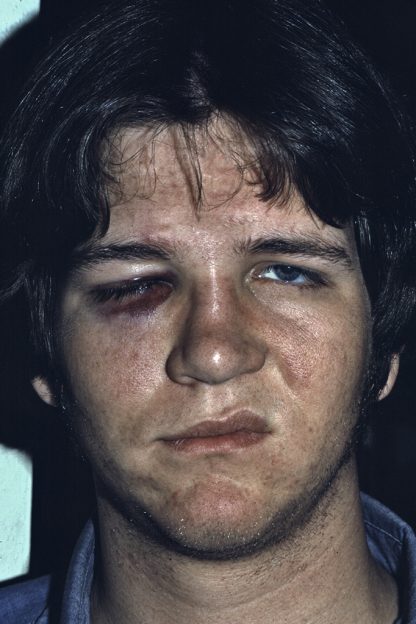
“What happened to this guy,” I asked, pausing at a photo of a guy smiling at the camera with a nasty, swollen black eye.
“I honestly don’t remember, he’s not the type of guy who would get in a fight. But I have no idea where he is today. I’ve lost all contact with these friends. So, I wouldn’t even be able to take a photo today for a now-and-then thing.” He appeared to get lost in thought. I continued scrolling.
“I don’t know what it is that I want to say,” he suddenly confessed, and his candor ripped me from the computer screen and towards him. “I was a computer programmer for 30 years. But part of me never left my 20s.”
I imagined myself as David in 40 years, as a man in my 60s or 70s with a vital need to create, feeling more alive than ever and needing to justify my artistic impulse, and then being told by someone much younger that, sorry, your work is just nostalgia.
“They’re amazing though,” I said, “I think you’ve really got something here.”
David folded his laptop back into his bag, “Thank you. And thank you for wanting to look at them.”
“Hey, I did want to ask,” I said, reaching out to the middle of the table once again. He looked up at me, still glowing. Would the pleasantries of the previous hour crumble into one big pretense?
“Is there any chance you can do Bar Talk this Monday? We had another cancellation.”
“No, I can’t Monday,” he said, swatting away the question like a fly.
“No, of course,” I added quickly.
“This city is amazing, isn’t it? Suddenly I have four amazing friends.”
I nodded back. Happy for him. And then he made clear he was including me.
“I hope you don’t mind me counting you.”
***
Back in my apartment, I sat down in front of the editing software displaying last week’s Bar Talk shoot. For minutes, I stared past the frozen image on screen, reviewing in my mind moments from my conversation with David. Suddenly, I wanted to make a record of our meeting. I stood up, grabbed my camera and ran back to the café.
He was reading in a different seat than where I left him.
I tapped him on the shoulder. “Hey, sorry, can I take a photo?” He showed no surprise and held his gaze as I snapped it.
“Wait, hold up.” David fished a booklet from his backpack. “I’ve got my script with me if you want to read it.”
“Yeah, of course. I promise I’ll get to it soon.”
In my hands was a screenplay about a photographer in his 70s. He meets a guy in his 20s and the two hit it off. The old man walks away, infatuated with their wholesome encounter. Until he realizes his wallet’s missing. We cut to the boy pocketing the cash. As he walks away, he discards the rest of the wallet’s contents, one by one, leaving a trail of personal effects.
***
Mauricio Gonzalez-Arranda was born in Ciudad Juárez, Mexico and later raised in El Paso, Texas. He is is a Mexican-American documentary director living in Brooklyn, New York. His most recent web series, Bar Talk (@bartalkseries), featured everyday New Yorkers having unscripted conversations at bars. He graduated in 2015 from Princeton University with a Bachelor’s of Science in Physics.
photos
1 – David Keenan in college in 1970s
2 – David Keenan outside Sweetleaf, Greenpoint, Brooklyn
3 – David’s friend with a black eye