


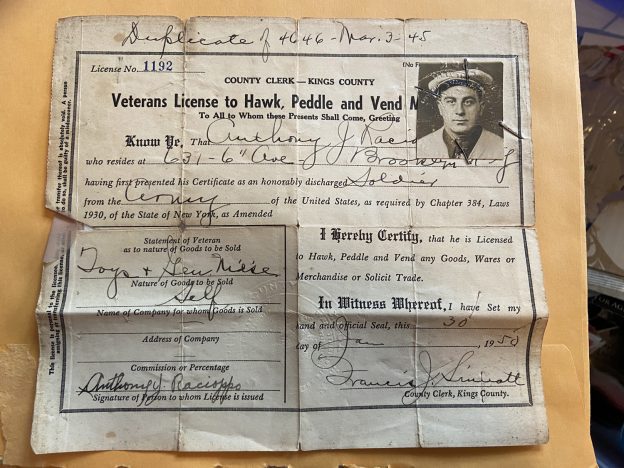
I was going through some old family papers recently and chanced upon my father’s New York City peddler’s license. It is a document not just from another time, but also another world.
He is wearing a tan Big Apple hat and a black shirt and stares straight at the camera, looking incredibly fresh and handsome. The address on the license 661 Sixth Avenue, Brooklyn, was my parents’ first apartment. My younger brother and I spent our early childhood there in a spacious apartment on the third floor of what was a multi-family building located between Prospect Avenue and 17th Street. There was a direct view of the Statue of Liberty from our kitchen window. In 1955, when I was 8 and my younger brother was 4, our family moved to Sunset Park, because our building and several adjacent ones were set to be demolished to make way for the construction of the Prospect Expressway, one of Robert Moses’ major projects.
I was very young when my father was a peddler. I remember that he had a horse and wagon, but do not remember the horse’s name or where it was stabled. Now and then my father would take me with him and sit me on the resting horse as he weighed and bagged the orders of his mostly female customers. I was a cute kid with curly black hair and chubby red cheeks and, while waiting their turn, many of these women enjoyed squeezing my cheeks, making them even redder.
Eventually pickup trucks replaced horses, but the same slanted displays of fruit and vegetables remained.
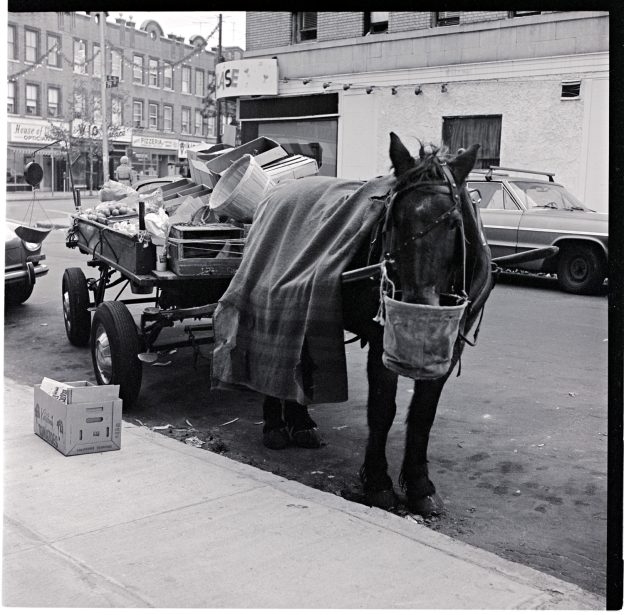
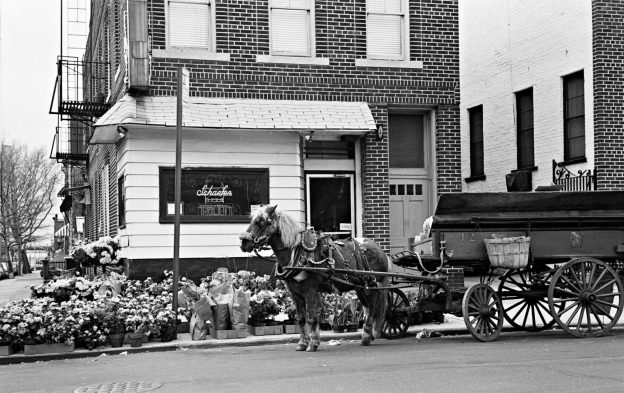
—Two of the last working horses I photographed in Brooklyn —
I wish I had paid more attention to the lives of my parents and my extended family. I know almost nothing about my grandparents. All four immigrated from southern Italy, settled in South Brooklyn, and raised large families, while making modest livings. Because they spoke only Italian and I only English, I never got to know them well. My maternal grandmother was a shadowy figure on the edge of our family life, often sitting alone in her black dress staring out the living room window.
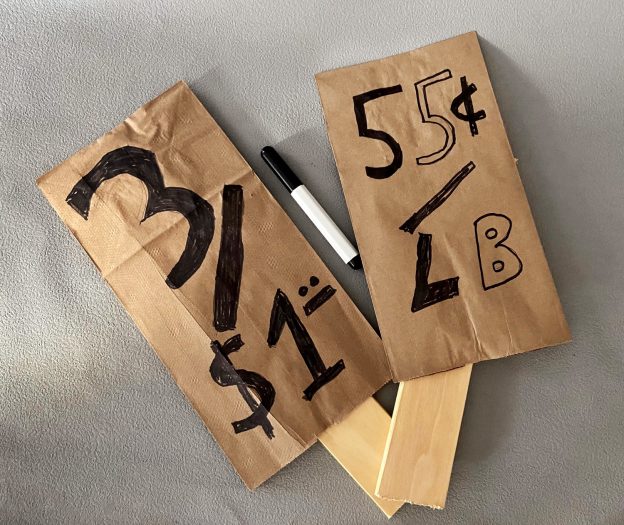
I distinctly remember my father though and can close my eyes now and see him sitting at our Formica kitchen table making signs for the prices of the fruit and vegetables that he would sell the following day. With a large black marker, he would draw stylized numbers on brown paper bags and attach them to slim pieces of wood. In the morning, he would place these signs near the corresponding items on his wagon.
During the years he worked as a peddler, my father also “shaped up” on the Brooklyn docks. At some point after my brother was born, he opted for the security of a steady longshoreman’s job and joined the International Longshoreman’s Association (ILA Local 1814). Over time the shipping industry changed. As the use of large cranes and containers increased, fewer men were needed to unload a ship’s cargo. In 1965 the ILA and the New York Shipping Association, Inc (now called the Shipping Association of New York and New Jersey) negotiated a progressive contract that included the Guaranteed Annual Wage (GAI). On weekday mornings, my father was required to “check in” at a computer terminal in the ILA’s hiring hall on 3rd Avenue and 63rd Street, Brooklyn. If there was a need for a longshoreman in his job category, he would be told which pier to report to. If there was not an immediate need, he had to wait one hour in case someone in my father’s job category called in sick. When that hour passed, my father could leave – with a full day’s pay.
Some of his fellow longshoremen used this opportunity to work another job or start a small business. My father was not ambitious and was happy to have the free time. During New York’s horse racing season, he often spent the day at Aqueduct racetrack with my uncles and their friends. At other times, he would visit his peddler friends in their small Brooklyn shops and talk about their shared interests — card playing and gambling. Sometimes my father waited on customers at Jimmy’s, a small fruit store on Smith Street, a few doors south of Union Street. On those days, my father came home with a little extra cash and a bag of fresh vegetables and fruit.
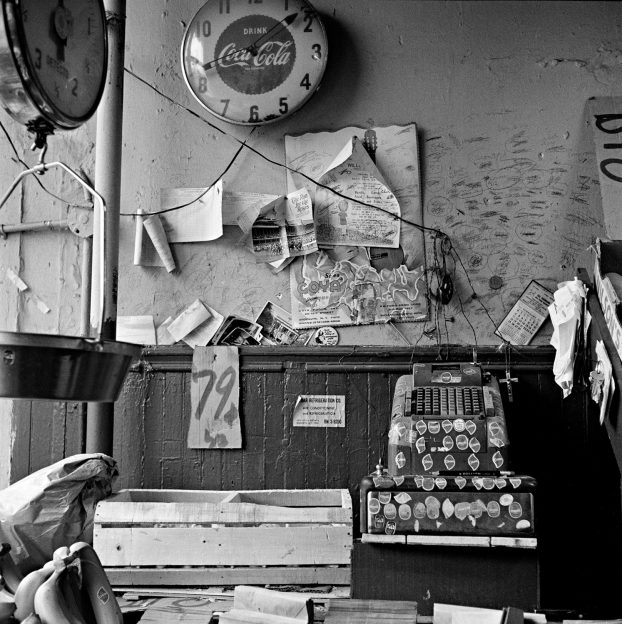
—Scale and cash register at Jimmy’s, 1973—
As a beginning photographer in the early 1970’s, Jimmy’s gruff manner and rugged good looks fascinated me. He did not understand my interest in him, but always said OK to being photographed.
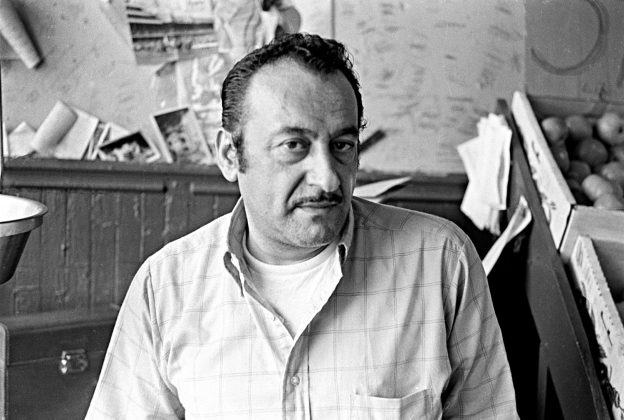
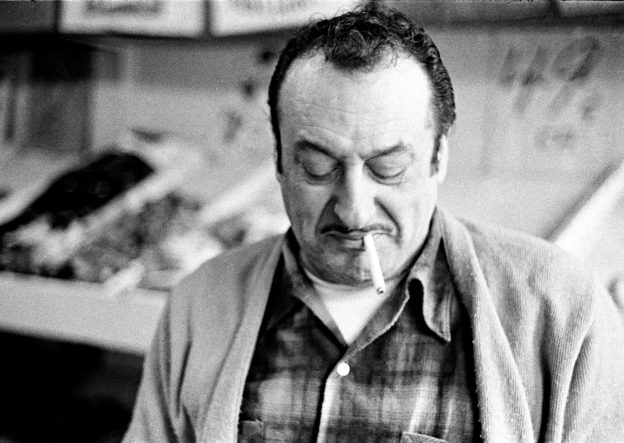
–Jimmy in 1971 and 1974—
Jimmy’s friends often dropped by to share stories about their wins and losses at poker, “the Track,” and OTB (NYC’s Off-Track Betting Corporation began operating in 1970). They often commiserated on missed chances of “hitting the number.” I remember one fellow ruing the fact that the day’s number was 518, and that just last week he had visited a cousin in room 518 at Methodist Hospital, but had neglected to play that number for the following week or two. He asked himself “How could I be so dumb?” I enjoyed listening to these working-class, mostly Italian-American men, whom I knew only by their nicknames: “Lucky”, “Big John” and “Wapo”.
Another fruit store owner visiting Jimmy once explained to me his system of keeping a few thousand dollars of working cash handy but safe from robbery. He walked me over to his Buick sedan and opened the trunk. He pointed to a pile of about 50 crumpled up paper bags and said “I’m the only one who knows which bag has the money!”
Almost 50 years have passed since I photographed at Jimmy’s store. These days I rarely encounter individual peddlers, but when I do, I always ask if I can take a picture. Almost nothing has changed, including the homemade signs.
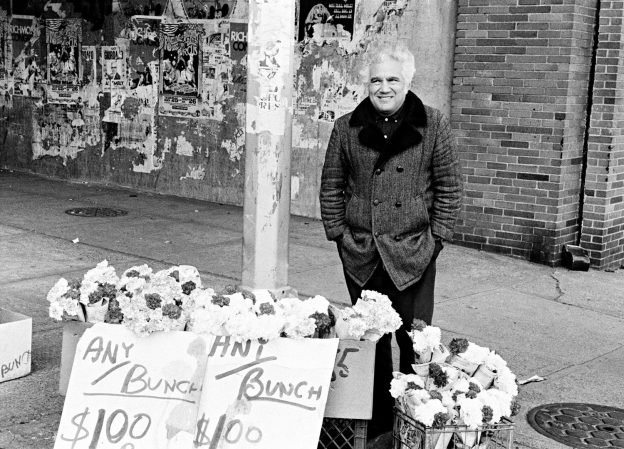
—Fourth Avenue, 1974—
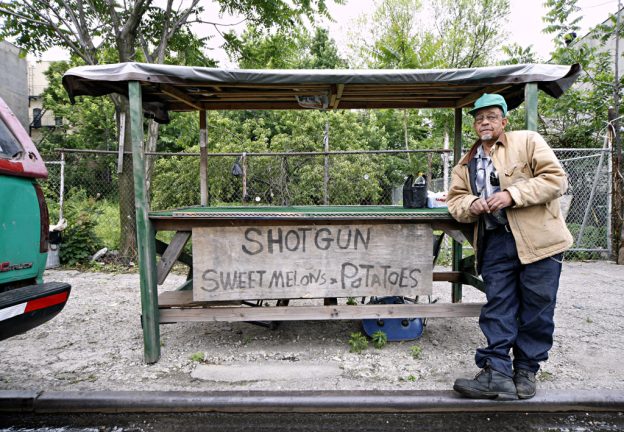
—Atlantic Avenue, 2008—
My father, Jimmy and almost all their friends are long gone. I think of them and life in pre-gentrified South Brooklyn often.
Recently, I scanned the 1975 photographs I made of another peddler friend of theirs. Smokey pushed a metal cart with fruit and a small scale through South Brooklyn.
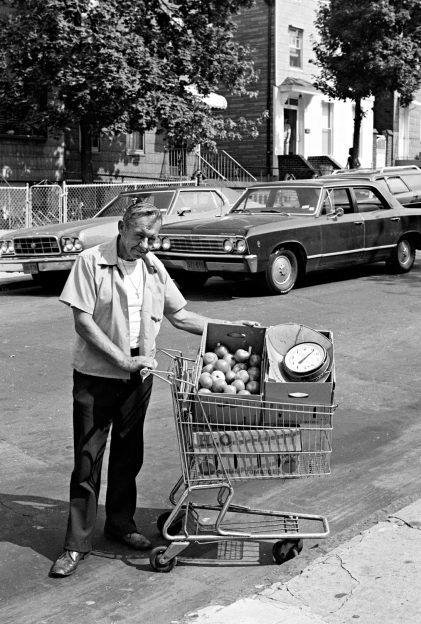
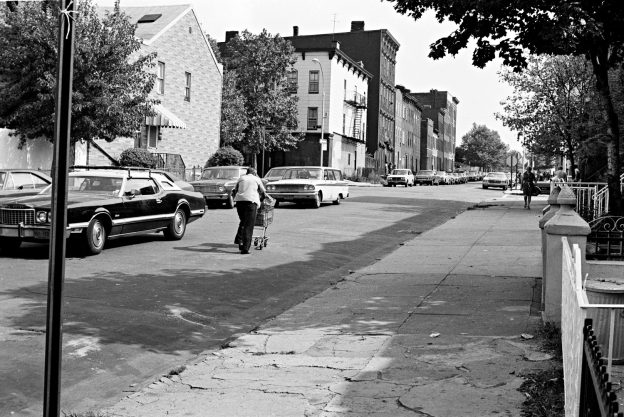
—Smokey on 18th Street between 5th and 6th Avenues—
***
Larry Racioppo returned to South Brooklyn in 1970 after two years in California as a VISTA volunteer. He took a course at the School of Visual Arts, began to photograph his family and friends, and has never stopped. His latest book, I Hope I Break Even, I Could Use The Money: Photographs from Aqueduct Racetrack 1972, will be published next month by Blurring Books.
Very cool piece! The pic captioned, “Fourth Avenue, 1974” looks to be next to the 4th Avenue and 9th Street subway station. Willing to bet in the 10th Street side. Very cool piece and great pics.
And Larry just emailed me to say I was wrong in my guess: “You’re close but you would lose your bet. The peddler was on Fourth Avenue and Prospect Avenue.”
“I wish I had paid more attention to the lives of my parents and my extended family. I know almost nothing about my grandparents.”
This is very rich, and the photographs are incredible, but as thrillingly specific as this piece is, it’s the sentiment expressed in this line that struck a chord. A sentiment that I am sure has been expressed in various languages for centuries and millennia. Some biological imperative for the young to be oblivious to all this, combined with the corollary, the imperative to rue the earlier oblivion.
But man, Jimmy. It’s like the male of the species has profoundly evolved in the span of 70 years. When I think of that generation, the shoes, the haircuts, the coffee and cigarettes… gone like the horse drawn fruit cart.
Beautiful, though.