


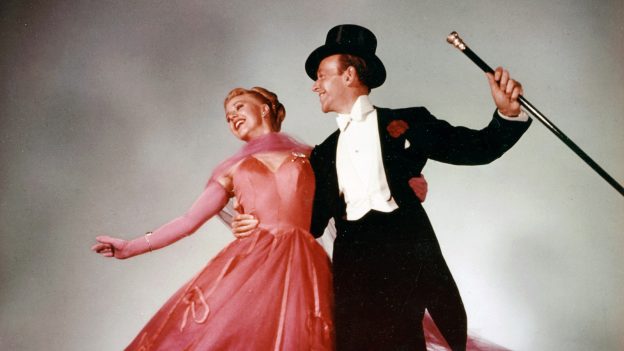
I was only thirteen years old when I decided that I must live in New York City. Fred Astaire made me do it.
Watching his old films in the early 1960s on our local tv station while growing up in the Cajun Country of Southwest Louisiana, I saw a glamorous and sophisticated world far different than the folksy, rural one surrounding me. Astaire’s elegant Art Deco world of penthouse apartments, stylish nightclubs, and chic people living to a romantic soundtrack by Cole Porter and Rogers and Hart called to me. I had to be part of it.
Thirteen years would pass before I would make the big move.
Late one hot, steamy August night, while sitting in a coffee shop, a friend agreed to move with me. She wanted to be an actress, and New York was the place to do it. I was ecstatic. My other friends were not. They predicted I would either move back within a year–or be dead.
Everyone knew New York was a city of murders, robbers, and drugs. The year I planned to move, 1977, a serial killer named Son of Sam was stalking the city. One friend, a high school English teacher, expressed her fears for me in literary terms, bringing up Willa Cather’s Paul’s Case. In Cather’s story, Paul, a young man living in Pittsburgh at the end of the nineteenth century, dreams of New York City which he sees as “the symbol of ultimate glamour and cosmopolitan sophistication.” He steals money from his employer, hops a train to New York, buys an expensive wardrobe, checks into the Waldorf-Astoria, attends the theater, and eats in expensive restaurants. The city is all he imagined; his days are spent in splendor. But his money runs out and when he learns his father is coming to bring him home, he commits suicide.
But instead of understanding this as a cautionary tale, I saw in Paul a kindred spirit. Besides, in thinking about my options, I quoted to myself a line that a character said in the then Broadway hit, A Chorus Line: “I thought about killing myself, but then I realized to commit suicide in Buffalo is redundant.”
In September my friend and I filled a rented truck with our belongings and drove two thousand miles. We quickly found an apartment we could afford–$350 a month–on West 70th Street, just off Columbus Avenue. It was not much, just the parlor room of an old brownstone carved up to include a sleeping loft, not more than four feet in height. My friend took the loft to sleep, and I installed a cot below in a space barely leaving room for me to stand.
We had little furniture and almost no money, but we thought we were in heaven. Our humble new home seemed to me like Holly Golightly’s meager apartment, or Kim Novack’s simple yet chic rooms at the back of her shop in Bell, Book and Candle. And I fully expected before long that I’d be invited to a party in a swank duplex penthouse like the one in the movie, The Boys in the Band.
New York City in 1977, of course, had nothing of Astaire’s sparkling world. His Art Deco New York had become grimy and derelict. Empty and abandoned buildings haunted the streets. Graffiti-covered trains rumbled underground filled with sad, tired people. Shops were shuttered each night behind heavy metal curtains. Garbage sat piled on curbs. The shimmering black-and-white world of Top Hat had descended into The French Connection and Panic in Needle Park.
But I was in New York City! I walked Manhattan, each street unfolding a new vista, with its own fascinating characteristics. I explored the Village, looking for signs of the Beat Generation. I traveled through SoHo as it was blossoming into a new artistic center. I walked around the new and very modern Lincoln Center and marveled at the majestic beauty of the New York Public Library. I stopped in grand department stores, snuck into the Metropolitan Opera at intermission, and splurged on dinner at the Plaza’s Oak Room.
But there were places I would not go. I stayed away from Times Square. Its gritty life was nothing like that of Guys and Dolls. When I walked up Columbus Avenue in my Upper West Side neighborhood, I’d turn back at West 81st Street where the abandoned, menacing buildings took over. I stayed away from Amsterdam Avenue after dark and walked into and quickly out of Central Park, its Great Lawn a dust bowl.
And the people I met were neither suave nor elegant. Few shared my notion of New York as a magical city. Many had grown up in the outer boroughs, and rarely came into Manhattan except for work. They were decent, caring people but not characters from Astaire’s films.
I had to accept reality: the films that formed me were not at all the city in which I was living. And not only were the movie sets a fantasy version of New York, but Astaire in those movies, for all his wit, could be viciously sarcastic, manipulate his friends, and pursue Ginger Rogers like a stalker. Holly Golightly was actually a call girl. Kim Novack was a witch. The boys in the band hated themselves because the world hated them.
But I have never left New York City. Manhattan has been my home for forty-plus years. I’ve moved apartments plenty of times, at first mostly on the Upper West Side, but also to East 93rd Street and First Avenue, a location that seemed so far uptown, before the recent Second Avenue subway extension, that a wise-cracking friend said I lived in Maine. I ended up buying an apartment in Midtown East for its convenience to all that Manhattan has to offer.
When I retired a few years ago, people asked me repeatedly if I would move out of the city. Why, I wondered?
Then I realized that many of them had come to New York just to work or for a lark and did not see it for its glory. Or they wanted a warmer climate. As Jerry Seinfeld quipped, “when you get old, you have to move to Florida. It’s the law.” But I had come to New York City for the possibility of an exciting life. Coming to terms with the reality as opposed to the celluloid fantasy, over time I discovered the excitement and glamour of Astaire’s world in beautiful restaurants, sophisticated bars in fashionable hotels, magnificent mansions turned into museums, tree-lined streets with charming townhouses, and the skyscrapers that soar above me.
Fred Astaire had shown me a world that spoke to my deepest longings, and I have never regretted my move to New York–except that I wish I had done it even earlier.
***
Claude Barilleaux retired from a career fund raising for New York City institutions including the Central Park Conservancy and the Museum of the City of New York. His essays and articles have appeared in The New York Times, The Christian Science Monitor, Paper magazine, and Home Cooking.
“I had to accept reality: the films that formed me were not at all the city in which I was living. And not only were the movie sets a fantasy version of New York…”
Good observation.
In old films, you have to scratch the surface to get past the veneer of fantasy.
New films just lay the gritty reality right out there.