


There we were, recent college graduates stuffed with random knowledge and useless information, still hanging out, wasting our time. The economy of the mid-to-late 1970s hadn’t been kind to boomer college grads. The Vietnam war had ended in defeat. A president had resigned in disgrace. New York City was facing bankruptcy, its economy in tatters. The American Dream no longer seemed ascendant.
The internet was still decades away. No Indeed or ZipRecruiter. No way to apply for a slew of positions almost instantaneously. Job hunting back then involved scanning the classified employment ads in the newspapers—The New York Times at the time had a Sunday section that often ran over 80 pages devoted solely to classified job listings. Or you might hope to find work by perusing a bulletin board at a college career office. If you found something that looked possible, the next step was mailing off a photocopy of your resume with a typed cover letter. And then waiting. And more waiting. If you were fortunate, a parent or someone who worked with a parent or a neighbor, might have information about a possible opportunity. Growing up in the then blue-collar ethnic neighborhood of Brooklyn’s Windsor Terrace, local connections for work in journalism or publishing were, as far as I knew, virtually non-existent. Despite a liberal arts degree, a load of clippings in my college newspaper and some freelance stuff published in obscure publications, plus my then current gig working as a bookstore clerk in Penn Station, the odds did not seem promising.
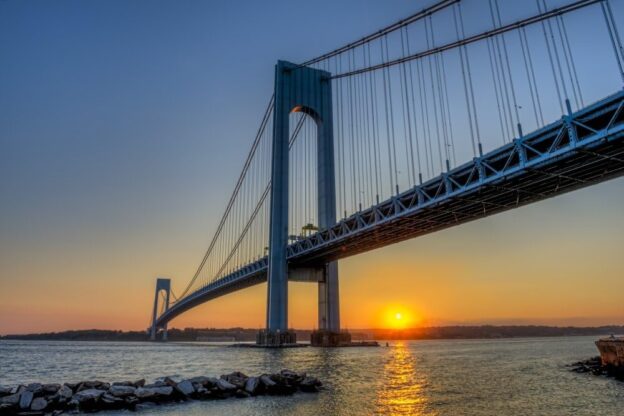
Hiking over a low berm and down a grassy incline from Shore Road, my Windsor Terrace friend and I headed to the sacred spot. It seemed a perfect afternoon for reflection. Sitting on a hillside, with a six pack of Ringnes, a Norwegian beer we picked up from a Scandinavian deli in Bay Ridge near the bridge, we gazed out over the Verrazano Narrows on an idyllic late afternoon in spring.
The mighty Verrazano Bridge loomed overhead, as the shade angled away from our sunny redoubt. With the afternoon waning, the gorgeous light began to shift from Brooklyn to Staten Island and points west. Traffic was making its way across the bridge, as good fortune shined on the gainfully employed, driving home after a full day of work and what we dreamed of—a substantial paycheck. We were still young and it was the 1970s, so the conversation, if I recall correctly, turned first to the Grateful Dead. then to the recent publication of yet another book about the Manson murders in Hollywood—an event which had kind of ended the 1960s, and finally the local doings among our cadre of Brooklyn natives, comprising fellow collegiate strivers in Windsor Terrace, Park Slope and Dyker Heights.
Then, “Shhhhh—it’s almost time,” I cautioned. We sat contemplating the moment, almost in a trance. Suddenly, the sun’s rays shattered into a million glimmering shards and sparkles, covering the waters of the Narrows from shore to shore—bold, fierce and like a dream. It was a daily occurrence at this time of the year but one that never ceased to amaze, especially for guys whose references were the sycamores and rolling hills of Prospect Park and not the waters of New York Bay.
“Whew—I wonder if a few centuries ago Native Americans sat here, on this same hillside, stoned on tobacco or whisky that they had traded for with Dutch colonists in nearby Manahattta. Just admiring the sunset,” I said out loud.
“Yeah, absolutely,” my colleague mused, “like before it was known as Brooklyn. Maybe they called it ‘Taka-Maka-Doy-Land’ in Lenape or Algonquin, or whatever.”
“Dude,” I said, somehow pulling some fuzzy geographic tidbit from the far corner of my memory, “I think Takamaka is a region in the Indian Ocean. Remember, we aren’t talking about those kinds of Indians.”
“Of course,” he countered,” but you studied about history and different cultures, you get my point?” he countered. “They probably had their name for this spot and this amazing experience, no?” Taking a deep breath, he continued, riffing on the invented word he had created out of thin air. “Probably called this moment in their language ‘the Hour of the Golden Needles in Taka-Maka-Doy Land’,” he declared, before explosively exhaling in laughter and wonder at the moment and struggling to catch his breath.
During this near religious experience, the Ringnes beers were solemnly finished, their amber hues now matching the darkening golden glow of the sunset in the western sky. Finally, the glimmers and sparkles on the waters subsided and dusk arrived. It was time to pack up the empties and the lighters—the paraphernalia of spiritual technology—and head back to Windsor Terrace as we continued to grapple with our unwritten futures.
—
Author’s Note:With all due respect to the original residents, the Delaware Project says that in the Lenape language, WSIKA means sunset, and TOKANILOKU means a nice evening (beginning at sundown).
***
Anthony Napoli is a Brooklyn native who now resides in the Hudson Valley.