| Tango Junkies Part II: The Professional |
| La Belle Epoque, Broadway between 12th and 13th Street |
|
by Emmeline Chang
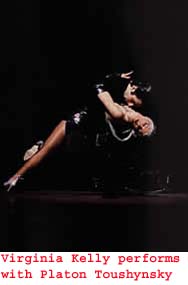
Virginia Kelly and I are sitting outside the entrance to La Belle Epoque, a French restaurant which metamorphoses into an Argentine tango salon on Friday nights.
La Belle Epoque evokes that popular image of tango: elegant gowns and seductive evenings drenched with music. Inside, the restaurant is lit by the glow of round lamps which hang from the walls. Near the front of the room, tango musicians play the bandoneon and violin; and men with slicked-back hair dance with women in clinging dresses. Behind the dance floor, the tables are filled with friends catching up on gossip; and on one side of the room, there are balcony tables from which you can watch the dancers below.
Tango began in a different world. Argentina at the end of the nineteenth century was in the midst of a huge economic boom: ranching and agriculture on the Pampa, miles of railway throughout the nation, and grand construction projects which were turning Buenos Aires into a city of trees, spacious parks, mansions, monumental public buildings, and a wide main avenue inspired by the Paris recently remodelled by Napoleon III and Baron Haussmann. In Buenos Aires, the air was thick with new sweat and smells and people: Italian and Spanish immigrants drawn by the boom. Displaced gauchos who herded cattle from the Pampa to the slaughterhouse. Native-born compadritos who roamed the streets in slouch hats, loosely tied kerchiefs, and high-heeled boots, knives tucked into their belts. European immigrants and ‘creole’ Argentines danced the polka, the mazurka, the Cuban habanera, and eventually a local Argentine dance called the "milonga." When these dances met the wildly rhythmic candombé danced by African Argentines, Argentine tango was born.
In an immigrant society where women were scarce, the men danced with each other on the docks, or with the the women they met in brothels. Most middle and upper class Argentines kept a "respectable" distance from the dance—until wealthy Argentine playboys introduced tango to Paris in 1912 and the dance took the world by storm. Though tango has had its ups and downs, flourishing from the 1920s to the 1940s, then fading under the post-Peronist dictatorships of the 1950s, today tango is almost everywhere. It is revived in Argentina. It is the unofficial national dance of Finland. It is popular in Berlin, Paris, Amsterdam, and Turkey, and growing in Israel and Japan. Tango devotees take trips to Bali and Cuba to introduce the dance, and tango professionals from Argentina travel around the world to teach. Virginia Kelly is one of these teachers.
Tonight Virginia is perched on a high stool wearing a thin-strapped top, long rose-patterned skirt and red suede heels with thin straps running across the top of her foot. Below us, women in close-fitting black dresses and men in dark jeckets climb the long, carpeted stairs. When they approach Virginia, there are cries of recognition—"Ola!"—and kisses and affectionate bantering. Except for the newcomers, everyone seems to know Virginia. It’s no surprise—many of the people who come to La Belle Epoque are tango obsessed: they plan their dates around tango, spend their vacation time dancing in Buenos Aires or "tango camps" throughout North America, and pass their weekends and weeknights in a blur of dancing, going from one "milonga" to another. They can recite the weekly schedule of Manhattan milongas in their sleep and argue happily with each other about which ones have the best music, the smoothest dance floors, the highest quality of dancing. As a performer and teacher, Virginia is one of the many poles around which the New York tango world revolves. Deep inside, many tango junkies harbor the desire to become professional tango dancers. After all, the professionals have taken junkiedom to the next level—they’ve made it their life. As a sometime tango junkie myself, I wanted to find out more about the "professional" life that beckons tango lovers like a siren’s call.
EMMELINE: So how did your tango career begin?
VIRGINIA: I was dancing casually in university. I had lots of other activities, but eventually one day a week became six days a week. I moved the furniture in my apartment and put in mirrors and a barre.
EMMELINE: And how did you train?
VIRGINIA: I studied with many teachers because I wanted to try different styles, and then I chose Rodolfo Dinzel, who is the director of the Tango University of Buenos Aires, because he is the newest in tango evolution. They create interleading, which is the opportunity for women to lead also, in order to have a dialogue between partners. As a result there is a real improvisation where none of the partners knows what’s going to come next. In Argentina I started my own dance shows with musicians and different performers. We did improvisatory things with the public. In the middle of dancing with my partner we would grab people from the audience and pretend to do tango with these people who had no idea how to dance. I was almost climbing the man while he was lifting the woman. People around us were laughing, dizzy, taking pictures…
EMMELINE: That sounds like so much fun. How did you develop that kind of show?
VIRGINIA: In my dance show, I was training many partners, so I had to develop techniques to do aerials without them really lifting. You couldn’t tell that I was backleading—you couldn’t see the difference.
EMMELINE: So how did you come to New York?
VIRGINIA: I was invited, and I was planning to bring my partner but he couldn’t come, so I stayed by myself. The jobs came and one thing led to another. When you come for the first time and don’t have a partner to show off your work, you have to make yourself known. (She laughs.) My mother said, "You are a free woman, but you choose a dance where you need a man!"
EMMELINE: Was it hard when you first came here—to a new city and a new country?
VIRGINIA: Yes, but I felt like everyone was welcoming to me. It is a close community even though the people are from all over the world. The tango community is a kind of family. (She laughs.) We have a saying—"Tango is very jealous." If yesterday I was not at La Belle Epoque, today I will receive four phone calls. At milongas I meet my students, my colleagues, my partners, my friends… Sometimes I work in the milonga. Other times I go to meet students because the lesson doesn’t start and stop when you make the appointment. Students need the teacher to be aware of how they do on the dance floor, how they are doing socially… A lot of women complain that no one invites them. They need to know why they don’t get asked. Some women are ashamed to go alone at night to a dance where they don’t know people, and they don’t get the courage to ask men to dance.
EMMELINE: So what do you do for them?
VIRGINIA: I introduce them. I tell the men I’ve been teaching her the same steps—this is someone they can practice with. The women are always feeling they are not good enough dancers for the men, but usually the men are feeling the same way about themselves, so they don’t ask the women. The communication is lost between the genders—and not only in the dance floor.
EMMELINE: What do you mean?
VIRGINIA: Almost everyone I know who dances tango is divorced or single. Those who aren’t, I don’t know. Most of the time, tango generates a crisis in people’s eyes.
EMMELINE: Really?
VIRGINIA: If only one is involved in tango and gets very serious, eventually he or she will go out for many evenings, and the other one doesn’t understand. Then there will be a problem. Even for couples who met dancing tango, tango is what brought them together but it also breaks them apart. Usually in a couple you share interests, but you want to have your own life, your privacy. But you don’t always know how to negotiate that. Everything that is there in a relationship, tango will bring it up.
I know a lot of professional dancers—people fall in love with them and then they don’t want them to perform. Jealousy shows up, and they fell like they are sharing their lover, and they don’t want that. They feel, "Stay home and perform for me!"
EMMELINE: Really? Do a lot of professional tango people date tango students? How does that work for the tango professionals you know?
VIRGINIA: Sometimes there is interest at first, but as things get more concrete, there is less. One dancer I know has lots of admirers, but no one dates her. Part of this is because as a professional you are in public and on stage and that puts distance between you. In Argentina, there is more machismo. A lot of men think, "I don’t want anyone looking at my girlfriend all the time." They don’t want to feel in the shadow.
EMMELINE: And is it the same for men?
VIRGINIA: No. If men are interested in female performers, they are more likely to idealize from a distance, thinking she has a harem. If it is the opposite, the women just jump all over the man because they feel "he’s a man, he can’t say no to me." It can be very exhausting for the men. They get bored of women. They don’t feel like men but "toys."
At the beginning maybe they romanticize the idea of all the women around them, but they can’t satisfy them all—for obvious reasons. They feel forced if they don’t choose the woman. They need to pursue. They need an active role. Most of my ex-partners were like, "Save me!"
EMMELINE: So how do you save them?
VIRGINIA: When they were going to be with a student alone and they were worried, they would have me partner with them. Sometimes if they were dancing with someone they would look at me, and I interrupted with his permission—or with his beg. (She laughs.)
EMMELINE: Have you dealt with that kind of idealization?
VIRGINIA: I used to hate when friends bring men to meet me at a performance. They see me, they see high shoes, a silver dress, hair up this high, long eyelashes… and then later I put on my jeans and my jacket and they ask, "You weren’t taller? Your hair wasn’t darker?"
Sometimes you have to fight with your own image. If you are a professional, you perform at parties and work in milongas, and people expect you to look a certain way. Most people are doing it as a hobby. They like to get dressed up and go out. They say, "I am done working, it’s time to dance and have fun." But if you’re working on it every day of the week, it becomes your life, and sometimes you need to relax to keep the enthusiasm in what you choose.
My original ideal was to travel all over the world doing shows, and my husband would be my partner. Now I realize that is just an idealization. I am best at performing and improvisation, but I recognize its limitations. Performing can be a more risky profession for women if they want a private life or a family. For example, dancers tend to keep on dancing for the first three months of their pregnancy, while the belly doesn’t show up, but that’s the most risky period to lose the baby. It’s very usual for male dancers who are travelling to have children, but it’s not usual for females. Men are more free to have the wife and the kids and go around. They can go away for two months and say, I’m just getting money for the family, I am the good guy. For women it looks like they have abandoned their family. And if men and women are traveling with their kids, for sure that’s not what psychologists consider good for kids. It’s a circus life. This is unfair to women because they may feel they reached the age limit for having children, but they don’t want to give up what they have done for their whole life. There are younger women who can perform all the time, so they feel they have to stay to fight for their place. Female dancers who are fifty can be very frustrated. They can feel they are not as pretty and not as flexible as they used to be. When they stop performing to teach, it is too late to have a family, and they are unhappy about that.
If you make a living from performing and you are in a company, you can’t take lead of your own schedule. Your private and personal life is second, and your partner is the first person in your life. I think that is cruel because first is the person and then the dancer. I love to teach on my own besides performing because this way I can be more free.
EMMELINE: Is it very different for a woman to be a professional tango dancer? Or to be a professional tango dancer in Argentina?
VIRGINIA: Oh, yes. In Argentina there is not an open mind about the tango possibilities, and any kind of fusion or liberty you take with the dance, traditional people would complain, "That’s not tango."
Here society is more respectful to recognize female teachers. Tango started between men, so in Argentina usually men are the teachers, and female teachers try to be selective when they give privates.
EMMELINE: How is that?
VIRGINIA: In Argentina at the beginning I send my male students my group classes and after a while of knowing them I would consider giving them privates. Whenever I was inviting them to come to my private studio, I would have a boyfriend or male relative there. If they come and see that I am with someone, I can see what intention they have. If they are really interested in tango, they come back. If they are not, they don’t.
Once I had a class that was all men, so I had to dance with all of them. Of course they don’t mind that because I am the teacher. Then one day my boyfriend came, and the next time half of them were gone. It was ridiculous. Probably they were thinking, "There are no women in this class, and the one woman here has a boyfriend."
EMMELINE: So do you plan to stay in New York? Or will you go back?
VIRGINIA: I don’t think I will go back, but I don’t think this will be my last place either. I was always in contact with nature, so I prefer a wilder life, where I can even have horses.
EMMELINE: Really? Do you ride?
VIRGINIA: I rode for ten years in Argentina—jumping, cross-country, shows, bolteo…
EMMELINE: What’s that?
VIRGINIA: It’s like circus stuff where you jump over the horse, bounce, do figures over the horse with others. But then I started to become too long—too tall. As I kept on growing—and you need a little body like a jockey’s—I stopped because it started to be dangerous.
EMMELINE: I didn’t know you did that. So did that help when you started dancing tango in college?
VIRGINIA: Oh, yes. They are both about building up the communication between two bodies. There are a lot of principles shared between tango dancing and riding horses. When you ride a horse, you have to bend your knees and your weight is over your toes—exactly the same as tango. (She got off her stool to demonstrate, balancing on the balls of her feet on the top step of the long staircase and bending her knee.) There is a straight line between the shoulder and waist and toes, like in tango. To turn your horse, you have to turn your torso like this. (She twisted gracefully from the waist, her shoulders turning forward.) If you look, it is the same as coming out of the "5" in tango. (The men passing the open doorway stopped to poke their heads out. "That’s beautiful," they commented.) The people who used to dance tango were the men who worked in the country. They only had their horse and their knife. The way of dancing was to be tricky. (She posed herself with her arms bent above and across her face, an imaginary knife tucked into one outturned hand.) It was a way to show who was better without killing each other—among friends. (She laughed.) Among enemies they just killed each other.
EMMELINE: But tango is a city dance.
VIRGINIA: Yes, that is a very good point. The first immigrants went to the country, but after a certain point there was no more land to work unless they owned it, so they had to go back to the city… to work in the ports. They were like lost men, the men from the country in the city.
Tango was born at the beginning of the century when lots of foreigners came to Buenos Aires, so it includes much of other cultures. That’s why tango speaks to people all over the world.
Click here for Part One of the Tango Junkies
For more Emmeline Chang action, tango and otherwise: Click here.
For more info about tango at La Belle Epoque: Click here.
|
| Close this Window |