| The Day Dustin Hoffman's House Blew Up |
| 11th Street Between 5th and Sixth Avenue |
|
It was a quiet block. Then one cold March day in 1971 a house blew up. It was a bomb. When it came to light that it had been the (accidental) work of the Weathermen Undergound, it changed the face of radical politics on a national scale. More locally, the explosion set off a wave of bomb scares throughout the city (over 500 were reported on March 13th). Dustin Hoffman lived right next door in a garden apartment, and Mel Gussow lived in the apartment above him with his wife and young son. His account of the explosion follows.
Photographs: Black and White by Mel Gussow, John B. Baily, Wire services. Color by Josh Gilbert
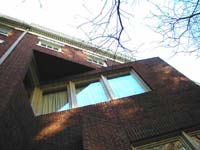
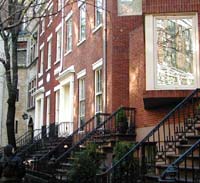
Eleventh Street between Fifth and Sixth Avenues was one of the quietest, nicest residential blocks in Greenwich Village. As the Village changed, as Eighth Street became a penny arcade of pizza stands, peddlers and button-and-poster stores, 10th, 11th and 12th Streets held fast to tradition and esthetic standards. With its tall trees and handsome ivy-covered townhouses, some of them still one-family houses, 11th was one of the few streets in the Village that seemed left over from an earlier, more elegant age.
There was a pride of residence and ownership. Apartments were highly prized, and changed hands infrequently. The building superintendents, the first to know of prospective vacancies, were courted and flattered. Those who lived there cherished the street, and even its oddities like the tiny wedge-shaped Second Cemetery of the Spanish and Portuguese Synagogue. Let a developer cast a covetous eye at that parcel and people would be up in rebellion, just as they were years ago when the New School first moved in. The New School was in fact a modern intrusion on an old-fashioned street, and when the school announced its intention of razing brownstones on 12th Street in order to expand facilities, residents on both streets—usually hesitant about community action—spoke out and signed petitions. The main bane of 11th Street was probably the restaurant on the corner, which had gone through many transformations, including a stint as a homosexual Hawaiian restaurant, and was now a Blimpie Base. It was a teenage hangout and reportedly a drug center for youngsters who loitered on and littered the streets.
But basically the street was old and preserved, like something out of Henry James and Edith Wharton. Some residents had lived there for decades, clinging to low-rent apartments. Others were new and paid royally for the privilege of living on the street. At least a few of the townhouses were always being renovated or painted.
The street, as we came to know it in the three or so years we lived there, was heterogeneous, but with a definite emphasis on people in the arts. My wife and I (and our three-year-old son) lived at 16 West 11th Street in a house owned by Joe Hazan and his wife, the painter Jane Freilicher. We lived on the third floor. Dustin Hoffman and his wife and daughter lived on the second floor. Mel Brooks and Anne Bancroft owned a house down the street and rented half of it to James Goldman, who wrote The Lion in Winter. Barbara Harris rented an apartment across the street. Actress Cynthia Harris and her husband, producer Gene Wolsk, owned a house. Among these artists, actors, writers, there was a certain contact. But generally, as in most of Manhattan, there was something insular and isolated about the lives of the people on the street—until the house at 18 West 11th Street exploded.
On March 6, 1970, at 11:40 a.m., my wife Ann and I left our apartment and as we walked past 18 West 11th, a one-family house owned by James P. Wilkerson, Ann noticed a girl looking out of a downstairs window. She said nothing about it and walked with me to the subway. I went to my office at the New York Times and she picked up our son Ethan at his nursery school around the corner. Several minutes after noon, I entered my office, and Clara Rotter, the drama secretary, informed me hesitantly that Ann had just called, was terribly upset, and had said that the house next door to ours had blown up.
Ann and Ethan had taken shelter at a friend's house. I called her immediately, caught a taxicab, prodded the driver as traffic slowed, finally jumped out of the cab at 16th Street, and ran down Fifth Avenue. Together with my wife—we left our son at the friend’s house—we walked over to the scene of the explosion, and she told me what had happened.
Precisely at noon, she had picked Ethan up at school, and was walking south on Fifth Avenue with the other children and mothers. As they reached the corner of 11th Street, there was a deafening blast, followed by a billowing cloud of black smoke, and—as soon as they could see through the smoke—flames leaping from a house on the south side of the street. "My God, it’s my house," said Ann, and leaving our son with a friend on the corner, she ran toward the house. As she approached, she saw that the flames were coming out of the windows of Number 18. She ran into the building on the corner and telephoned me. Then she went back toward Fifth Avenue, which was shrouded with dense black smoke three blocks south to Washington Square.
At the moment of the explosion there was only one person inside 16 West 11th Street, Marie-Thérèse Thiesselin, the baby-sitter for Dustin and Anne Hoffman’s daughter Karina. Marie-Thérèse was standing in the middle of the Hoffman living room when the fireplace came crashing out at her. Calmly, she picked up O.J., Dustin’s pet terrier, walked into the kitchen, telephoned Dustin and the fire department. Afterward, she went outside and for most of the rest of the day seemed to be in a state of nervous shock.
On the other side of 18, at 20 West 11th Street, Arthur Levin, the owner of the house—and an occupant—was at home feeding a dog. Also in the house were two tenants. At the sound of the blast, Levin ran outside, then back in, called the fire department and then went back out again.
At the time that my wife was running west on 11th Street, Anne Hoffman was running east on 11th Street. She had been in a taxicab at the moment of the explosion, had jumped out and run toward her house. After seeing Marie-Thérèse, she entered the building, ran upstairs and knocked on our door to make sure that we were not trapped inside.
At 12 noon Bob and Lenore Schwartz, who rented a duplex in a building toward Sixth Avenue, were standing in their kitchen with their maid. The blast shook their house. Lenore ran outside toward Fifth Avenue. "There was mortar flying out of Number 18," she recalls, "and a gray screen of dusty debris." She rushed back to her house to call the fire department which, to her anguish, insisted on asking, "Who are you? Where do you live? What’s your telephone number?" Finally she shouted, "It’s a dire emergency! Get here quick!"
Meanwhile her husband had gone down the street to the blast. "There was stuff blowing across the sidewalk, and rubble all over the place. The blast was so strong that a drape from the front window was hanging across the street on a railing [and as high as the sixth floor, the windows on the building across the street were smashed]. Virtually no one was present. As I stood there, a lady crawled out of a window of Number 18 with no clothes on. She was like a mine victim—heavy dust all over her, glass cuts on her breasts, no major bleeding. I took one of the drapes that was on the fence of her house and said, ‘Here, you better put this on.’ She was indifferent to this. She said, ‘There are people inside. I have to go back.’ She looked very abstracted. I repeated, ‘Here, put this on.’ I felt like an idiot haberdasher. Then I heard the fire engines on Fifth Avenue. Rubble blocked 11th Street, so I pushed some of it aside and moved traffic through. I was motioning a truck and as I watched, a huge column of flame shot out of every window. It was like a Cecil B. De Mille movie."
In addition to Schwartz there were at least six eyewitnesses to the explosion, including two patrolmen, a retired fire marshal (who had also jumped out of a taxicab), a medical student from NYU, and Arthur Levin. Two girls escaped from the fire; all of the witnesses saw one or both of them, and the first four witnesses reportedly helped them out of the house. At the same time at least two series of photographs were being shot, one by an architectural student who, it was said, was photographing buildings at the other end of the block; the other, color pictures by someone apparently in the building across the street. In these pictures appeared not only the eyewitnesses but the two girls.
"From the beginning one of the great mysteries was the role of the police and the FBI."
Also in her kitchen at 50 West 11th Street at the time of the explosion was Susan Wager. She ran outside toward Number 18, saw the two girls, put her coat around the one who was naked, and led them to her house. She offered them her shower and some clothes, and went back to the burning house. When she returned to her own house, the girls were gone. They had told the housekeeper they were going to the drugstore for medicine. The fastidious housekeeper straightened the bathroom, in the process removing all fingerprints. Mrs. Wager felt it strange that the girls left so hurriedly, but "I thought that, if they didn’t have anything to hide, why wouldn’t they come back?" The girls have never been found.
As my wife and I watched, it was a scene of great horror. We both felt that certainly our house—with every one of our possessions—would burn to the ground, that perhaps more blasts would follow until the street was wiped from the map. That initial horror was followed by a feeling of relief, something we were to feel a great deal in subsequent days. After all, we were alive. Actually my son’s school had let out five minutes late that day. Otherwise he and my wife would have been in our house during the blast. Every other day of that week I had been at my desk at noon, with my back to the wall of the Wilkerson house. What if Marie-Thérèse had been standing by the fireplace rather than in the middle of the room?
The earliest arrivals on the scene were the fire and police departments, but almost simultaneously there were the Red Cross, the press, the sightseers, and the insurance adjusters. The adjusters seemed the most ghoulish. Like ambulance chasers, they tried to sign up everyone in sight. The Red Cross immediately set up Disaster Headquarters in the Parish House of the Episcopal Church of the Ascension—two doors from our house—and tried to give everyone coffee and doughnuts. They also offered all of us, including Dustin, a room for the night. Fortunately, each of us had friends and family easily able to accommodate us, and we politely declined. The Red Cross lady actually seemed surprised. I wondered later where she would have sent us.
The street, sidewalk, and parish house were soon swarming with newspaper, magazine, and television reporters, lugging heavy television equipment. With the massive, immediate press coverage, and the gaping sightseers, the scene reminded me of the movie Ace in the Hole. The press and the tourists (and some of the city officials) seemed almost as interested in Dustin as in the disaster. He said later that one of the strangest experiences was being interviewed in front of the fire and realizing that the man interviewing him was wearing television makeup. Whenever news of fresh disaster reached the networks, they mobilized the reporters and camera crew—but first, the reporters stopped to put on makeup.
Even before the explosion, we had been friendly with the Hoffmans. Their daughter Karina and our son—who were only one month apart in age—were best friends. They would wake each other up in the morning, play inside their apartments, on the stairs, and in the hallway outside. To facilitate their free play, we left our doors open. The children came and went at will. We were not on the same basis with the other tenants. I had never met the man who lived in the garden apartment. We said hello to our upstairs neighbors, but did not know them well. Now in the closeness brought on by the shared disaster, we instantly became great friends—and regretted not having known our neighbors before.
This friendship also sprang up with people in the neighborhood. People at both the Church of the Ascension and the First Presbyterian across the street, where our son went to nursery school, were exceedingly hospitable. Tradespeople—some of whom in the normal course of business seemed quite aloof—suddenly became compassionate as citizens in a Welsh coal-mining town. Everyone volunteered to let us store things in his apartment. Surrounded by homeless tenants, the mailman held mail call in the middle of 11th Street.
Everyone was interested not just in our plight, but in what had happened next door. We snatched at rumors. The most frequent one was that the explosion had been caused by a defective boiler. I wandered through the backyard of the Church of the Ascension and looked up at the rear of our apartment and the flaming structure next to it. A seedy, unshaven man approached and said that he had inspected the boiler at Number 18 a few days before, and found it needed repair—but nothing was done about it. I never saw that man again.
In a curious way, we were isolated—the residents of 16 and 20 West 11th Street—not really victims, but victimized by the occurrence. We were a group unto ourselves, and commiserated mostly among ourselves, and with friends from around the city. As our friends heard about the explosion, they thronged to the site, offering comfort, consolation, rooms for the night, every possible kind of assistance.
The rest of 11th Street was concerned, but then slowly became estranged from the disaster. As one neighbor expressed it, "At first there was a camaraderie, but then there was a general sense of helplessness, a kind of loneliness, a sense of distance." Beginning that first night there was also the noise of drilling and demolition. The street looked like a war zone. I would guess that everyone inspected his boiler and locked his doors securely (although of course there was no shortage of police on the street). I wouldn’t be surprised if some people left town immediately.
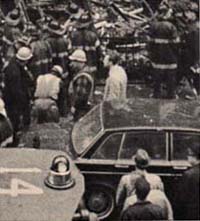
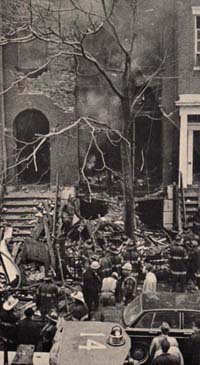
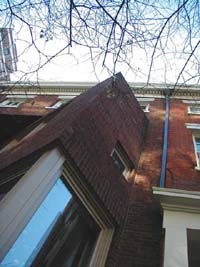
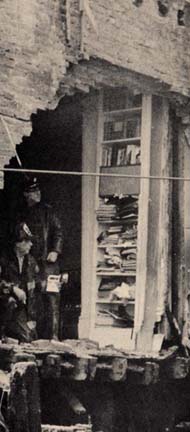
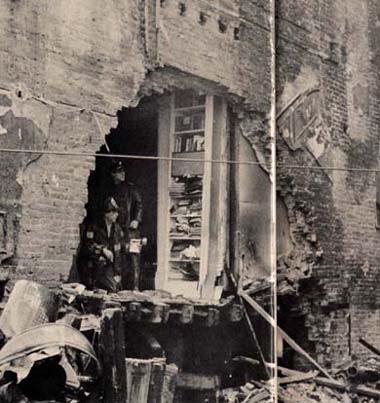
Almost as soon as the fire died, a huge crane appeared, dwarfing the townhouses. The firemen began tearing down the side and rear walls and carefully sifting the rubble. They were obviously looking for something, presumably bodies. It was also clear that our building and the other one on the other side of the cavity were weakened. After the blast, in fact, both buildings were condemned, and remained so until the owners had them shored up. High above the street, clinging to the side of Number 20, and lurking ominously long after the explosion, were the remains of Number 18—a bookcase, charred and seemingly sealed to the wall, looking like a spectral Louise Nevelson sculpture.
Late that first afternoon, the firemen in charge said that each tenant in our building could make one quick trip to his apartment—one person for each apartment, accompanied by a fireman—to reclaim small essential property. I tried to decide what was our most essential property, and as if struck by amnesia couldn’t at first think of anything. I went upstairs with a fireman. We walked in the door to the bedroom, and as I entered, the telephone on the night table rang. I looked at the fireman as if the call might be for him. He, as astonished as I was, shook his head no. I picked it up. It was our friend Nancy Cunnison calling from Great River, Long Island. "I’m sorry. I can’t talk," I said, matter-of-factly. "Our house is burning down." "That’s why I’m calling," said Nancy. Her husband had heard about the explosion on his car radio, had called her at home, and she had frantically been trying to reach us—at my office, through friends. Finally her oldest daughter, Liz, had said, "Why don’t you try their number?" Nancy had said, "But they wouldn’t answer." She had dialed just as I entered our apartment. "Talk to you later," I said, and put down the phone for the last time.
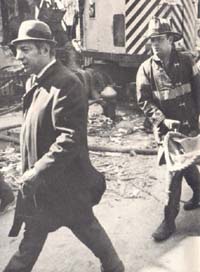
Our apartment was a shambles. Everything was full of smoke and water. The ceiling in the bedroom was splitting. The windows were smashed. I walked quickly to the rear of the apartment. The ceiling above my desk heaved as if it were about to collapse. The fireman urged me to leave at once. I took a manuscript of my biography of Darryl Zanuck, a large oil painting by my brother, and a few small framed photographs I had taken of my son, and started down the stairs. Dustin and I almost collided at the entrance. He was also carrying a big painting. He went out the door first, and the photographers popped their shutters.
One of our neighbors, a playwright, decided before he made his one trip upstairs—at the time we all assumed this would be our only trip—that three things were most important to him: his completed tax forms, an oil painting and a Picasso drawing. He took all three and was starting for the door with scarcely a look at his collapsed skylight, his ruined antique furniture—his now-desecrated apartment had recently been the subject of a beautiful photo spread in the New York Times Magazine—when, overcome by insatiable gourmet greed, he walked into the kitchen and came out with a tin of truffles. "And then," he remembers, "the chimney collapsed."
We planned to stay at my parents’ apartment that evening—we stayed for almost two weeks—but Ann and I remained at the blast until about nine o’clock, watching with compulsive fascination. Finally, late that evening, a body of a man, unidentified, was found. It was removed in a blanket, like a limp sack of ashes. Our street was all over the late news that night. There were many more rumors than facts. One story persisted—that there was a child missing inside the house. As possible proof, the newscasters showed a boy’s red tricycle standing outside the house. The tricycle belonged to Ethan. We had left it that morning in the lobby of our building and the firemen, charging in, had removed it and thrown it outside.
Saturday morning we began an early vigil. When the firemen informed us that we might be able to go into our house that day during the firemen’s lunch hour—when the crane was not working—and reclaim a few small things, we called a number of our friends, mobilizing them for action. The fireman advised us not to stray to the far side of the building since it had been weakened by the blast.
Our upstairs neighbors brought an assortment of packing boxes, which we shared. All of the tenants, each with a legion of friends, stood lined on the sidewalk. I found a brown paper bag and on the back of it scribbled the few most essential items in the house and read them off like battle assignments. At a nod from the fire marshal, and as the sightseers watched, we each grabbed a box and flew upstairs. It looked, for all the world, like a supermarket sweepstakes. How much could we squeeze into our shopping carts? How many trips could you make in ten minutes? Once inside, everyone forgot my instructions and grabbed whatever was nearest or dearest to his heart. My sister-in-law lifted an unwieldy sliding oak cabinet, and hugging it like a baby, carried it downstairs. One male friend darted into our kitchen and snatched a toaster (but apparently not the mouse who had been cozily living in it before the explosion) and an electric mixer. Ann and I were mostly interested in saving Ethan’s books and toys. We looked like Santa as we bounced down the stairs.
Meanwhile our gourmet neighbor liberated, among other things, a cold beef salad Lyonnaise from his refrigerator, and had if with friends for dinner that night. We—the army of scavengers—flew down the narrow stairs. The action speeded up, as in a Keystone comedy. Up the stairs! Down the stairs! Grab a new box! What none of us knew as we thumped and bumped through the building was that there were some 60 sticks of live dynamite buried, as yet undiscovered, in the Wilkerson house—enough, said one inspector later, "to blow up the entire street."
We stored our booty in the church parish house, which with uniformed officers, field phones and piles of boxes looked more and more like a frontline command post. With our friends, we went over to the Cedar Tavern for lunch. As we were eating, it suddenly grew dark outside. It was not the apocalypse but a total eclipse of the sun. Shielding our eyes, we went outside. It was impressive, but, I must admit, after the explosion even a total eclipse seemed anticlimactic.
Sunday was a clear sunny day. The explosion had disappeared to page 71 of the Times, the only news being that one of the girls who fled the blaze was thought to be James Wilkerson’s 25-year-old daughter Cathlyn. The police were still trying to identify the body of the man discovered in the wreckage. We went downtown early and spent most of the day looking at the house. The fire had stopped and the fire department was cleaning up the rubble and searching the debris.
Mr. and Mrs. James P. Wilkerson had been on vacation in St. Kitts in the Caribbean, and returned to New York on Friday night. At 1 p.m. Sunday, they walked past the scene of the explosion and no one seemed to recognize them.
On Monday we took Ethan to nursery school. Some of his classmates thought that Ethan’s house had blown up, and they were happy to see him. The teacher explained the explosion to the three-year-olds, and that seemed to calm them. But it was obvious to us from the beginning that our son was terribly touched by the event, that no matter what we did or said, it would probably be traumatic. Not just our son, but many of his classmates, became preoccupied with the fire—the blast, the black smoke, the flames. In subsequent days, Ethan would often mention some toy that "I used to have—before the explosion." We would tell him that it was at a friend’s house, but he would still insist that it was something "I used to have." He was never to go back into his room again.
With the identification of the body as that of Theodore Gold, a Columbia University strike leader, people began talking about possible conspiracies. My attitude was that just because Gold was a campus radical was no reason to assume that there was a plot being hatched in the Wilkerson cellar. But on Monday firemen discovered the building’s oil burner in the debris. It was in one piece, which gave credence to the theory that something else might have caused the explosion; something other than a simple accident might have shattered the tranquility and architectural serenity of 11th Street.
The Wilkerson house, like ours, had been built in the 1840s by Henry Brevoort Jr. Ours was a four-family, four-floor dwelling, but Wilkerson’s housed just one family. It was, according to the realtor Allan House, one of the few townhouses in the area that had always been a one-family dwelling. From some time before the explosion, the house had been for sale—at $255,000. The Wilkersons were planning to move to England. In the preceding weeks Mr. House had been in and out of the building with prospective clients. He was, in fact, very close to a sale and was scheduled to bring his buyers back to the house at noon on March 7. But Cathy Wilkerson asked if they couldn’t come at 2 p.m. instead; they couldn’t, and so the visit was postponed.
The house was one of the choicest on a choice street, a Federal townhouse with the original molding, woodwork, and glass. There were ten high-ceilinged rooms, including a huge double-drawing room on the parlor floor, a sauna bath, a wood-paneled library where Wilkerson kept his collection of fragile sculptured birds, and an enormous master bedroom with a bathtub in the middle of it—in the open—with recesses for martinis and books, and with a picture next to it of boating on the Thames. Wilkerson had furnished the house Georgian-style, and if was full of Hepplewhite furniture, Georgian silver, and fine English landscape prints. In the sub-basement there was a workroom where Wilkerson himself repaired and refinished his antiques.
Often my wife and I would sit on our tiny terrace and have lunch or an afternoon drink and look down on the gardens of 11th Street, the handsomest of which was next door at Number 18. It was the scene of afternoon teas—poured by the lady of the house—and cocktails at dusk. The bushes were finely pruned—again by the lady of the house. The paths were pebbled. At the far end was a fountain with a mirror behind it. The garden seemed frozen in time, like a Seurat painting.
Once, coming home late, we arrived at our house just as a formal dinner was ending at the Wilkersons’. Guests in tuxedos and gowns seemed to dance through the door—glimpses of mahogany and crystal chandeliers inside—to waiting limousines. A touch of Fitzgerald to your Henry James. There was an elegance to that house—and to its occupants.
Soon after the Wilkerson house exploded, my wife and I passed Mr. and Mrs. Wilkerson on Fifth Avenue. The Wilkersons expressed concern for us and for the loss of our apartment. Then Mr. Wilkerson showed us what he was carrying in his hands—the remains of a glass vase. He said it was the only object he had been able to save from his house.
At that moment it was our lives and those of our neighbors that had been upset. For some it was an economic misfortune, although, like the Wilkersons, most of those financially affected could apparently sustain the loss. Ted Gold had died, but the cause appeared to be accidental. Then suddenly that day, Tuesday, the townhouse explosion became a national tragedy.
Digging in the ruins, the workers found the torso of a young woman, some 60 sticks of dynamite, 30 blasting caps, and a supply of homemade bombs, many of them, it was reported, with nails protruding, making them vicious anti-personnel bombs. The huge crane stopped in midair, and the watchers ran for cover. Apparently Cathlyn Wilkerson, Ted Gold, and their friends, members of the radical Weathermen were making bombs in the sub-basement of the Wilkerson house. The story leaped back onto page one. "Not Idealists: Criminals" read the headline of a Times editorial. The papers were filled with stories about the youngsters’ radical activities. These were not young kids accidentally blown up by a boiler, but desperate revolutionaries bent on the destruction of someone—or something—although succeeding only in killing themselves and blowing up Cathy’s father’s house.
What were they planning to blow up, and why the anti-personnel bombs? What if the entire street exploded? Dustin appeared on The Dick Cavett Show and spoke for many of us when he said that it was not anger he felt against the bombers, but fear: for ourselves, our families, our country.
Our landlord felt angry. He had marched on Washington and supported peace movements, and was now suddenly cursing the young revolutionaries. They had destroyed his house. Partially it was his economic loss. But also there was the fact that it was his house, which he and his family had lived in for a number of years. Arthur Levin said, "It convinced me more than ever of my belief in nonviolence. It just substantiated how dangerous it is to try to control violence your way. Violence is uncontrollable in every form." Levin, like myself, had ridiculed the bomb theory, the thought of a conspiracy. Now we were faced with proof. Our narrow escape would never be forgotten. Who is living next door to you? What are they doing in the basement? But also we were jolted out of our solipsism. One was forced to wonder, what had created the bombers?
On Wednesday night, standing in the glare of television floodlights in front of what had been his home, Wilkerson made his first statement to the press. He addressed a message to his daughter asking her to contact him "just to let us know how many more people, if any, are still left in the ruins of our home." He looked tired and sad, and finally perplexed, as newsmen surrounded him and asked further questions. When had he last heard from his daughter? Had he known she was staying in his house? How did he feel about SDS? Was he "communicating well" with his daughter? He answered frankly, "As parents, we’d have to say no, not in recent years."
In the following days more dynamite and another body were found. The torso was identified as that of Diana Oughton. The girl who escaped with Cathlyn Wilkerson was apparently Kathy Boudin. I searched for reasons and meanings as I read about these girls and Ted Gold. They came from different, but converging, backgrounds. Within the families, the accumulation of wealth, position, education, intelligence, respectability, was astounding. The 11th Street radicals were very much the children of affluent America. To a certain degree a group profile emerges. These men and women—one has to be constantly reminded that they were not children, Gold the youngest at 23, Miss Oughton the oldest at 28—were for all the right things and against all the wrong things. Or so it seemed. Somehow all their feelings and frustrations led from pacifism to activism to violence to bombing to death.
One day that week, an older couple and a child (later reported to be a student from a school in Michigan at which Diana Oughton once taught) placed some flowers on the rubble at Number 18, as if on a gravesite. The photographers, whose pictures had become stale with repetition, leaped into action. One of our upstairs neighbors was so outraged at the sight, at the thought of the bombers as martyrs, the blasted house as a memorial, that he charged through the police lines and angrily stamped the flowers into the ground. The police were astonished. They grabbed him and tried to arrest him. "One doesn’t do things like that," said one cop. Our friend answered, "One doesn’t blow up houses." And he walked away. He was never arrested, but curiously, the police took the crushed flowers into custody.
The discovery of the bombs somehow seemed to trigger an epidemic. On Friday, March 13, there were three first-page stories about bomb scares. I went into the office, and the Times itself had been threatened by a bomb scare. According to one report, there were 590 bomb threats that one day.
From the beginning one of the great mysteries was the role of the police and the FBI. The night before it happened, around midnight, one Villager was walking up 12th Street and saw a police riot van pull up in front of 18 West 12th. Policemen jumped out and went into the house. When contacted, the police at first did not want to give information, then finally said a man had threatened his wife with a shotgun. But still the coincidence of the street numbers makes one wonder, could the police have been given a wrong tip?
The police and FBI scoured the area for information. Both the FBI and an assistant district attorney interviewed Dustin and Anne Hoffman. The FBI paid several visits to Bob and Lenore Schwartz and later talked to their housekeeper, who had gone back to Virginia. Schwartz’s first FBI visitor showed him photographs of the explosion, dozens of glossy 8 by 10s, some with Schwartz in them, which seemed to begin with the first blast and to click off about every 20 seconds for 20 minutes. If flipped, they would seem like a movie, like the Zapruder pictures of the Kennedy assassination. There were no credits on the backs of the pictures, and Schwartz asked the investigator where he had gotten them. They had been taken by "an architectural fan," he said. But to Schwartz they seemed much more on top of the scene. Some people suspected that the FBI had staked out the townhouse, and was prepared for the explosion. "Did you guys have anybody in the building?" Schwartz asked the FBI man. "No," he answered. "I’m sure because I was in charge."
One of the main purposes of the FBI interrogation was of course to determine the identification of the escaped girls, Cathy Wilkerson and Kathy Boudin. As one 11th Street resident recalls, "It was frightening for us old-line liberals, being asked to put the finger on somebody. There was something about those girls being in the police lineup that made them all look like criminals."
Every day, as if for work, I reported to 11th Street, hoping for some clue to the mystery. The atmosphere first became unreal and then oppressive. I’m sure even those friendly churches were becoming tired of our inhabiting their premises and using their telephones. One day the assistant minister at the Church of the Ascension said in exasperation to Dustin, "It’s been a harrowing experience, Mr. Hoffman. A harrowing experience. I woke up this morning and I realized I had to go to a funeral and I was so glad to be getting out."
Finally, almost two weeks after the blast, my wife, son, and I flew to California. I had been scheduled to leave about a week earlier, on special assignment for the Times, to write a story about the death of Hollywood, which had seemed increasingly remote as the events cascaded on 11th Street. Now I was glad to be free of the nightmare and to be involved in something else. But the truth is that I was also obsessed by the townhouse. Wherever I went in California I found myself compulsively talking about it. Whenever someone did not know about it, I was amazed. Hadn’t he read about it, or seen it on television? On March 23, while we were in California, the search in the rubble ended. The case temporarily was closed. The story was soon replaced in the headlines and the minds of New Yorkers by the mail strike.
Soon after, the Wilkersons moved to England as planned. Dustin and Anne moved uptown to a rented apartment while waiting for their new townhouse—purchased before the explosion—to be renovated. We had finally found an apartment in the village that was available in September, but as the anniversary of the explosion approached, because of renovation problems, we still had not moved in. In the fall Ethan returned to his nursery school and almost always as we passed 11th Street, he would insist on looking up at his house. We assured him that they were fixing the place, but we would probably move elsewhere. As it turned out, we never had a choice. Our landlord completely reconstructed Number 16, increased the rents, and rented it to new tenants. One of the new tenants was Michael Wager, the actor and estranged husband of Susan Wager. Before the bombing he had been planning to move into the Hoffman apartment; his occupancy was unavoidably delayed. After Number 20 was repaired, Arthur Levin and his tenants who had witnessed the explosion moved back in.
At the same time that we were realizing the extreme difficulty of finding a permanent place to live in New York, we recognized the unimportance of possessions. Was there anything we had that we really needed? One result of the blast is that my wife and I have vowed to simplify—not to save, not to amass. But somehow things accumulate.
The townhouse story goes on. Weeks after the explosion there was a report at the tag-end of a story from Washington that said the FBI had prior knowledge of the "bomb factory." In September there was an article in the Manhattan Tribune, a New York weekly, that denied there had even been a bomb factory. Weathermen had simply stopped by the Wilkerson house the previous evening and brought explosives into the basement. Cathy Wilkerson had wanted to have them left in a car. The explosives, said the story, included anti-personnel bombs and were to be used at some unnamed corporate meeting. The stories diverge wildly. Who was in the basement? Why were they there? What caused the bombs to explode? The mysteries are locked in the minds of the fugitives, wherever they are—and perhaps in the files of the FBI. A year later nothing more is known by the public.
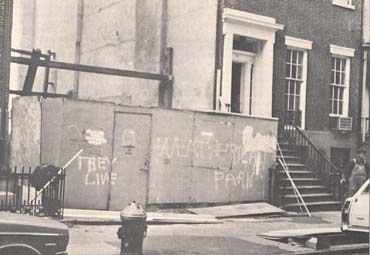
Once the police and firemen were finished with 18 West 11th Street, a fence was erected, with a door in it. From the first there were rumors about possible sale of the property—that the lot would be blacktopped within a week and used for parking, that the adjacent buildings would be demolished and a home for blind children would be erected. Briefly there was consideration on the part of neighbors that they should buy the land and turn it into a park. What discouraged that was not so much the price, reportedly $100,000, but the fact that an open space on the lot would give access to the other gardens behind the houses of West 11th Street. As it turned out, over the months, children began using the property as a playground.
Recently I wandered over to 11th Street. Numbers 16 and 20 looked clean and fully rented. Their sides were freshly plastered. The black hanging bookcase had been removed. But Number 18 was still a gaping wound on the street. The fence in front of the lot was filled with graffiti, some as old as last March, some fairly recent. One was altered since it first made its appearance. In answer to the slogan, Nothing Is Free, someone wrote, "Everything Is Free," which had been changed to "Everything is still Free Especially Death."
Scrawled were such messages as "Make Love Not Bombs," "Come to Your Senses. This Must Not Happen Again. Super Sam," "Ted Gold Was a Nice Jewish Boy. Join the National Renaissance Party," "Smash Facism," "Too Much Money. Not Enough Brains," "Kirche Küche Kinder." Two graffiti stood out. "Weatherman Park" was wiped across the entire face of the fence, and in thick ghostly print there was an ominous "THEY LIVE."
As I read and photographed the graffiti, two workmen, one black, one white, appeared and like Shakespearean grave-diggers, began boarding over the boards with fresh boards—longer, larger pieces to discourage anyone from entering "Weatherman Park"—covering up all the graffiti and stringing a row of barbed wire on top. Some months before I had watched as a car stopped, two men jumped out and, movie cameras in hand, had opened the door in the fence and filmed whatever was beyond. Now I opened the door—which the workmen would soon put a lock on—and walked in. it looked like bombed-out Berlin—soot, rubble, broken beams. At the entrance I saw the charred remains of a book: it was Catch-22.
The land has finally been sold, reportedly for $75,000, to Francis Mason, the assistant to the president of Steuben Glass, and to Hugh Hardy, an architect. The Hardys and the Masons, each of whom have two children, plan to build a two-family house. Hardy is designing the structure. On March 9 there is to be a public hearing before the Landmarks Commission. I talked to both Mason and Hardy. They seemed enthusiastic and optimistic about their new home, not the least haunted by the explosion. "It was a place for living," said Mr. Mason, "and it should be a place for living again."
The text of this article first appeared in New York Magazine, March 8, 1971 (vol. 4, no. 10)
|
| Close this Window |
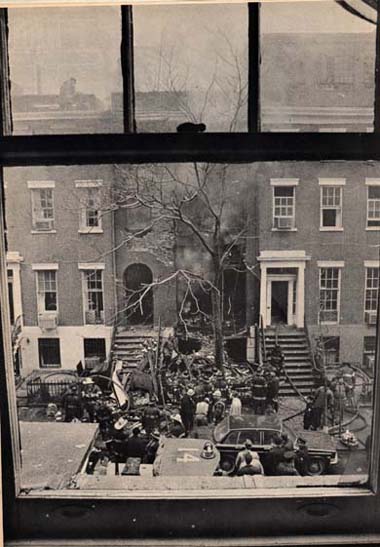
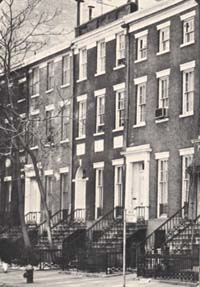 18 West 11th Street: Before.
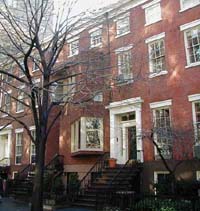 After.
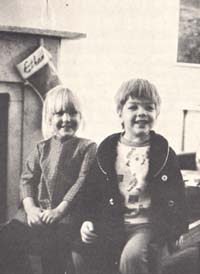 Ethan Gussow and Karina Hoffman enjoy a giddy holiday moment in the Gussow household. Note the stocking hanging on the mantle.
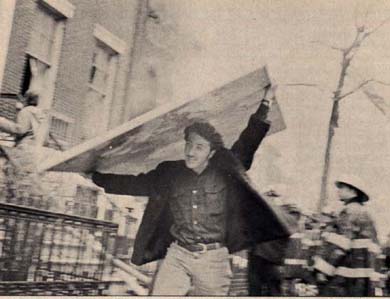 Dustin Hoffman rescues a painting from the wreckage amidst a media circus.