
| Fran Lebowitz |
| 57th Street and 7th Avenue |
|
by Thomas Beller
Thomas Beller: Is the book you're writing now like your first two?
Fran Lebowitz: No, it's a novel. It's called Exterior Signs of
Wealth. I don't have quirks about discussing it, but there isn't enough
of it to discuss at length.
TB: How about in brief?
FL: It's set mostly in New York. It starts in 1970 and goes up to the
present time, whatever time that might be when I finish it.
TB: Are you spending much time in the countryside?
FL: I don't mind the countryside, providing it is sufficiently luxurious. I
don't like the kind of country living where you have to help. I like country
living where there is help. I don't own a house in the country. For a lot of
the time, I couldn't afford it, and when I could afford it, I didn't have
the urge. I think that almost everyone now owns a house in the country, so
there is a guest shortage, and I feel I fill that need.
TB: That's very civic-minded of you. What are your other civic activities?
FL: I don't dump toxic wastes.
TB: Do you use hairspray?
FL: I don't use any hairsprays whatsoever. Mainly because I think smoking is
enough. I don't like to breathe in anything superfluous. Smoke and air are
the only two things I breathe. Willingly.
TB: What do you breathe unwillingly?
FL: Everything else. Aftershave is the thing I breathe most unwillingly.
TB: In what context?
FL: Elevators usually.
TB: Any other complaints about elevators come to mind?
FL: There's nothing about an elevator that I like. It's too small. It's
filled with people I did not invite. And often these people are wearing
conflicting perfumes.
TB: And the aroma sends you into a tizzy.
FL: Fury. I'm more the fury than the tizzy type.
TB: Do you ever have occasion for tizzyness?
FL: I can't think of the last time I was in a tizzy. I'm not that
lighthearted.
TB: Is this why we are getting into the novel realm?
FL: What do you mean?
TB: A novel is a somewhat less lighthearted vehicle than a short essay.
FL: Not necessarily. There are some short essays that are very grave, and
most contemporary novels are lighter than air. There are a number of reasons
why I am writing a novel. One, I got sick of the short essays. And there
were things I wanted to do that you can't do in an essay. It's too
restrictive. You're able to tell the truth more in novel because you can
disguise your opinions by putting them in the mouths of others. You can be
meaner, hence, funnier. Also it's a more relaxed form. And it's not so
distilled. Each sentence doesn't have to be hilarious. Every three sentences
don't have to be funny.
TB: If that's the ratio in an essay, how many funny lines can you get away
with in a novel?
FL: Oh, you can get away with none, as you can tell from the best seller
list. Also, novels have dialogue, which for me is the easiest form of
writing. It's much more complicated in terms of structure. You suddenly
become an architect, a profession I've always assiduously avoided.
TB: Actually, I got the feeling from your books that you hold architects in
relatively high esteem.
FL: I do have a couple of friends who are architects, I prefer them to
lawyers. But I prefer anyone to lawyers.
TB: What have your lawyer experiences been?
FL: I've been sued a couple of times. I consider them to be a kind of
sub-human group, without question, the worst profession. I think child
pornographers are more admirable. At least they provide a service.
TB: In reading your work, one doesn't get the feeling that you produce
copious amounts of pages at a sitting.
FL: No, I don't. First of all, I don't write drafts. That's mostly where
people get a lot of waste paper. I cross out. Instead of writing it wrong
six times and then writing it right, I think it wrong six times and then
write it right the seventh time. I cross things out. I work on the page. I
also have a tendency to write very short things. Sometimes magazines call me
up and say: "Why don't you give us something that is lying around?" There
isn't any extra writing lying around my house.
TB: As a rule, you don't write for magazines anymore. Why is that?
FL: The primary reason is that I'm working on a book right now. But I don't
really feel like writing for magazines.
TB: Why?
FL: People throw them away. It's up to you to save them. Whereas with books,
it's up to them. Also the deadlines are too close. Every month. With books,
the deadlines are nicer, usually two years. They can be longer. If you don't
make your book deadline, they can't publish it without you. But they do tend
to do that with magazines and newspapers.
TB: This is true. Of course the exception to the book rule would be the
unauthorized biography.
FL: There certainly will never be an authorized one.
TB: You promoted your books on book tours. How was that?
FL: Actually, I haven't published a book in so long...
TB: That you've forgotten?
FL: No, it's just that book tours are different now, with satellite TV. The
last book tour I went on was eighteen cities in twenty-one days. This is not
the sort of things that one forgets. They're pretty awful. But they're
extremely beneficial. I don't know how you could possibly sell a book in
this country without going on TV. You can't rely on people browsing through
bookstores because there aren't enough of them.
TB: Kind of paradoxical that one has to go on TV to sell a book.
FL: You have to go to TV to sell everything. And since people buy everything
they see on television, it behooves you to be on television with your book.
TB: What are some memorably stupid things TV talk show hosts have said to
you?
FL: I don't know if there is such a thing as a memorably stupid thing.
Consequently, I don't remember.
TB: Say something about the fact that you have a hard time writing.
FL: I have a hard time writing. Most writers have a hard time writing. I
have a harder time than most because I'm lazier than most. I don't want to
brag, but I'm the laziest person I have ever known. I am more than slothful:
I'm almost inert. And since writing is so arduous, I tend to avoid it
assiduously. Another problem is fear.
TB: I suppose that is all the more acute when you are supposed to be funny.
FL: Part of it is that. It's harder to write funny things than things that
are not funny, even if you can write funny things. Obviously it's harder;
hardly anyone can do it. You can see that it is hard to write by how many
people do it well.
TB: If you can tell how hard something is by how many people are doing it
well, one would think being President would be difficult.
FL: That is slightly different because there is that popularity factor,
which obscures the actual work itself. Mostly being president is getting
elected. And the things that people elect politicians for have
nothing to do with the job. People elect the President for reasons
that have nothing to do with his ability to be president. And don't elect
them for the same reasons. For example, in this most recent election, of all
the contenders for the Republican nomination--not at all an impressive
group--it seemed to be that by far the most intelligent was Bob Dole. Bob
Dole was not elected because people constantly said he was mean. Who cares
if the President is mean? Are you going to see him? Maybe you don't want to
have a mean boyfriend--but you don't have to talk to the President on the
phone; you don't have to go out with him. "Mean" to me does not seem to be a
good reason to disqualify a person from being President. "Dumb" would seem
to me to be a good reason to disqualify a person from being President. But
not here. And the President doesn't ever seem to take the rap. No one puts
himself on the line like a writer. If you're a writer, you can't blame
Congress.
TB: The essays in both your books are very era specific. Do you think there
was a greater degree of absurdity then than there is now?
FL: Oh yes, because things invariably get worse. So everything has gotten
worse, and five years from now things will be much worse. In my lifetime, I
have not seen one thing get better.
TB: The leisure suit has gone out though. That seems to have been one of
your arch nemeses.
FL: The leisure suit has disappeared. We now have the leisure presidency. Is
that your idea of things getting better? I don't think clothes have gotten
better.
TB: Is that why you wear only Brooks Brothers?
FL: I don't wear only Brooks Brothers, just mostly.
TB: Why?
FL: I always wore them since I was a teenager. I always thought that it was
a very good, unobtrusive look. It was neat and attractive. I hate to shop,
and the best thing is at Brooks, you don't have to shop. No decisions. The
only thing that happens occasionally is that a shirt starts coming in a
different color. Other than that, you can order all your clothes on the
telephone and they'll send it to your home. So most of my clothes I get from
Brooks, for the reasons of convenience and lack of choice.
TB: I sort of remember this restaurant being darker and more French.
FL: You were younger. When you're younger, everything seems darker and more
French. And when you're younger, darker and more French seem desirable. When
you're older, the less French, the better. The French lack humanity. They
learn many things when they are children. They learn how to tie a scarf
perfectly, and they forget to teach them how to be people.
TB: Do you travel much nowadays?
FL: Quite a bit. More than I would like.
TB: Why more?
FL: Because most of the travelling I do is to go give lectures at colleges.
TB: What do you lecture on at colleges?
FL: I read, and I answer questions from the audience in an entertaining
fashion.
TB: What colleges have you read at?
FL: Every college in America I would think. I do a great number of them and
I've been doing it for more than ten years. The colleges that I go to are in
places like San Angelo, Texas, not places like Florence, Italy. I go quite a
bit to the Midwest.
TB: Are you big in the Midwest?
FL: Mostly I get these lecture dates because of being on David Letterman.
TB: Have you been on Letterman often?
FL: I've been on fairly often. And most of the kids who book these things,
book things they see on David Letterman. They're not the biggest readers in
the world.
TB: What do you do on Letterman?
FL: I do the same things I do when I lecture: answer questions in an
entertaining fashion. Just quicker.
TB: There being less time.
FL: And more commercials. And sometimes other guests. It's the down side of
TV.
TB: Other people.
FL: Other people. It's the downside of life in general.
TB: Do you drink wine or beer?
FL: I stopped drinking when I was nineteen. I was a kind of teenage drunk.
TB: Did you write when you were a teenage drunk?
FL: Do you mean did I write when I was drunk or did I write?
TB: Both. Did you write at all, did you write drunk?
FL: I wrote when I was a teenager, but never when I was drunk. Even as a
teenager I was aware of the fact that people who write when they're drunk
usually write garbage. Mostly the point of getting drunk was, for me, to be
unconscious. I didn't write while I was unconscious. I haven't had a drink
since I was nineteen.
TB: Really? Was that a dramatic decision?
FL: No, I was quite sick. I managed, by the age of nineteen, to drink enough
to make myself fairly ill. So the choice was between stopping drinking when
I was nineteen or never being twenty. That was the choice I made.
TB: A wise choice, Fran. We're all happy for you.
FL: Although I must say I miss drinking quite a bit.
TB: Do you pine for it?
FL: Often.
TB: And what keeps you from taking the plunge?
FL: Wanting to be thirty-nine. Also I have a mortgage. If I was unconscious
as much of the time now as when I was a teenager, I wouldn't be able to
write enough to pay the mortgage. If I win the lottery tomorrow, I may start
drinking again. To me, the point of drinking is passing out. Being aware is
the goal of the drinker. Although I like lots of things about drinking. I
like the taste. There's nothing about drinking I can think of that I don't
like. Except that it seems to lead to a lot of AA which...
TB: You've had enough of.
FL: I've had enough hearing about. Life was certainly more entertaining when
people were indulging their vices as opposed to going to meetings to indulge
in a new vice: discussing their innermost thoughts in public.
TB: Seen any good movies lately?
FL: No.
TB: Do you read magazines?
FL: Sporadically.
TB: From your books one would gather you used to spend a good amount of time
reading them.
FL: Yes, and I don't do that anymore. I read some magazines regularly; those
are mostly the ones that they send me for free. The National Enquirer
and the Star I buy myself. I'm not a big magazine reader. Mostly I
find them to be just really annoying.
TB: Why?
FL: Because basically they have been the ruination of life, and of New York.
Starting with New York magazine in the 60s. As soon as you had a
magazine called New York you had all these journalists who had to
constantly write about New York. So eventually they would seek out things
that they never could have come across on their own--like restaurants and
places to go and ways of life--and start to write about them. And they
turned these things upside down, so these things became open to the public,
hence, boring and unauthentic. And eventually, the entire city became like
that. There would be a club that no journalist in a million years would know
about. Then one would find out about it, write about it, and ruin it. And
then you'd go to another one and keep escaping these journalists. Then
people starting opening clubs with an eye to being written about, so it was
never a club you wanted to go to.
TB: New York has become one huge press release.
FL: That's why New York is boring.
TB: Which is why you live here.
FL: I live here because when I got here it wasn't boring.
TB: Do you long for the old days?
FL: Absolutely. I wouldn't move here now. I used to work a little bit to pay
my little rent. I used to drive a cab until the exact moment my rent was
paid and then stop. I never wanted to have any extra money, if it meant
having to have any extra work. Now there's now way you can live in Manhattan
and drive a cab. To move to Manhattan, you have to have a rich father. The
kids who come here are either rich or are moving here to make money in
business, which is a dull kind of kid anyway.
TB: My take on this is simply being glad that I am part of it at a moment
when it has reached its most ludicrous excess. It's almost like an absurd
play.
FL: Yes, but life is so absurd now that it is almost impossible to be a
satirist in this era. Who could think of a Dan Quayle? You can't think of
the things that happen now. Evelyn Waugh couldn't have thought of Donald
Trump. It's too much like a comic book. It lacks subtlety.
TB: Does that have something to do with the fact that you are writing this
novel?
FL: I don't think so because I decided to do this novel so long ago. But
it's a good excuse.
TB: So you've been working on it a long time?
FL: No, just thinking about it. I only started actually spending time on it
last spring.
TB: It's funny you should say that, because when I spoke to someone at your
publishing house about talking to you, they said with a barely discernible
tremor of anxiety, "We think it's best she just concentrate on writing the
book right now."
FL: Oh yeah. I've never had so many people concerned about my health in my
life. When I was nine years old, my parents weren't as concerned about me. I
was in an extravagant car accident not long ago...
TB: Were you O. K.?
FL: I was fine, but I totaled my car, which had just been restored at great
expense.
TB: What kind of car was it?
FL: A Checker Marathon.
TB: What's happening to it now?
FL: It's being restored at great expense. But after the accident the people
at my publishing house had a tremendous amount of concern for how I was.
Nothing happened to me at all. But there was a lot of heartfelt concern. If
you want people to worry about you, sign a contract. It's probably the most
modern form of affection.
***
Addendum:
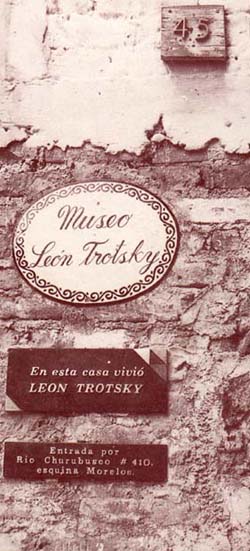
Not too long after this interview, which took place in 1990, I took a trip to Mexico City. The purpose of the trip was to write a piece about the making of
Then I saw a particular color, a bright yellow, that was familiar. I reached for it, and there found that among the serious tombs was Fran Lebowitz's "Social Studies."
When I returned to New York I reported all this to her breathlessly, thinking she would be amused, and she did seem amused, which, with Fran, is a condition that can be difficult to infer, but which is often signaled by the absence of some comment from her about how she is not amused. We talked for a bit longer and then I mentioned, as an afterthought, that I had bought the book.
"You bought it?" she said. The rest of the sentence, unstated, was, "You took a copy of my book from the Trotsky Museum Bookstore in Mexico City and brought it to Manhattan, where there are already more than enough copies of my book? You idiot!"
She was not amused.
|
| Close this Window |
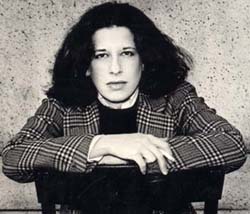 Fran Lebowitz and I stand on a curb trying to figure out where we can go to
be alone. It's a blustery afternoon, and a little dog with big eyes strains
on its leash to get near Fran, who ignores it. We've just come from her
dentist's office where I had stared from a distance at the little X-rays of
her teeth clipped to a fluorescent light. Fran's teeth are okay. Wandering
down Madison Avenue, we happen upon a French restaurant that we both knew
from a long time ago.
Fran Lebowitz and I stand on a curb trying to figure out where we can go to
be alone. It's a blustery afternoon, and a little dog with big eyes strains
on its leash to get near Fran, who ignores it. We've just come from her
dentist's office where I had stared from a distance at the little X-rays of
her teeth clipped to a fluorescent light. Fran's teeth are okay. Wandering
down Madison Avenue, we happen upon a French restaurant that we both knew
from a long time ago.
 Romeo and Juliet