
| Yes! Marv Albert On The Knicks, Brooklyn, Cosell, And Himself |
| RCA Building at Rockefeller Center |
|
by Thomas Beller
Photo by Ricky Powell
Thomas Beller: Where exactly did you grow up?
Marv Albert: Brooklyn. Brighton Beach at first, but mostly Manhattan Beach.
Manhattan Beach was a basketball haven, a lot of really good players used to
come down to the schoolyard there. It's amazing how many good players come
out of Brooklyn. When I was growing up, Connie Hawkins and Billy Cunningham
used to come down. They would all play on basket number one. A basket, it
should be pointed out, that I did not appear on?
TB: How was your game?
MA: I was an average schoolyard athlete. Decent jump shot. Needed
screens. I had some skills but I couldn't really go left, jump, little
things like that.
TB: I don't want to date you here but are we talking set shot or jump
shot?
MA: Please! Jump shot.
TB: What was your mother's relationship to sports?
MA: My mother, as much as she was exposed to sports, couldn't tell you a
thing about it. She went to games all the time, but it just didn't sink in.
She was the type of person who, if I or one of my brothers was on the air
calling a game, would say, "Sounds good." As in, "He's healthy. He doesn't
have a cold." My father was a big sports fan. Not a fanatic. They were both
very supportive of my interests at the time. I was obsessed then with doing
what I'm doing right now. They bought me a tape recorder at an early age. I
wanted to be either a writer or a sportscaster. My fantasy was to be calling
games for the Knicks and Rangers and also writing for The New York Times. So
two out of three I'm happy with.
TB: I have the impression that a place like Manhattan beach in the late
50s and early 60s would be suffused in radio.
MA: Absolutely. That's all I would do, listen to games on the radio.
Keep score.
TB: Were you singled out as being a little peculiar for this obsession
with being a sportscaster?
MA: Well, no. I was always kind of shy then. I wouldn't be the type of
guy who would break into play-by-play while I was playing a game. I did have
a friend who used to kid around doing play-by-play while we were playing
ball. There was a referee in the NBA by the name of Sid Borgia who was very
animated and would occasionally exclaim, "yes, and it counts!" And my friend
was always imitating this. It was a couple of years into my doing the Knicks
on radio, when Dick Barnet hit this fling at the end of the third quarter in
the playoffs against the 76ers, banked one in and I said "Yes!" and
afterwards some people repeated it back to me. So I started to use it. If
you look for a phrase it doesn't work. But it happened to catch on, and then
with the Knick championship years it really caught on. Now, it's a national
thing, you hear it on schoolyards in L.A.
TB: Speaking of basketball what's going on with the Knicks?
MA: Getting Riley was an excellent move. He's a motivator. He's the one
guy who can reach Ewing, who, numbers aside, really didn't have a good year
last year; he didn't have any support and he really didn't react well to the
situation. His defense isn't near what it used to be. In the right
situation, though, he could be the top center in the NBA. Better than
Robinson and Hakeem. He has more skills.
TB: Does the arrival of Riley remind you of the arrival of Pitino? A
kind of B-ball Camelot?
MA: Rick Pitino will be a terrific coach. Pat has done it already. Pat
and Rick share in common the fact that they both were able to come in and
motivate people like Ewing and Jackson--although in the long run there is no
doubt in my mind that at point guard, it's going to be Greg Anthony. Mark is
certainly going to be a better player than he has been in the last of couple
of years, but with Anthony you're talking about a guy who could be better
than Kenny Anderson as a pro.
TB: What else about Riley?
MA: Riley is a guy who has very specific ideas about the way things
should get done. He's very private, all his practices are behind closed
doors, but from what I've heard from the players, the whole organization has
turned around completely. Right from handling a very difficult Ewing
situation this summer, which could have blown up in their face if it was
mishandled. If they can get the team in a contending, which I think they
will, that all goes away.
TB: What else do the Knicks need now?
MA: An outside shooter off the bench.
TB: Kiki's not sufficient?
MA: Helps, but they need a guard who can shoot, too.
TB: I feel that Xavier McDaniel is the first impact player the Knicks
have had at small forward since Bernard King. It's like Bernard left such a
vacuum it took them four years to fill it.
MA: I see X as more of a complementary player rather than an impact
player. He can score, he adds a little toughness. He also allows Kiki to
come off the bench and be an instant offense-type guy against second-team
players.
TB: Do you think X will be able to share the ball?
MA: I think he'll be fine. I think he's so happy to be playing in New
York right now, to be in the middle of things. In Seattle, even in college,
he never thought he got his due. Now the Garden is using him in the ad
campaign "X Marks the Spot." Such a good character, he has that good smile.
TB: Good smile! That's interesting, an insider's assessment of talent:
Good post game, tough under the boards, good smile.
MA: Well, we're talking marketing here, Tom.
TB: What else?
MA: Charles [Oakley] hurts them. He tends to make the wrong move at the
most critical time. That's what he did in Chicago. Teams go into games
hoping Charles makes his first jump shot. They used to say that about Wilt
Chamberlain. If he hits his first outside shot, he stays outside. And then
you see a two-for-nine. And he kills you.
TB: It's almost exhausting to think about this. Maybe this is provincial
but I feel like the sports fans in New York have been emotionally
traumatized by the stupid things their teams have done over the years. I
mean, letting Rodney go? Mind-boggling.
MA: The interesting thing is, on Al Bianchi's behalf, if the San Antonio
Spurs had Maurice Cheeks last year instead of Rodney Strickland, they might
have gone a lot farther.
TB: What does them being stupid have to do with us being stupid?
MA: They're having problems with Rodney's contract right now, and you
can see why. Here's your point guard, the guy you want to look to. He breaks
his hand in a fistfight at some nightclub, misses 25, 30 games.
Irresponsible situation. A nice kid, a great player, but then he gets back
into the line-up, Larry Brown says he's the key, he's the guy, he makes
David Robinson go, and then he gets accused--and these are just
allegations--of exposing himself. You don't know what to think about that,
except it's Rod in another crazy situation.
TB: But this is off the court.
MA: But that affects how the management thinks about you, when you're
constantly in trouble. So the Knicks felt they couldn't handle this anymore.
Bianchi thought they had a chance of going all the way when he got Cheeks.
TB: It seems to me that you're becoming as prominent a sportscaster as
Howard Cosell was. What do you think of him?
MA: I would like to think I'm very different from him, particularly on a
personal level. I think he's just become a very bitter, pathetic, person,
especially toward the end of his career. As a kid listening to him I really
admired a lot of things he did. But I thought he was faking it towards the
end of his career.
TB: Faking what?
MA: His knowledge of things. He was just taking shots at people. He's a
very bitter man. It's sad.
TB: If you had to exist on one sport, which one?
MA: Basketball. Definitely.
TB: You have two boys and two girls. Do you think your infatuation with
sports has had any particular effect on their childhood?
MA: Well, their childhood has been very game-oriented. We've got the
electric hockey games. A lot of stuff like that.
TB: You know, maybe I could consult with you on one of the true
mysteries of my childhood, which was this big extravagant electric football
thing; a big slate of metal with a grid painted on it, and all these little
plastic players you were supposed to elaborately set up on offense and
defense and then when it's all set up you were supposed to flick a switch
and the board starts to vibrate...
MA: Never worked. I had that game, I had every game like that. I was in
leagues.
TB: I'm glad you couldn't get it to work either. I spent hours with it
wondering if I was doing something wrong.
MA: It doesn't work! The thing goes in 20 different directions. It was
a scam! You turn it on and the running back starts running off the field.
But I was into all that stuff as a kid. Even as an adult, I've had two
baskets at my home. One regular and one that you could stuff on. And you
know, the couple of times I had a professional basketball player over, guys
I was friendly with, they went to the small basket first. Without fail. When
Julius was with the Nets, he lived near me. We were friendly and when he
came over the kids would ask him to dunk. Julius was afraid to hurt his
knees on concrete, so he would always go over to the small basket.
Unbelievable. Here's the master of every move in the universe and he would
do a reverse on the mini-hoop.
TB: I hear that once you had a stoop constructed at your house in the
suburbs for stoop ball.
MA: Yes. It was a good idea, but it didn't measure up to the real
thing. It was too easy to get extra base hits, because there's this grassy
area so the ball doesn't bounce the way it does on concrete. But it was just
for a kick. Although I did get a letter from the national stoop ball
society. They made me an honorary member. A very proud moment indeed.
TB: Did it take a little explaining to the local contractor when you
said that you wanted a stoop on your back lawn?
MA: Yes. The guy really didn't speak English that well, he didn't
understand. It was a stoop... to nowhere!
TB: I never thought that stoop ball could have such existential
ramifications.
MA: He didn't get it. It's a very hard thing to explain. A stoop. For
what?
|
| Close this Window |
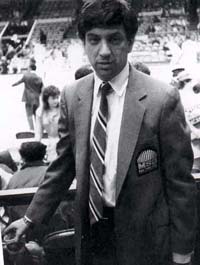 In the midst of the most un-ironic activity in the world--sports--Marv
Albert is a burst of jazzy, sardonic, droll Brooklynese. Marv is all about
cadence and inflection; his initial notoriety was based on the pronunciation
of a single word--"Yes!"--drawn out and shaped like a piece of taffy.
For 24 years he has called play-by-play for the New York Knicks, and
although he does other sports, hockey, boxing, football--his home will
always be the Knicks. There's something about him that seems so perfectly
suited not just to basketball, but basketball in New York. Given that
reading a print interview with him is like experiencing a drum solo by
looking at sheet music, we recently spoke to Marv Albert about the new
Knicks and about himself.
In the midst of the most un-ironic activity in the world--sports--Marv
Albert is a burst of jazzy, sardonic, droll Brooklynese. Marv is all about
cadence and inflection; his initial notoriety was based on the pronunciation
of a single word--"Yes!"--drawn out and shaped like a piece of taffy.
For 24 years he has called play-by-play for the New York Knicks, and
although he does other sports, hockey, boxing, football--his home will
always be the Knicks. There's something about him that seems so perfectly
suited not just to basketball, but basketball in New York. Given that
reading a print interview with him is like experiencing a drum solo by
looking at sheet music, we recently spoke to Marv Albert about the new
Knicks and about himself.